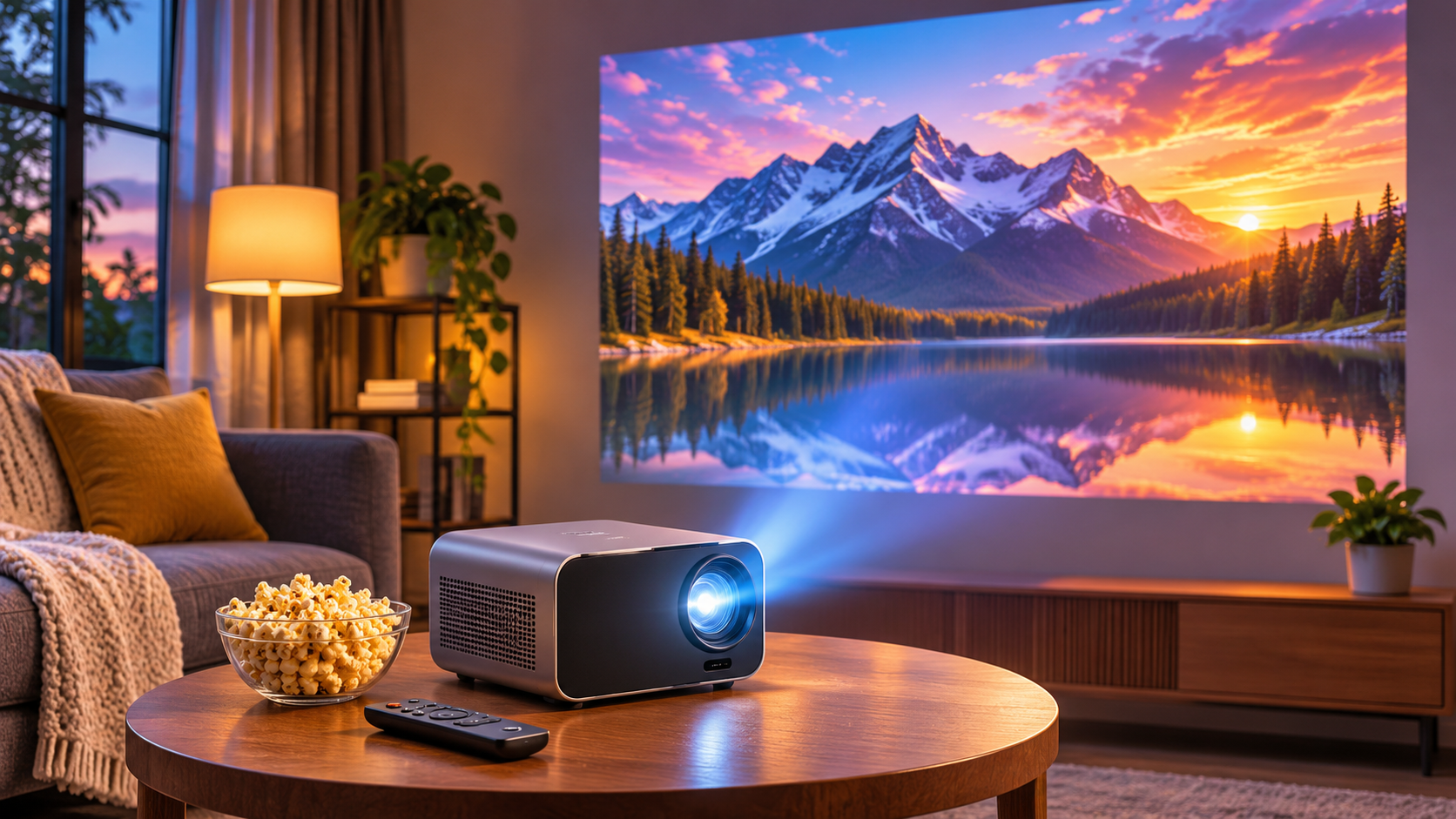
A 150-inch screen for just ₹8,499 sounds like a great deal, but the details iBall has shared so far leave several important questions unanswered.
iBall has launched three Android projectors in India, and the Lumora 40 is the cheapest of them, with an introductory price of ₹8,499. MobiGyaan reported this on 30 October 2026, and the projector is available on iBall’s online store. The company has not yet shared the prices of the Lumora 50 and Lumora 60, nor the regular price of the Lumora 40 once the introductory offer ends.
What the Lumora 40 Offers
The Lumora 40 runs Android 12, so it works like a basic smart TV without needing a separate streaming stick. iBall says it supports Netflix, YouTube, Prime Video and JioHotstar. For external devices, it connects to phones, laptops and game consoles through HDMI, USB, Bluetooth and screen mirroring, and its sound comes from a built-in bass speaker.
It also has auto focus and auto keystone correction. Keystone distortion happens when a projector sits at an angle to the screen, which makes the picture wider at one end than the other. Auto keystone correction adjusts the image digitally so it stays rectangular, so you do not have to prop up one corner with a book. The trade-off is that digital correction can slightly reduce sharpness, so placing the projector straight on is still the best option.
The light source is an LED, which iBall says lasts up to 30,000 hours. At three hours of viewing a day, that works out to more than 27 years, but only if the claim holds up in real use. LED lamps also dim gradually over time, so “lifespan” usually means the point where brightness drops to a set fraction of the original.
The larger models offer more on paper. The Lumora 50 claims 4,200 lumens, 200-inch projection and Android 14, while the Lumora 60 claims 4,500 lumens and a 50,000-hour lamp life.
Brightness: Why 3,750 Lumens Needs Context
iBall says the Lumora 40 produces 3,750 lumens, which is a measure of how much light the projector puts out and therefore how well it can fight room lighting. However, iBall has not said how it measured this number, and that matters a great deal because figures from different test methods cannot be compared directly.
ANSI lumens come from a standardised test, while many budget projectors advertise “lumens” figures that use looser methods and often come out much higher. The Lumio Arc 7, which launched in India on 6 October at ₹34,999, claims 500 ANSI lumens. Placed next to that figure, a 3,750-lumen claim at ₹8,499 tells us very little until iBall explains how it arrived at the number.
Resolution and Other Missing Details
The native resolution is also missing from the reports. Native resolution is the number of real pixels the projector’s panel can display, and it decides how sharp the picture looks. Many cheap projectors accept a 4K video signal but show it on a lower-resolution panel, so “supports 4K” does not mean the image is 4K.
A useful comparison is the Lifelong projector launched in April at ₹7,999. It has a native 720p panel, supports 4K content and claims 4,500 lumens, so buyers can see exactly what the panel can do. The reports on the Lumora series offer nothing similar.
Several other basics are still unknown, including the warranty, the speaker’s power output and the date of the first sale. iBall has also not said how long Android 12 will receive updates, which matters for streaming app compatibility over time.
What Independent Testing Still Has to Answer
A projector gives you a far bigger picture than a small TV, but it struggles in bright rooms because ambient light washes out the image. For that reason, brightness and contrast matter more than screen size in daily use.
At ₹8,499, the Lumora 40 looks interesting, but one question remains open. With the curtains open, how bright and how sharp is a 150-inch picture? Only independent tests can answer that.