Robots Learning to Work as a Team
Picture two people carrying a big sofa through a narrow door. They watch each other and adjust as they go, step by step. Researchers now want robots to do the same. In 2026, several teams showed that robots can learn to work together without a person telling them every move. Most of this work is still in labs, but the results are real.
Two Robot Dogs and One Big Box
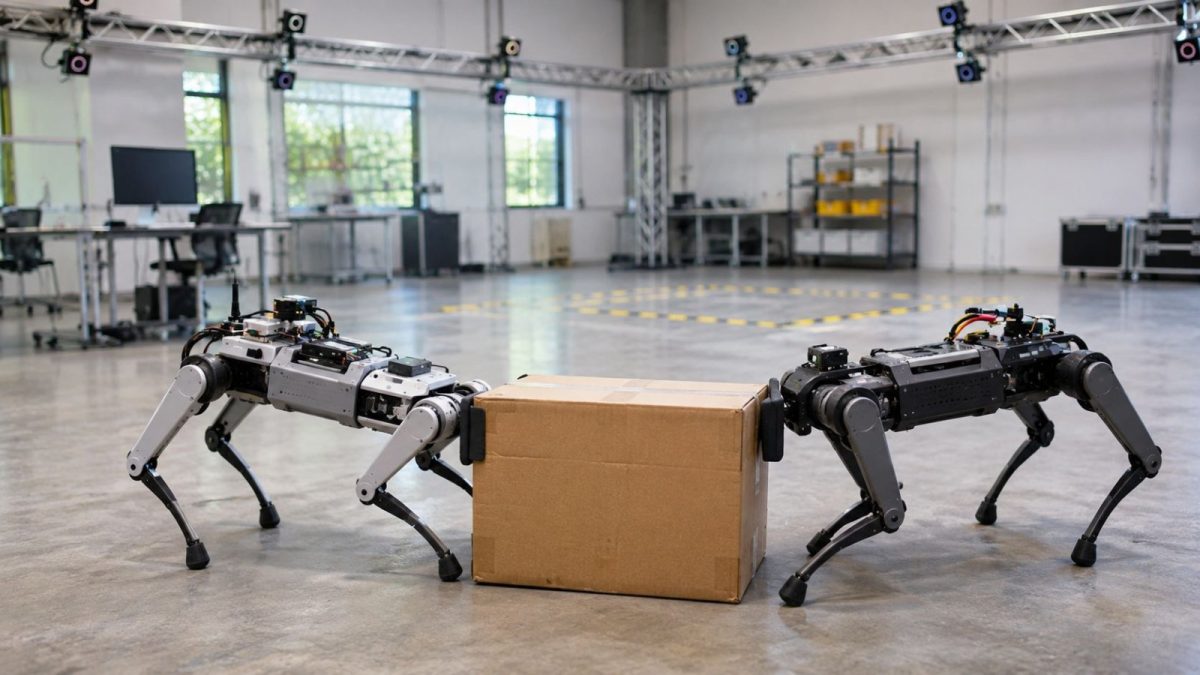
At the ICLR 2026 conference, a team from the Chinese Academy of Sciences and the University of Chinese Academy of Sciences presented a method called SeqWM. They tested it on two Unitree Go2-W robot dogs. The robots pushed a large box together, squeezed through a narrow gate, and guided a third robot to a target area.
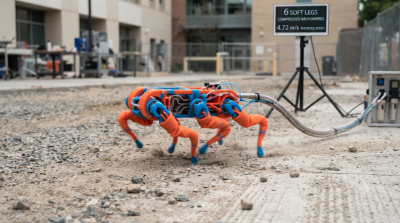
Harvard researchers also built small ant-like robots called RAnts. The study came out in PRX Life on April 10, 2026, and Harvard announced it on April 17. These robots can build and take apart simple structures with no boss in charge.
How Do the Robots Learn?
The robot dogs learn by trial and error. They try a move, get a score for how well the team did, and then try again. This is called reinforcement learning.
The main trick in SeqWM is sharing plans. One robot first predicts what it will do next and passes that plan to the second robot. Then the second robot picks its own move based on that plan. The researchers call this sharing intentions.
The ant robots work in a simpler way. Each one follows a light signal, picks up blocks, and drops them when the signal gets strong. The light works like the smell trails that real ants leave behind. No single robot needs to know the whole plan.
Why Does Teamwork Matter?
Some jobs are just too big for one robot. In the SeqWM test, the box was too large for one robot dog to steer alone. At the gate, one robot slowed down and let the other one go first. The paper says these habits came up on their own during learning.
Swarms might also help in risky places. Harvard says the ant-style approach could help with building in dangerous areas and exploring other planets. One news report adds that a central boss can fail in places like collapsed buildings, but a swarm doesn’t depend on one robot.
What Are the Limits?
Most tests happened in computer simulations or in a small room, about 8 by 5 meters, with cameras tracking the robots. SeqWM only works when all the robots share one goal. The authors say it hasn’t been tested when robots compete with each other.
The ant robots can only do simple tasks in a lab. Also, “without instructions” doesn’t mean without people. Humans still set the goals, the scores, and the safety rules.
What Happens Next?
The SeqWM team wants to try mixed teams, like robot dogs, robot arms, and flying robots together. They also hope robots can show their plans to humans, so people can understand and trust them. Another group, from Carnegie Mellon and UT Arlington, is working on robots that learn to team up with people.