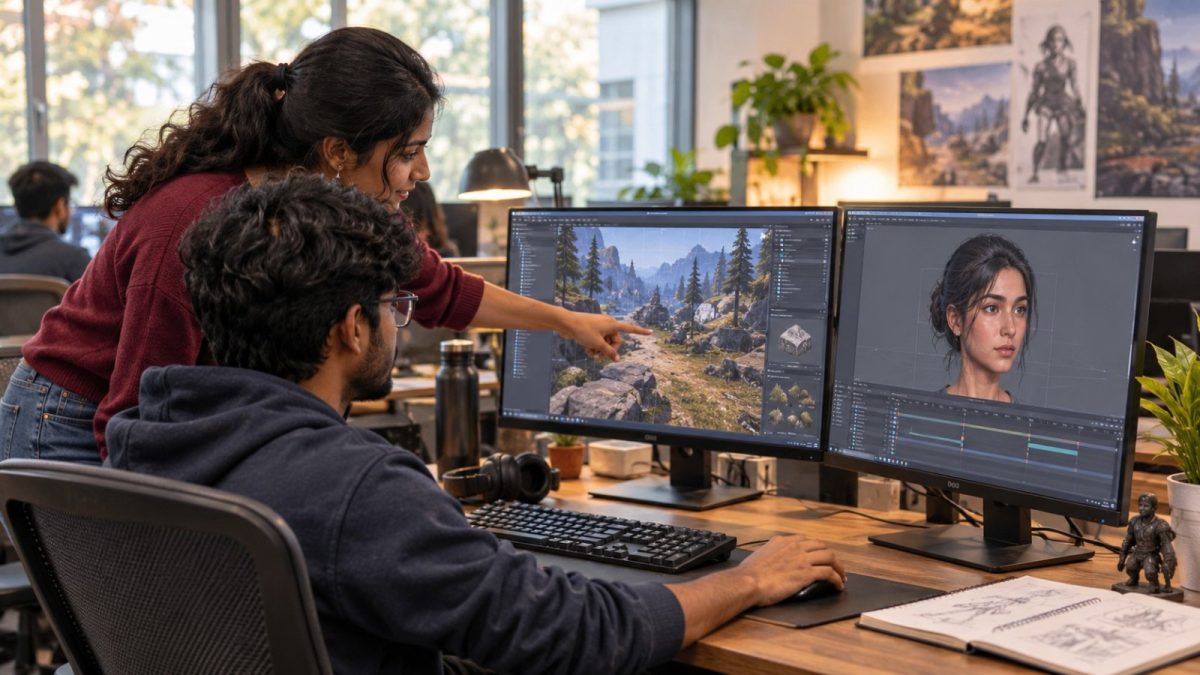
In older video games, background characters repeated the same short lines every time you walked past them. Every tree, hill, and stone wall also had to be placed by hand. Today, AI in game development is changing both of those things. Modern tools now help studios create non-player characters (NPCs) that react on the spot and build huge digital maps in much less time.
A Shift From Scripts to Live Thinking
Game companies are moving away from rigid scripts toward flexible AI helpers. NVIDIA offers its ACE software suite and Unreal Engine 5 plugins to help studios build autonomous game characters. Game publishers have also tested AI teammates that listen to voice commands during live play, while Epic Games uses rule-based Procedural Content Generation (PCG) tools inside Unreal Engine to help artists populate massive forests and cities. According to a 2026 report by the Game Developers Conference (GDC), 40% of surveyed developers now use generative AI in their daily work.
How Smarter Characters and Worlds Work
Think of a traditional game character like an actor reading from a tiny index card. If you ask a question not written on the card, the actor stays silent. New AI characters use small language models, which are compact text-prediction programs that run directly on a player's computer graphics card. These models listen to a player's voice, pick a reply, and move the character's face to match the words.
World-building tools work like smart building blocks. Instead of placing ten thousand trees one by one, a designer sets simple rules, such as keeping trees off steep cliffs and roads. The software then fills the environment automatically while keeping the designer in control.
Why Studios Are Using These Tools
Faster world creation lets small independent teams build large games that once required hundreds of artists. Smarter teammates also make solo play feel closer to playing with friends. On-device AI companions can follow voice plans and fight alongside players without needing a constant cloud internet connection. Automated testing bots also walk through new levels overnight to spot broken walls or software bugs before launch.
Real Limits and Industry Pushback
Despite these advances, the technology has clear limits. Language models still make mistakes, invent false facts, or break character if given odd prompts. Running AI models on a home computer also uses graphics memory that the game needs for smooth visuals.
Many game creators are also worried about their jobs and artistic quality. In the 2026 GDC survey, over half of the workers questioned said generative AI is hurting the industry, especially among artists and writers.
What Comes Next for Players and Studios
Over the next year, studios plan to combine traditional game rules with small, fast AI helpers. Developers will likely use strict scripts for fast combat while letting language models handle casual talk and quest hints.
AI in game development works best when it handles repetitive busywork rather than replacing human imagination. Players can expect livelier companions and richer maps, even though great games still depend on human storytelling.