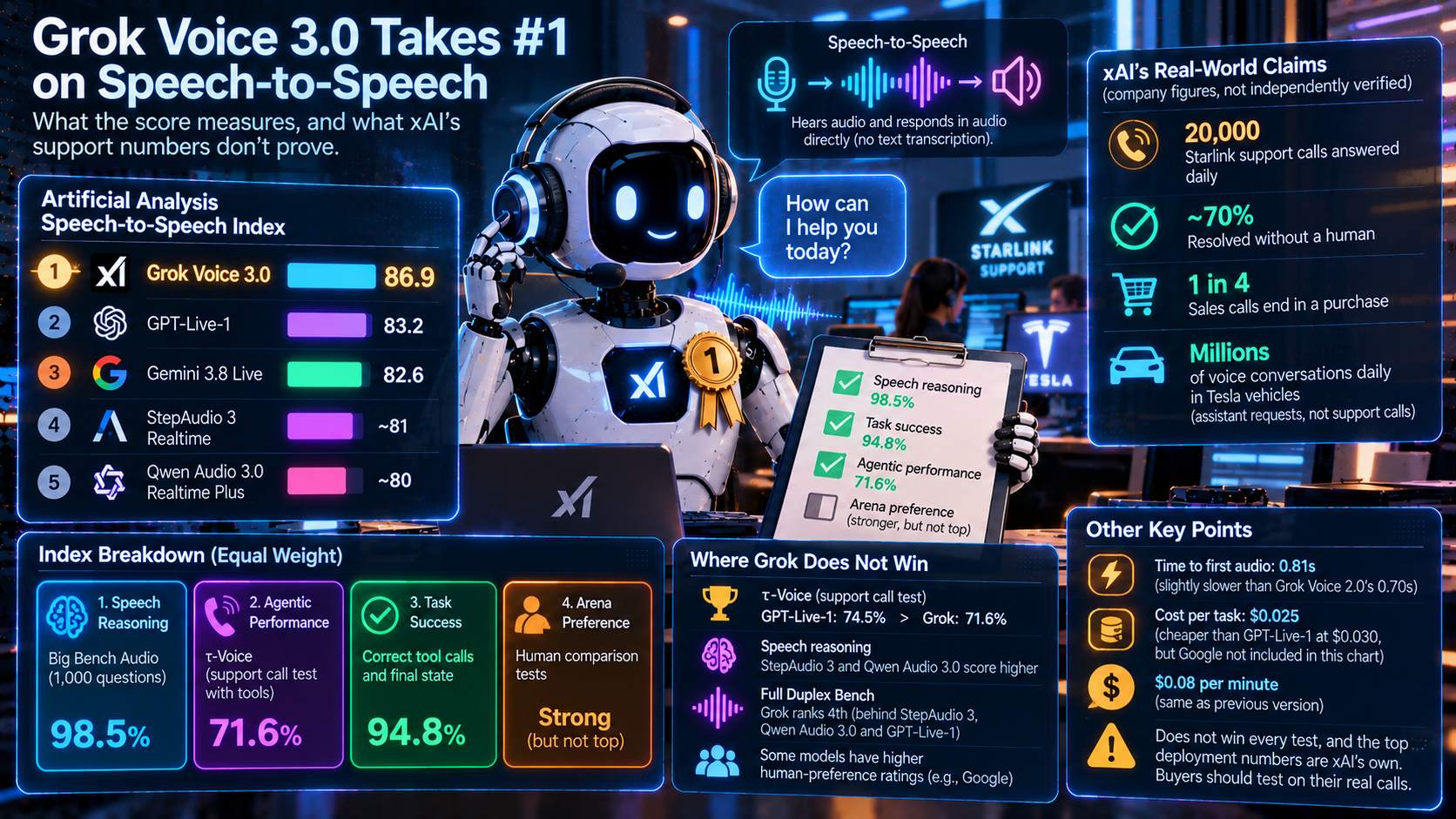
On October 14, 2026, xAI released Grok Voice 3.0, a speech-to-speech model for voice agents. A speech-to-speech model hears audio and answers in audio directly, without first turning speech into text. Artificial Analysis, an independent testing firm, ranks it first on its Speech-to-Speech Index at 86.9. OpenAI’s GPT-Live-1 scores 83.2 and Google’s Gemini 3.8 Live scores 82.6. That is a real result. But the index is an average, Grok does not win every part of it, and xAI’s numbers about real support calls are its own.
What the Index Measures
The index is an equal-weighted average of four parts. Speech reasoning uses Big Bench Audio, 1,000 reasoning questions asked and answered in audio. Agentic performance uses τ-Voice, where a simulated caller phones the model, which acts as a support agent with tools and a policy. It scores a success only if the final database state is correct. Arena preference comes from people comparing two unnamed models in the same scenario. Task success is the share of conversations that end with the right tool calls. A model needs all four results to get a score. Artificial Analysis tested Grok Voice 3.0 on October 13, a day before launch.
Grok Voice 3.0 scores 98.5% on speech reasoning, 71.6% on τ-Voice, and 94.8% on task success. It also scores 97.0% on Full Duplex Bench, which tests pauses, turn-taking, and interruptions. Time to first audio is 0.81 seconds, slightly slower than Grok Voice 2.0’s 0.70 seconds, so the gains cost a little speed.
Where Grok Does Not Win
A high average can hide mixed results. On τ-Voice, the test closest to a real support call, GPT-Live-1 scores 74.5%, above Grok’s 71.6%. Artificial Analysis notes that GPT-Live-1’s score is based on one trial. xAI calls the two comparable and points to 40% lower latency, which fits Artificial Analysis’s figures of 0.81 seconds for Grok and 1.34 for GPT-Live-1.
On speech reasoning, StepAudio 3 Realtime and Qwen Audio 3.0 Realtime Plus both score higher than Grok. On Full Duplex Bench, Grok ranks fourth, behind those two and GPT-Live-1 (Sol, low). Artificial Analysis also lists higher human-preference ratings for some Google models. Grok does lead on task success. So first place comes from being strong on all four parts, not from winning each.
What xAI Claims Without Independent Proof
xAI says Grok Voice 3.0 sets a new record for resolving support calls. On τ-Voice, Artificial Analysis’s support-call test, it is second to GPT-Live-1.
xAI also says Starlink call centers use Grok Voice to answer 20,000 calls a day, and that roughly 70% are resolved with no human. One in four sales calls ends in a purchase. These are company figures. xAI does not define “resolved,” no outside party audited them, and it does not say which model version produced them. It also says Grok Voice handles millions of conversations a day in Tesla vehicles, which are assistant requests, not support calls.
On ServiceNow’s EVA-Bench, xAI says Grok Voice 3.0 has the highest accuracy, at 74%. ServiceNow’s benchmark is open source, and a ServiceNow manager is quoted in xAI’s post, but the result is reported by xAI.
The cost claim needs care. xAI says it costs less than other frontier models, based on Artificial Analysis’s cost per task on Big Bench Audio: $0.025 for Grok, $0.030 for GPT-Live-1, and $0.055 for GPT-Realtime-2.1. That chart leaves out Google. On Artificial Analysis’s own page, cost per hour of input audio is $4.80 for Grok and $3.50 for Gemini 3.8 Live Extended Thinking. That measure excludes tool-call costs.
Prices are not like for like. Grok Voice 3.0 costs $0.08 a minute, unchanged from the last version. OpenAI lists GPT-Live-1 at $0.05 a minute for the voice layer only, with the backend model billed separately.
Why It Matters and What Could Come Next
Voice agents are moving from demos into phone lines and cars. Buyers should test them on their own calls, with their own accents, background noise, policies, and tool errors. An index average does not tell you how a model handles those.
In the near term, expect more trials on the index, rival updates from OpenAI and Google, and, ideally, independent data from real deployments. The long-term picture is speculation. If per-minute prices stay near a few cents, voice agents could replace many scripted phone menus. Whether they do will depend on resolution rates that others can verify.