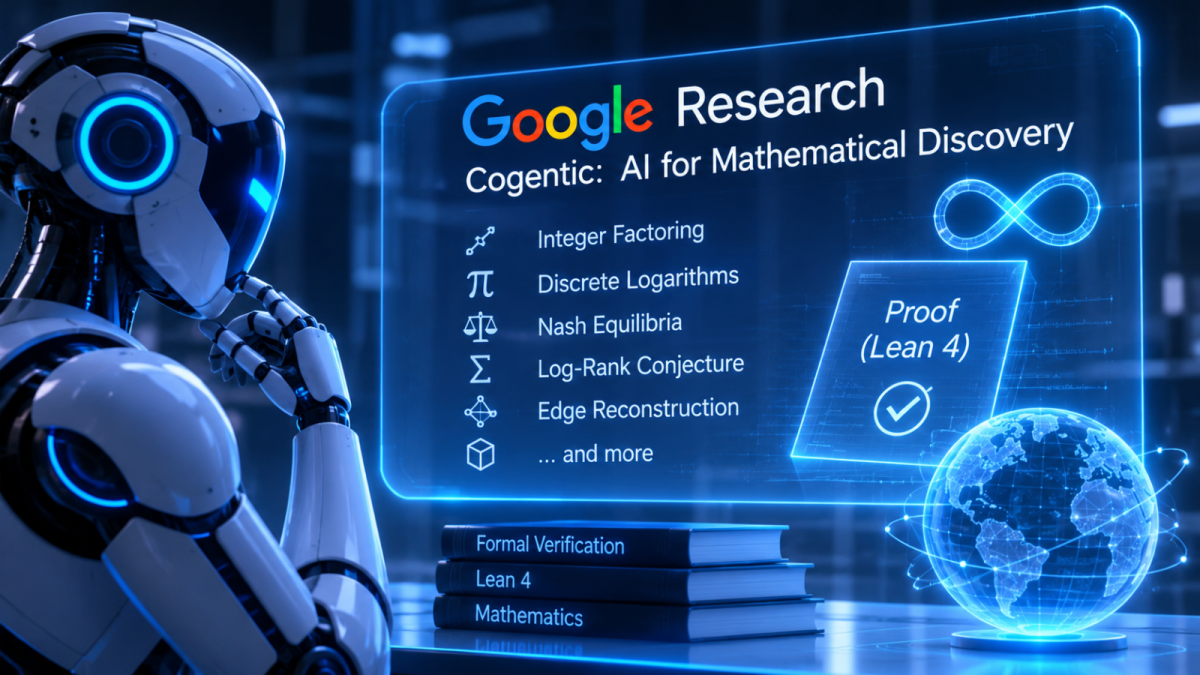
Google Research has posted six mathematics papers to its public GitHub repository, all credited to Cogentic, a multi-agent system built on Gemini 4 for mathematical discovery. The topics include integer factoring, discrete logarithms, Nash equilibria, the log-rank conjecture, and edge reconstruction. Coverage says the papers had no human input beyond the first prompt, which would make this one of the biggest batches of fully autonomous AI research released at once.
The Headline Claim
One paper claims a proven method for factoring integers in subexponential time, with no unproven assumptions. Another claims a deterministic version of the same result, which means no randomness is involved. These are claims about what can be proven in theory. They are not new tools for breaking codes.
What It Does Not Do
Commentators quickly pointed out that the result gives no practical way to crack existing encryption keys. It doesn't beat the factoring methods already used in practice, and reports describe it as a theoretical milestone and not a threat to current cryptography. Headlines linking this release to broken encryption overstate what the papers claim.
The Verification Gap
The main issue is checking. Google's commit promises Lean 4 versions of all six proofs in a later companion submission. Lean is a proof language where a computer checks every logical step, so a formalized proof doesn't have to be trusted on reputation. Those versions haven't been released, and the papers haven't been through peer review. Until both happen, the claims are unverified.
This matters because the papers weren't checked by their authors in the usual way. A human researcher normally understands each step of a proof before publishing it. Here, no person is described as doing that, so independent checking matters even more than usual.
Why Lean Is Becoming the Standard
AI systems can now produce long, confident-looking proofs faster than people can read them. Quanta Magazine has reported on mathematicians struggling to judge large batches of AI-written papers, with some described as correct but too loosely written to check. Machine-checked proofs give a way to settle whether something is correct without relying on a small group of expert reviewers.
Google's own earlier Cogentic paper, from September 2026, reported open-problem results that weren't machine-checked, and it only mentioned formalization as a possibility. That makes the promise of Lean proofs for this batch a step forward, but a promise isn't a proof yet.
A Note on Rumors
Online discussion has linked this release to claims that other AI labs hold bigger, unpublished results. None of that is confirmed. Unpublished work can't be judged, so readers should treat it as speculation.
What to Watch
Three things will settle this. These are the release of the Lean files, independent review by number theorists and complexity theorists, and whether the proofs hold up after that review. If they hold, the factoring results would be a real advance in theory, even with no effect on real-world security. If they fail, the episode will still be a useful example of how fast AI output can get ahead of human checking.
Until then, the sensible reading is that Cogentic has made claims worth checking, and not results worth celebrating or fearing.