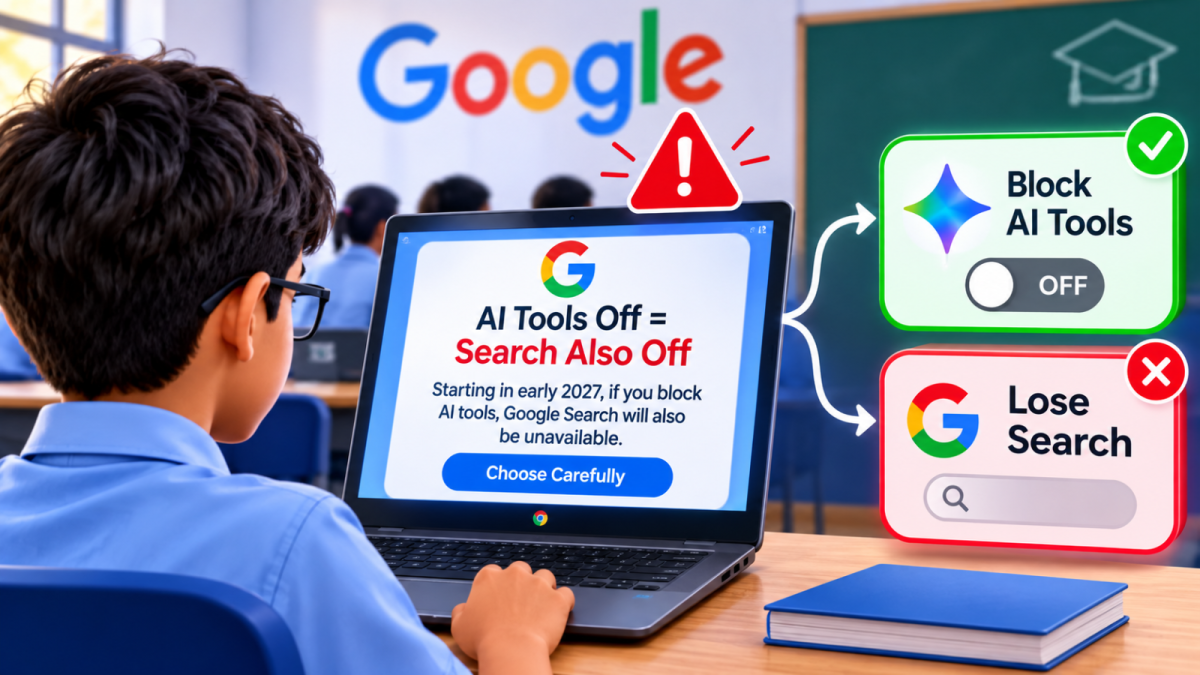
What Is Happening?
For years, school leaders have argued about how to handle AI tools in class. On November 3, 2026, Google made a policy change that shook up the entire debate.
As reported by TechCrunch, CNN, and EdSource, Google announced that starting in early 2027, tools like Gemini, Gemini Notebook, Gemini in Classroom, and Google Search will be turned off by default for K-12 student accounts. Schools will have to turn each tool on by hand. But there is a major catch: because Google Search now has AI built right into it, any school that blocks AI will also lose Google Search. Students trying to use search will just see a blocked screen.
This update follows an August 2026 change that turned Gemini on by default for many young students, which upset many parents and teachers. Along with these new settings, Google is launching "Guided Learning," an AI helper built into Google Classroom that gives hints instead of just handing students the answers.
How Does It Work?
Under Google’s new system, school IT staff will manage student accounts through the Google Workspace admin panel. In the past, schools could turn off extra apps while keeping basic web search running.
By 2027, separating search from AI will be nearly impossible because Google’s search results rely heavily on AI summaries. If an administrator turns off AI to keep distractions out of class, the system also blocks the search bar. Meanwhile, Guided Learning works differently than normal chatbots. Instead of writing essays or doing math problems for students, it asks guiding questions to help them figure out the steps themselves.
Why Is It Important?
This policy turns a normal chat about classroom tech into a huge fight over internet access. Digital rights groups call the move unfair. They say that tying basic search to AI takes away a school's freedom to choose.
On the other side, Google states that these changes answer requests from school districts asking for more control over student software. School systems are already trying to figure out what to do. For example, districts like Long Beach Unified in California are surveying students and reviewing their rules to balance new tech with honest schoolwork.
What Are the Challenges?
For teachers, losing web search is not an option. Lessons, history projects, and science reports all require online research. Forcing schools to accept AI just to keep search working puts a lot of stress on districts that want a simpler, offline classroom.
What Happens Next?
As the 2027 deadline gets closer, schools must choose whether to accept AI-powered learning or switch to other web tools that do not tie search to AI.


