The Gap in the Numbers
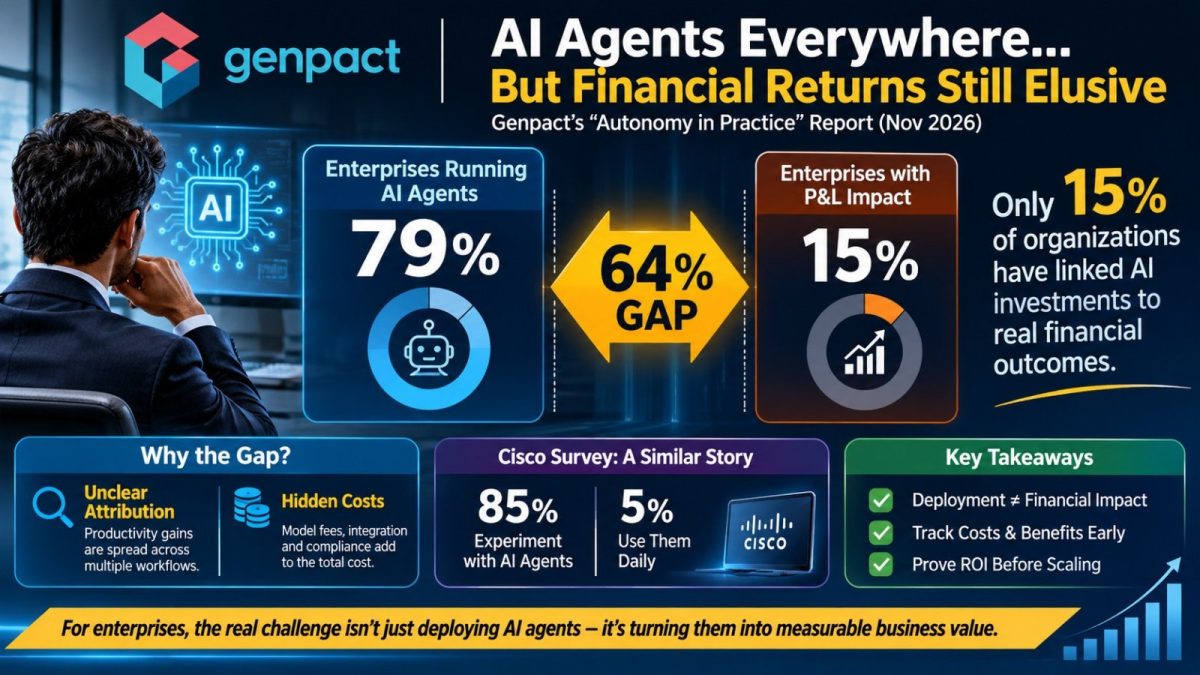
Everybody seems to be hopping on the AI agent trend, but almost nobody can show it’s making them money. In November 2026, Genpact released a report called “Autonomy in Practice.” It was announced through Business Wire, and Agile Brand Guide summed it up on November 13. The report says 79% of the companies surveyed already run AI agents in their operations. Only 15% have fully tied those AI investments to their profit and loss numbers. The summary also doesn’t say how many companies were surveyed, so keep that in mind.
That’s a 64-point gap, which is huge. Basically, starting up AI agents is the easy part, and proving they help the bottom line is the hard part.
Why It’s Hard to Measure: Hard to Give Credit
Genpact looked at how companies turn AI agents into real financial results. Almost four out of five run agents, but most can’t point to exact savings or profit gains on their income statements. I think there are three big reasons.
First, nobody knows what to give credit for. Agents usually help with small, scattered jobs like sorting support tickets, summarizing documents, or writing internal reports. They don’t usually take over a whole job by themselves. So when a few minutes get saved across dozens of employees, the finance team can’t turn that into a real cost cut.
Why It’s Hard to Measure: Running Costs and Supervision
Second, it costs more once it’s live. A test version is very different from one that runs all day. Agents that work in multiple steps make tons of model calls, database searches, and API requests. If nobody sets token budgets or uses cheaper models for easy tasks, the computing bills slowly eat the money saved on labor.
Third, watching it takes work. After launch, developers still have to build testing systems, safety rules, and review queues so humans can catch strange mistakes. That babysitting costs money too, and it’s usually missing from the first estimates.
How Genpact Compares to Cisco
Genpact’s results match other research showing that companies get stuck between testing and daily use. Genpact looks at running agents versus proving profit. Cisco’s research also shows that not many companies go from trying agents to relying on them every day across their workforce.
Put together, it looks like a funnel that gets really narrow at the bottom. Most big companies are testing or running agents in a few small areas. Only a tiny number have put them into core operations where the financial results actually get checked.
What This Means for Companies Buying AI
Boards are going to look hard at tech budgets going into 2027, so AI vendors will be pushed to show real financial results instead of just saying they have pilots going. Launching an agent is only step one. Leaders need to work out their baseline costs, set budgets, and set up profit and loss tracking before they launch anything. If they don’t, they’ll never be able to prove it was worth it.


