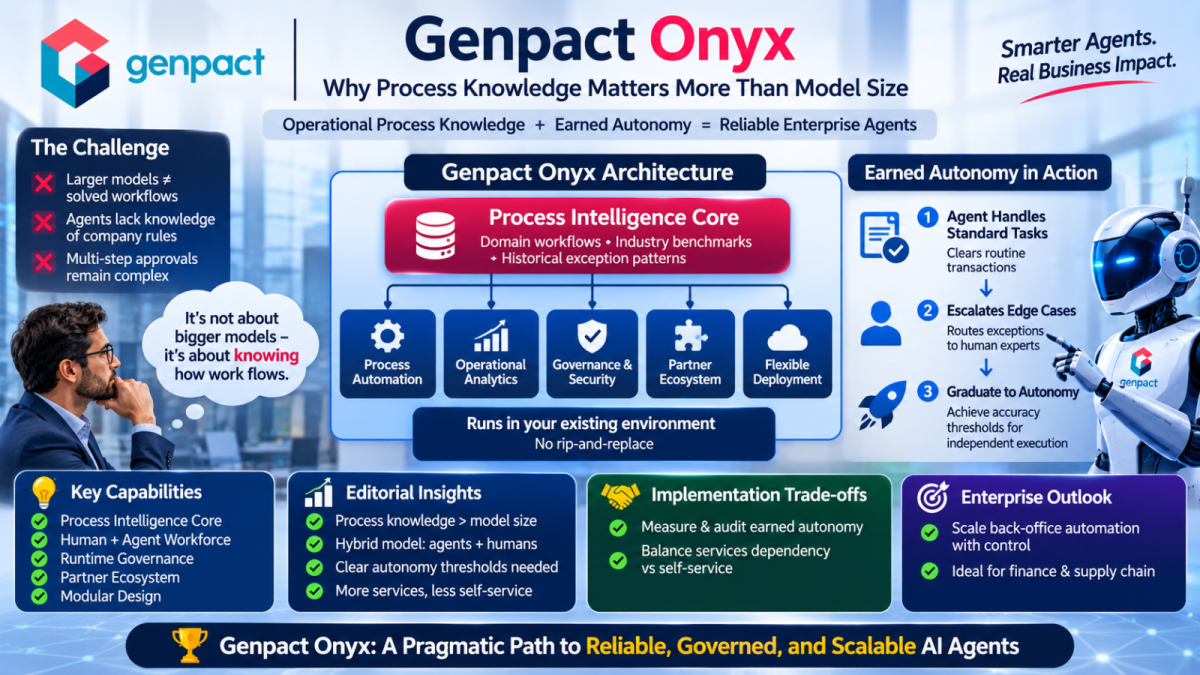
A lot of big AI companies say that bigger and smarter models will fix messy company workflows. But in areas like accounts payable, insurance claims and supply chain problems, the software usually doesn't fail because it can't write well. It fails because the agents don't know the company's unwritten rules or the many steps an approval has to go through. At Genpact's Agentic Operations Day in New York on November 12, 2026, Genpact showed off Genpact Onyx, and it launched on November 16, 2026. The idea behind it is simple: knowing how the work actually gets done matters more than how big the AI model is.
Bots don't get free access to everything on day one. Onyx uses something called "earned autonomy," where agents have to prove they're accurate while humans watch them before they get more power to act on their own.
How Onyx and Earned Autonomy Work
According to Genpact's November 16 media release, Onyx runs inside the technology a company already has, so nobody has to rip everything out and start over. It's built around Genpact's Process Intelligence Core plus five connected capabilities.
Process Intelligence Core. This is the center of the platform. It puts workflows, industry benchmarks and past exception patterns into organized context. Agents mix that with company data and AI pipelines, so their decisions match how work really moves through ERP and CRM systems.
Humans and agents working together. Onyx puts autonomous agents and human experts in the same workflow. In a finance example Genpact gave, an agent that understands the process clears the normal transactions by itself. When something doesn't match or looks odd, it sends that item to a finance person to sort out.
Partners and rules while it runs. So companies don't get stuck with one vendor, Onyx works with different foundation models and cloud platforms through Genpact's partners. Built-in governance and security controls watch every action and keep agents inside the policy lines. Performance numbers decide when an agent moves from supervised help to earned autonomy.
Things to Think About
Honestly, I think Genpact's idea shows a split between regular software companies and managed-services companies. Software vendors sell tools and leave it to the customer's IT team to redesign workflows. Genpact gives you both the orchestration layer and the people who actually run the back-office work every day.
Still, there are two things leaders should consider before picking Onyx.
Setting the thresholds. To move an agent from human-checked routing to signing off on its own, you need clear accuracy targets and limits for how many mistakes are okay. Risk, finance and operations leaders have to agree on those audit rules at the start.
It depends on services. Onyx leans a lot on written-down expert knowledge and humans staying involved. If a company just wants self-service tools for developers, this might feel more like a managed transformation project than buying software.
What Happens Next
By building AI agents on codified process knowledge and slowly giving them more freedom, Genpact Onyx gives careful finance and supply chain teams a practical way forward. Companies that set clear rules for when an agent gets promoted to more autonomy can grow their back-office automation without losing control of how things run.


