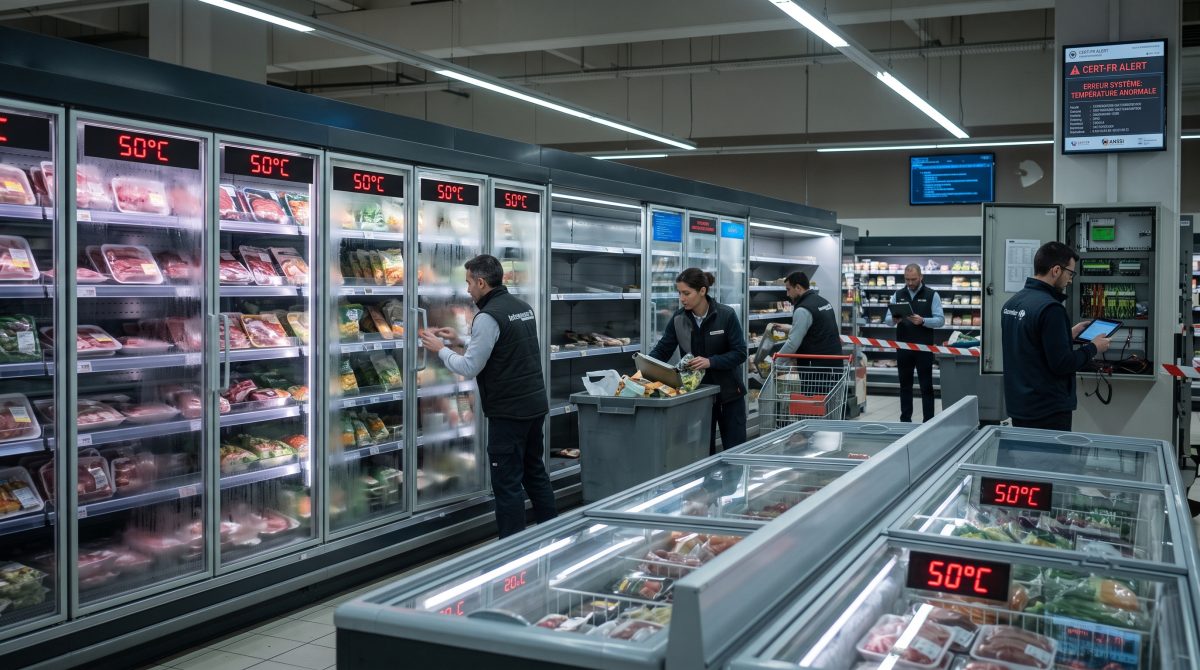
On 13 October 2026, France’s national cybersecurity agency, ANSSI (Agence nationale de la sécurité des systèmes d’information), widened its warning about the cyberattack on supermarket refrigeration. Its response team, CERT-FR (Computer Emergency Response Team), updated an alert to add Copeland and Dixell remote controllers to the Danfoss units it had named a day earlier. According to CBS News and the Organized Crime and Corruption Reporting Project (OCCRP), the hack struck overnight on 11 and 12 October and hit hundreds of French stores. The CERT-FR alert names no vulnerability, so how the attackers got in remains unconfirmed.
Fridges Heated to 50°C Across Hundreds of Stores
OCCRP reported that temperatures were pushed as high as 50°C (122°F), spoiling large quantities of food and sparking fires. CBS News, citing the news agency Agence France-Presse (AFP), reported that Leclerc, Intermarché and Coopérative U confirmed they had been hit, and that the Paris prosecutor’s office confirmed an investigation had been opened. CBS News, citing the news agency Reuters, reported that Carrefour said 80 of its 6,000 stores were attacked. The Mousquetaires Group, which owns Intermarché, told OCCRP that 300 of its stores were compromised. Its press office told OCCRP it expects about a week to return to normal for customers and two to three weeks to restore its systems fully.
What CERT-FR and Danfoss Have Said
CERT-FR, which sits inside ANSSI, published its alert on 12 October. It reported numerous compromises of Danfoss AK-SM and AK-SC remote controllers. The 13 October update added Copeland xweb and Dixell xweb systems. The alert calls exposing a management interface to the internet contrary to good practice. Danfoss told AFP, as reported by CBS News, that most affected equipment was legacy hardware that no longer receives software or security updates. It named the AK-SM800 and AK-SC355 models, and said one version of the AK-SM800 ran outdated firmware. Danfoss gave no figures on how many systems were affected.
Why Connected Refrigeration Is Exposed
Antoine Hautin of consultancy Almond told AFP, as reported by CBS News, that industrial equipment such as refrigeration units, long isolated from the internet, is now connected through sensors or remote monitoring. By likely affecting hundreds of units at once, he said, the attack showed a certain level of sophistication. Al Jazeera reported that security firm Claroty published research on 9 August describing flaws in Danfoss systems that could let attackers bypass authentication. CERT-FR’s alert does not tie the attack to any specific vulnerability, so that research should be read as background rather than as the cause.
Our Own Reading: An Old-Equipment Problem, Not Yet a Proven One
This section is our analysis, not a stated fact. The public statements so far point to exposed and unsupported devices rather than a new technique. CERT-FR’s advice centres on removing internet exposure, and Danfoss stresses ageing hardware. But that is an inference, and investigators have not confirmed the entry route. The addition of Copeland and Dixell suggests the weakness may stretch beyond one manufacturer. Until prosecutors say more, any claim about who is behind the attack deserves caution.
What Operators Are Being Told to Do
CERT-FR tells operators to remove internet exposure from affected units and from any device on a public address. Access should return only through a secure virtual private network (VPN) or a protected network. It advises checking insurance contract conditions before cutting the data link to a refrigeration contractor. It warns that attack campaigns are probably still under way, and that a factory reset alone is not enough for unsupported equipment, which will likely be compromised again. OCCRP reported that Coopérative U’s chief executive said affected products were withdrawn and destroyed.