Delhi Police Arrest Five Over Fake Traffic Challan SMS Network
Delhi Police have arrested five people for allegedly running a cyber-fraud network that used fake traffic challan messages, fraudulent links and reward-based mobile apps, officials said on Saturday, 31 October 2026, according to The Tribune. The accused are Moti Singh Baghela, Harshpal, Vicky, Vishal Das Vaishnav and Barjesh Kumar. Police link the network to 544 complaints across India involving more than Rs 10 crore. Every figure here is a police allegation as reported by The Tribune.
How One Credit Card Complaint Led to the Network
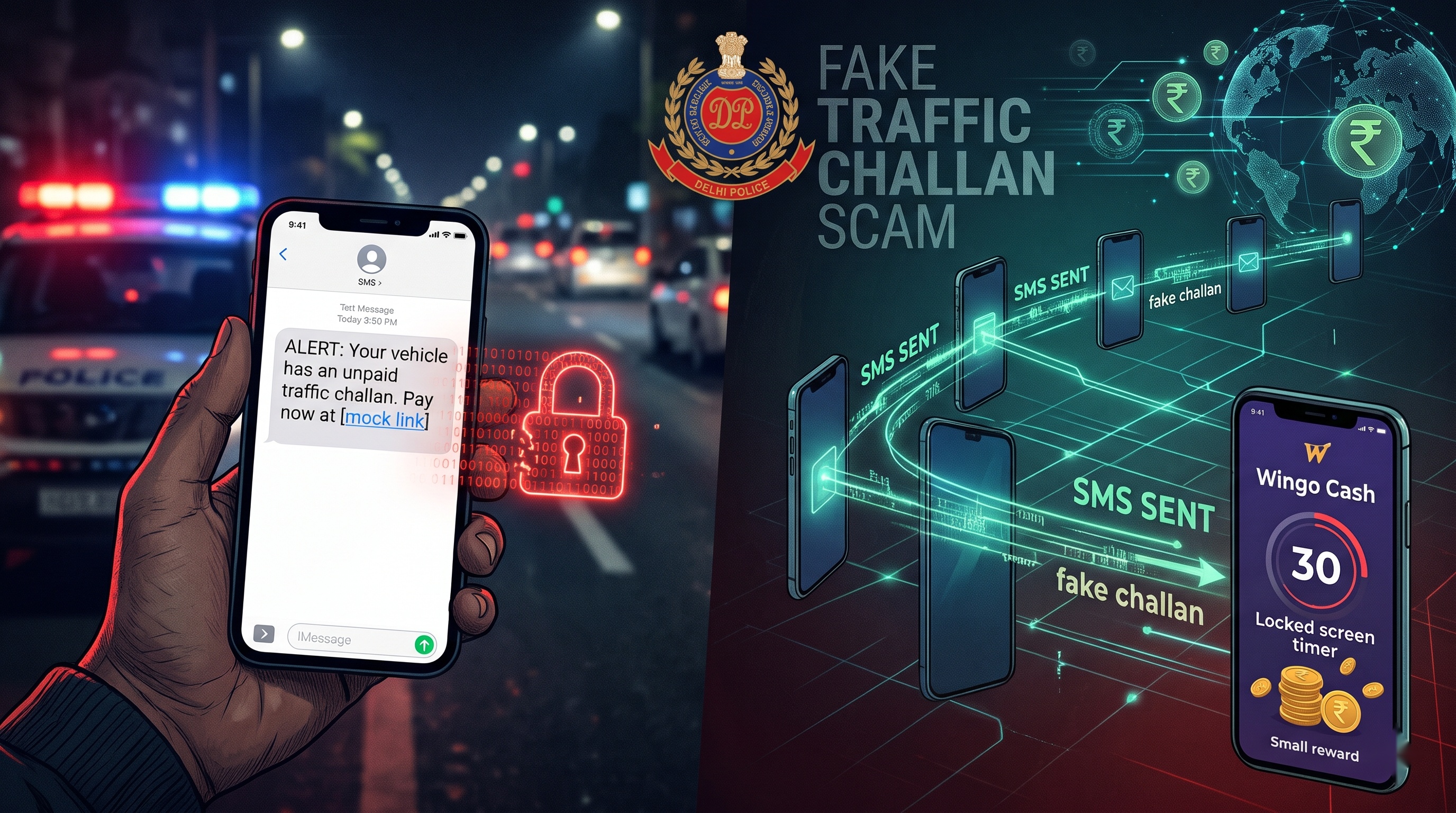
The Tribune reports that the case began when a complainant received an SMS with a link meant for paying a traffic challan. After he clicked it, an unauthorised transaction of Rs 2.21 lakh was made on his credit card. An electronic First Information Report (e-FIR) was registered under Section 318(4) of the Bharatiya Nyaya Sanhita (BNS) at the South-West district cyber police station on 28 November 2025, the report says. Investigators found that bulk SMS activity from the sending number began around 3 November 2025, with about 3,300 messages sent in the period examined. Police traced the cheated amount to an account at the National Bank of Kuwait, which they said complicated efforts to link the money to the alleged perpetrators. They also described phishing messages, a reward app, and bank accounts allegedly opened or operated for commissions.
How the Reward App Allegedly Worked
According to The Tribune, the trail led to an app called Wingo Cash, found on a school student’s phone and reportedly received through a WhatsApp group. Police allege the app exploited reward redemptions. Each time a user redeemed a reward, the screen stayed locked for about 30 seconds, and in that window the app automatically sent nine to 12 SMS messages. Police say they also identified a payout system that distributed around Rs 2 crore among more than 41,000 users within three days.
What Official Advisories Say
Business Standard reports that on 9 July 2026 the Press Information Bureau (PIB) Fact Check unit warned on X that scammers were sending fake e-challan links, Android Package Kit (APK) files and Portable Document Format (PDF) attachments by SMS and WhatsApp. The unit said clicking could compromise one-time passwords (OTPs) and lead to unauthorised bank or Unified Payments Interface (UPI) transactions. Business Standard adds that suspected victims should report through the National Cyber Crime Reporting Portal or the 1930 helpline, and check challans only on the official e-Challan portal.
Separately, ANI reported on 30 January 2026 that the Ministry of Home Affairs (MHA) geo-blocked servers linked to the Wingo app network, plus four Telegram channels with about 1.53 lakh subscribers and over 53 YouTube videos promoting it. The Indian Cyber Crime Coordination Centre (I4C) called Wingo a “Telecom Mule as a Service” app that paid users for SMS tasks. The reports reviewed do not say whether Wingo and Wingo Cash are the same app.
Our Analysis
This section is our own reading, not reported fact. The dates are worth lining up: the e-FIR came on 28 November 2025, the MHA acted against Wingo on 30 January 2026, the PIB was still warning about fake e-challan links on 9 July 2026, and the arrests were announced on 31 October 2026. That is about eleven months from first complaint to arrests. The reports do not link the Wingo action to this case, so the gap shows only how long fake challan messages kept circulating. Because the messages allegedly left ordinary users’ phones, recipients may have seen real-looking personal numbers rather than a bulk sender. A challan demand that pushes you to pay through a link is the warning sign; check it only on the official portal.