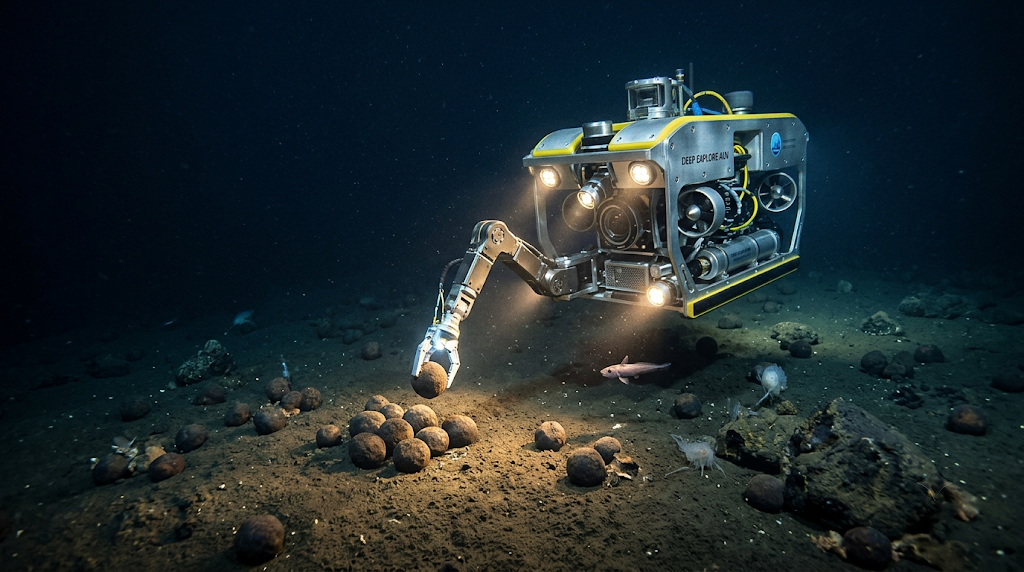
Most deep-sea mining machines work like giant vacuum cleaners, collecting rocks from the ocean floor. But a company called Impossible Metals is trying something different. Its Eureka II robot picks up rocks one by one instead of collecting everything around them.
On November 9, 2026, the company announced that Eureka II had collected around 450 grams of mineral-rich rocks from more than 4,000 metres below the Pacific Ocean.
What Did Eureka II Do?
The test happened in September 2026 in the Clarion-Clipperton Zone, between Hawaii and Mexico.
The robot collected special rocks called polymetallic nodules. These contain useful metals like nickel, copper, cobalt and manganese.
Impossible Metals says this was the first time a robot collected selected nodules on its own at such a depth. However, this claim has not been independently confirmed.
The company says the test was for scientific research, not commercial mining.
How Does Eureka II Collect Rocks?
Eureka II floats above the ocean floor instead of driving across it.
At 4,000 metres underwater, the pressure is about 400 times greater than at the surface.
The robot uses cameras and AI to find rocks. It is designed to avoid rocks with visible sea creatures living on them.
Its three robotic arms pick up selected rocks and place them inside the robot.
A special system controls how the robot floats, helping it return to the surface without a long pipe connected to a ship.
Can This Method Protect Ocean Life?
Impossible Metals believes its method could cause less damage to the seabed.
However, scientists are still concerned.
Marine biologist Douglas McCauley explained that careful collection might reduce damage, but removing rocks still destroys places where sea creatures live.
A 2019 study warned that removing these rocks could affect deep-sea habitats for a very long time.
Another study in 2021 estimated that removing nodules could reduce parts of the local food web by 18%.
These studies did not directly test Eureka II.
Environmental campaigners have also questioned whether the company's method is truly safe for marine life.
What Are the Limitations?
Eureka II still has many challenges.
The company admits that its cameras cannot detect microscopic organisms living on rocks.
The robot also collected only 450 grams during the test. This does not prove it can collect large amounts of minerals regularly.
There has been no reported independent environmental monitoring of the September dive.
Commercial mining would also need government or international approval.
What Happens Next?
Impossible Metals plans to test a larger robot called Eureka III in 2027.
The test is expected to take place aboard the German research ship RV SONNE.
Germany's federal geosciences institute, BGR, will monitor the environmental effects.
The company also plans to publish data from its earlier dive.
Eureka II has shown that robots can collect individual rocks deep underwater. However, more independent testing is needed to understand whether this method is truly safer for ocean life.