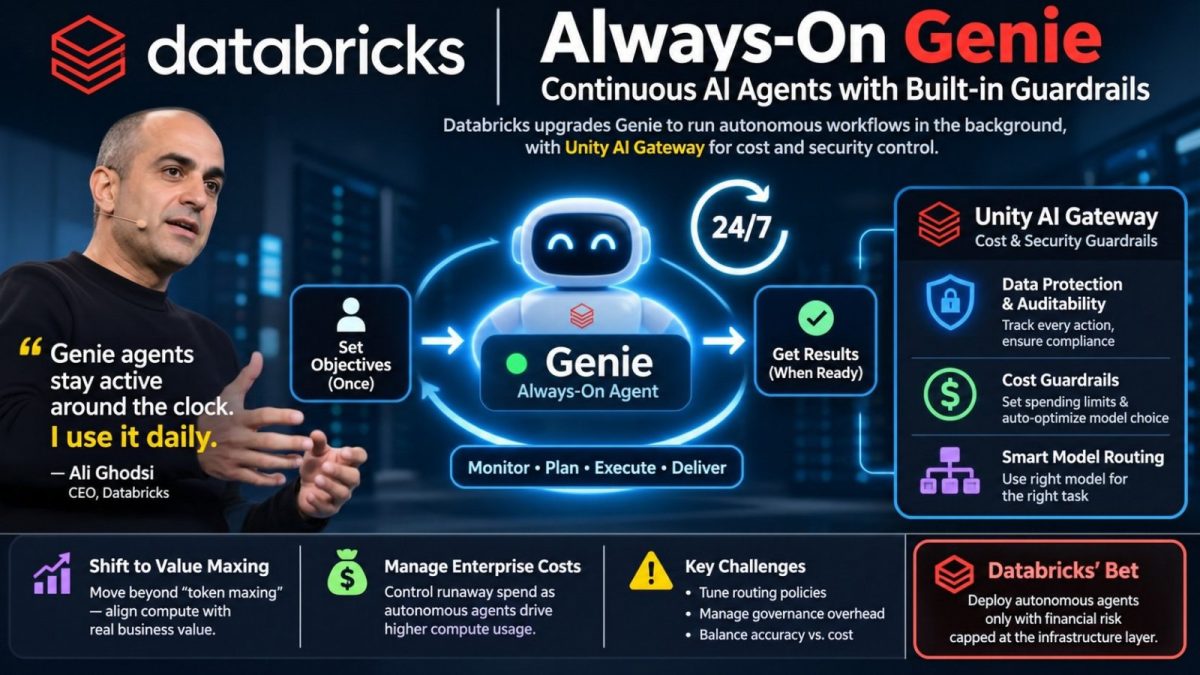
Okay so basically, a lot of AI helpers at companies only work when you keep typing stuff to them. If you walk away, they just stop. But on November 11, 2026, Databricks came out with a new version of its tool called Genie that keeps running in the background. It can do a whole bunch of steps on its own without someone prompting it every time. Ali Ghodsi, the CEO of Databricks, told Fortune that the agents stay on all day and night, and that he actually uses it every day himself.
The big thing here is that Databricks didn’t just make the AI more independent. They also added rules about money and security through something called Unity AI Gateway. The more these AI tools run, the more computing power they eat up, so Databricks is trying to make sure companies can control costs while the AI still does smart work.
How it works
From what Databricks said and what IT Brief reported, Genie used to be more like an assistant that answered questions when asked. Now it’s more like a worker that’s always there. It keeps an eye on goals, splits big jobs into smaller tasks, and only bothers a real person when someone needs to approve something.
Two main things keep it under control:
Protecting data. IT Brief says big companies can let Genie run long tasks without leaking private info. Everything Genie does gets recorded, so the compliance people can look back and see what data it used and how it made its choices.
Controlling costs. If an AI keeps looping in the background, it could burn through a ton of money fast. Unity AI Gateway sets spending limits to stop that. IT Brief and Techstrong both say it watches usage and suggests cheaper models for easy tasks, while the big powerful models are saved for harder thinking.
From “token maxing” to “value maxing”
Honestly, I think cost control is getting just as important as how smart the AI is. Techstrong says company tech budgets are getting messed up because these agents cause big, unexpected jumps in usage.
Databricks wants companies to stop “token maxing,” which means wasting tons of computing power by throwing the biggest model at everything. Instead, they want “value maxing,” where spending actually connects to results that matter for the business. Automatic model routing and spending caps are how they plan to do that.
But it’s not perfect. There are some downsides for data teams:
Routing needs fine-tuning. If the gateway sends a confusing task to a cheaper, weaker model just to save money, the answer might come out worse, and then people have to redo the work anyway.
More setup work. Even with audit logs, admins still have to decide the spending limits, what needs approval, and what data the AI can touch. You can’t just let it run in the background without setting those rules first.
So overall, Databricks is betting that companies will only trust AI workers with big jobs if the money risk is limited right at the infrastructure level. Which kind of makes sense, because nobody wants a robot quietly spending their whole budget while they’re asleep.


