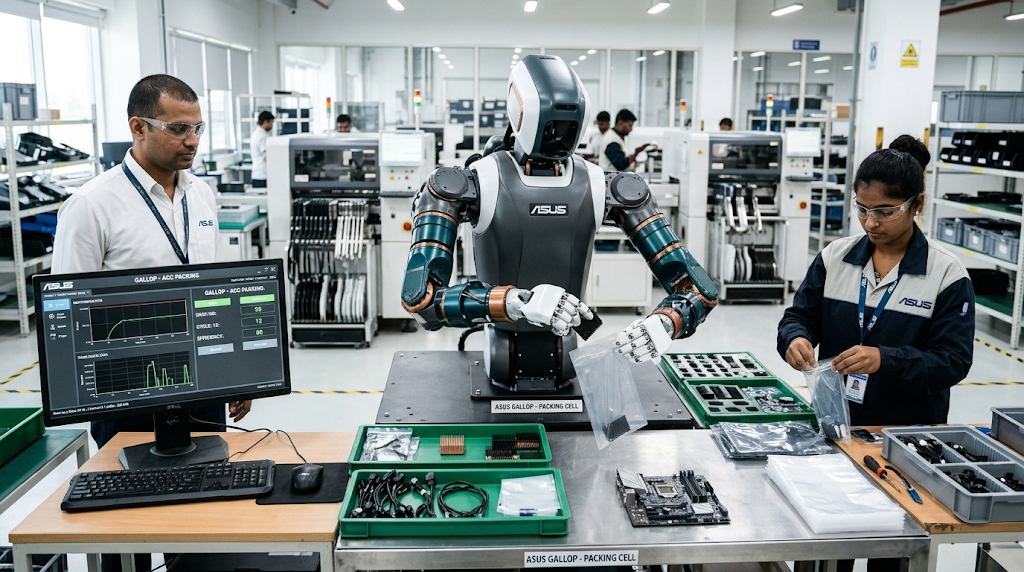
Humanoid robots look impressive in videos, but working in a real factory is not easy. A robot must do the same job correctly for many hours without making mistakes. On November 13, 2026, ASUS introduced its first humanoid robot called Gallop. The robot is being trained to pack small computer parts at an ASUS group factory.
For now, Gallop is only a prototype and is not available for sale.
What Does ASUS Gallop Do?
Gallop is being trained to pack small accessories that come with computer motherboards.
The task involves 15 different parts. Some are packed inside thin plastic bags, which makes them difficult for robots to pick up.
ASUS wants Gallop to complete each packing task within 20 seconds with a 99.5% success rate.
However, this is only the company's goal. ASUS has not shared the robot's actual success rate yet.
How Does Gallop Learn Its Work?
ASUS trains Gallop by showing it how people complete the same task.
With their permission, experienced workers wear small cameras that record their movements.
The company also uses virtual reality headsets and gloves to help operators guide the robot.
Gallop has different AI systems working together. One plans the task, another checks the progress, and others control its arms and movements.
The robot uses an NVIDIA Jetson AGX Thor computer to run these systems.
If something goes wrong, its AI is designed to change the plan and try again.
How Is Gallop Different From Other Robots?
Other companies are also testing humanoid robots in factories.
For example, Figure AI tested its Figure 02 robot at BMW. According to BMW, the robot worked ten-hour shifts and helped support the production of more than 30,000 cars over ten months.
Figure also reported more than 1,250 working hours and 90,000 parts loaded.
However, the robots perform different jobs. Figure handled metal parts, while Gallop is learning to handle small items inside plastic bags.
ASUS has not yet shared similar working-hour results.
What Are the Challenges?
Gallop still needs to prove that it can work reliably.
If it takes 20 seconds to pack one board, it could complete around 180 boards per hour without stopping.
Even with 99.5% accuracy, some mistakes would still happen.
ASUS has not shared how quickly Gallop fixes mistakes or how often workers must help it.
The robot also has a fixed base, so it cannot move around the factory.
What Happens Next?
ASUS plans to add touch-sensitive hands and wheels to Gallop.
The company expects to show it at Computex 2027 and introduce it to partners later that year. A wider market launch is planned for 2028.
Gallop is an interesting step for ASUS, but it still needs more testing. Its success will depend on whether it can work safely, quickly and reliably during real factory shifts.