AI Scientists Are Now Running Real Experiments
AI scientists that run experiments aren’t just an idea anymore. In 2026, several research teams showed AI systems that plan a study, run it, and read the results. It’s like a cook who picks a recipe, makes the dish, and tastes it, all without a helper. But the AI still needs people nearby, and the claims need to be read carefully.
A paper written and tested by AI
In March 2026, the journal Nature published a paper about a system called The AI Scientist. It was built by researchers from the University of British Columbia, Sakana AI, the Vector Institute, and Oxford. It can come up with an idea, write code, run experiments, make graphs, and write a paper. One of its papers even passed peer review at a workshop of a big computer science conference.
But for now it only works in computer science. The team says its papers sometimes had weak ideas and wrong citations.
How does an AI run a lab test?
These systems work in a loop. The AI picks a question, plans a test, and asks a machine to do it. Then it reads the results and plans what to do next.
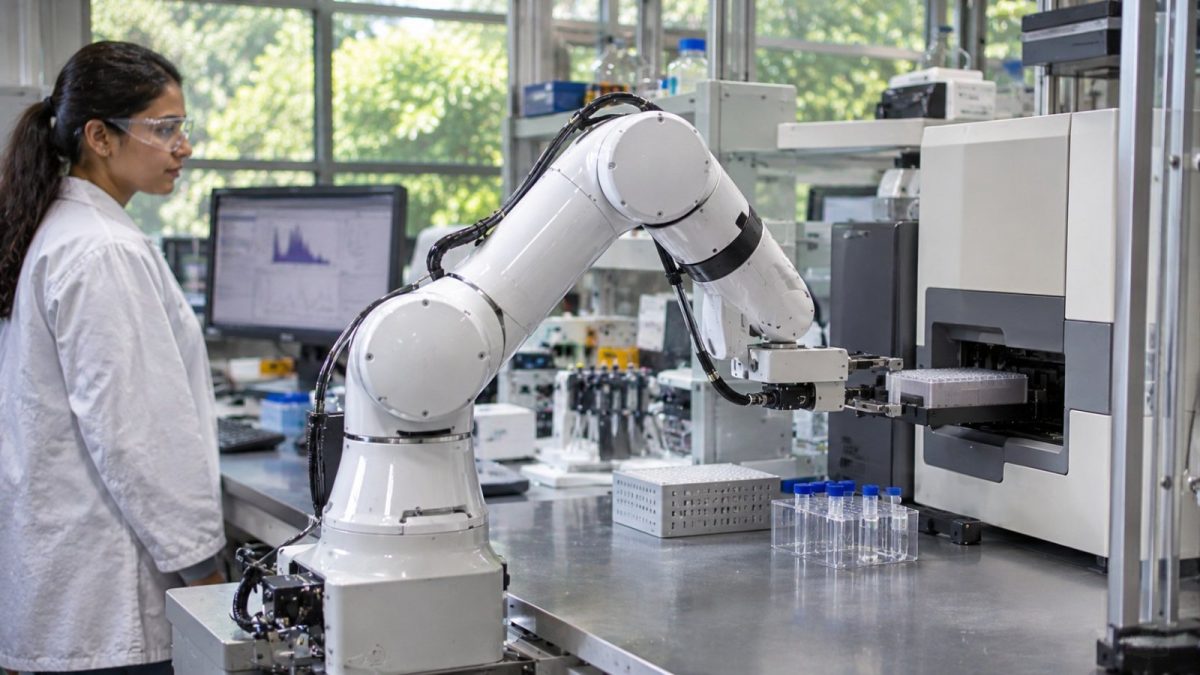
Some of them use real equipment. At Northeastern University, researchers tested an AI X-ray scientist at a real SLAC facility. It ran a simulated experiment, noticed a motor problem, and fixed it. At Argonne National Laboratory, a robot lab called Polybot made thin plastic films that conduct electricity, using choices guided by AI.
Why do these systems matter?
Labs spend a lot of time on slow, repeated work. A robot can try lots of options while people think about bigger questions. Argonne says those films could be made in almost a million different ways, which is way too many for people to test.
In biology, a team at Chalmers University of Technology built an AI lab that plans, tests, and learns in a loop, working on brewer’s yeast. It picked questions, suggested experiments, and judged the results with very little help from humans. Google’s Co-Scientist helps researchers come up with ideas, and it has helped produce lab results. In one test, a drug candidate blocked 91% of a scarring-linked response, Google reports.
What are the limits?
Most of these systems still need people. A lot of the results so far come from single labs and small tests. The X-ray test used a simulated experiment. Some labs are only partly hands-off, and scientists still guide the analysis. Sakana’s team also warns that AI-written papers could overload peer review.
Safety is another worry. A Phys.org report says AI can now run biology experiments at a large scale through robotic cloud labs, and the current rules weren’t made for that.
What comes next?
Google said it would give Co-Scientist to individual researchers through an experimental tool called Hypothesis Generation, announced in May 2026. Northeastern’s quantum institute is working toward fully self-driving labs. The UBC team thinks the same technology should work in other fields, but that hasn’t been shown yet.
These systems are real, but they’re still early. They can save time on slow jobs and test lots of ideas. For now, they work best as fast helpers next to human researchers, who still pick the big questions and check the answers.