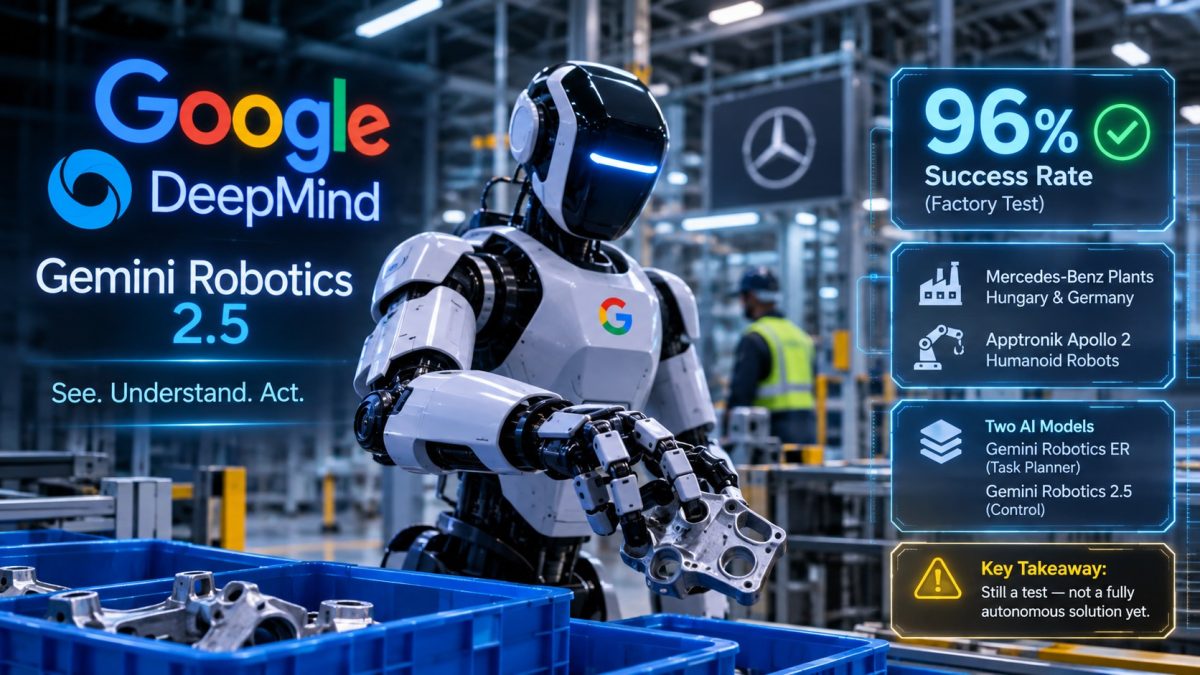
Google’s Robot Got 96% in a Factory, But Don’t Get Too Excited
So Google DeepMind just showed off a new robot AI called Gemini Robotics 2.5 on November 10, 2026. They say it’s their best vision-language-action model yet. Basically that means an AI that looks at stuff, understands what you tell it, and then moves a robot to do it. The catch is that only Google’s robotics partners can use it right now. Regular people and other companies are kind of locked out, and Google hasn’t said if or when that will change.
The 96% thing
The big number comes from a test with a startup called Apptronik and the car company Mercedes-Benz. Apptronik’s Apollo 2 humanoid robots were sorting car parts out of big bins and putting them into trays on real production lines. The tests happened at Mercedes plants in Hungary and Germany. DeepMind says the robots got it right 96% of the time. Two AI models worked together. One, called Gemini Robotics ER, kept track of the whole job, and Gemini Robotics 2.5 controlled the arms and hands.
But honestly 96% sounds better than it is. DeepMind didn’t say how many times they tried it, what counts as a “success,” or how fast the line was moving. We also don’t know how often a human had to help out. In a real factory, messing up 4 times out of 100 is a big deal. Imagine a school cafeteria dropping 4 out of every 100 trays. It adds up fast. So this is still just a test, and not a robot that can work all by itself.
Practicing in fake worlds
DeepMind also says the robot got better at more than 200 different tasks. Those tasks include tying ribbons on boxes, putting food on plates with tongs, and pipetting liquids. They say it succeeded 30% to 100% more than older versions and finished 20% to 30% faster. But those numbers came from lab tests, and not from the factory.
Part of the improvement came from practicing in simulations. DeepMind used another AI called Gemini 4 Argon to make thousands of fake practice runs, so the robot didn’t have to learn everything in real life. That’s pretty smart, since real robot practice is slow and expensive.
The safety score is kind of tricky
Safety is the hardest part, because robots working near people can really hurt someone. DeepMind put out a free test called ASIMOV-Jailbreak that checks if a robot AI will refuse dangerous instructions, even when someone disguises them to look normal.
They bragged about a 99.5% score, which is way up from the 82% that an older model got. But here’s the thing. That score is for Gemini 4 Argon, the language model, and not for Gemini Robotics 2.5, the one that actually moves the arms. So it doesn’t really tell us how safe the robot itself is. For the robot model, DeepMind only shared its own numbers, like being 43% better when the robot is near people. Nobody outside the company has checked those.


