What Is Happening?
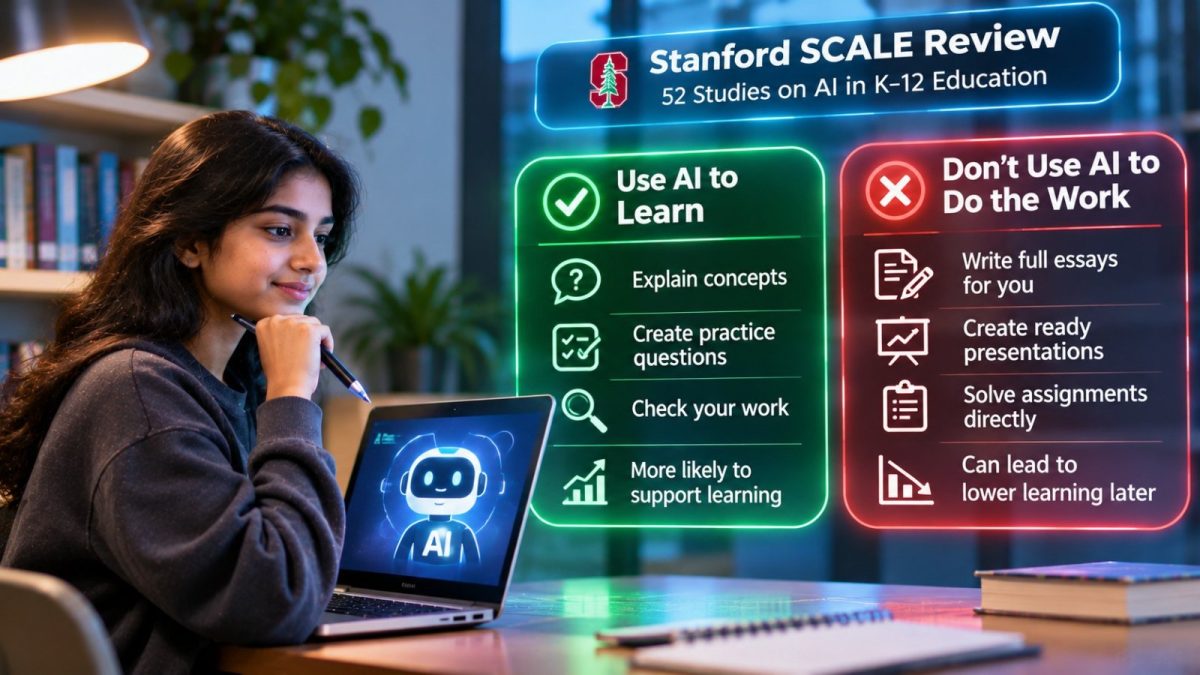
Stanford's AI Hub for Education checked new trials from October 2025 to June 2026. This raised its list of strong studies from 20 to 52, and 42 of them look at student tools. The team compared two habits: using AI as a study helper versus letting AI write finished homework.
When students let AI do the work, fast results hid weak memory later on. In one study, college students in Brazil made a slide talk faster with AI, in 3.2 hours instead of 5.8 hours, but they got lower scores on a surprise test 45 days later. Data from 3.2 million math-app sessions also showed that students spent less time on easy-to-copy problems after ChatGPT came out, and they did worse on watched tests. On the other hand, a trial with 1,423 Grade 7 and 8 students in Sierra Leone, shared by Google's LearnLM team, found that Gemini Guided Learning raised math scores by 0.258 standard deviations.
How Does It Work?
Regular chatbots use huge language models that guess the next word so they can give a full answer right away. That shortcut skips the brain work, called active recall, that helps students remember what they study.
Guided AI tutors change how the app behaves. Instead of an open chat box, builders add strict prompt rules, lesson files, and step-by-step limits, so the bot asks helpful questions instead of handing over the final answer. Even with those limits, how the class is set up still matters. In a US trial with 6,997 middle school students across 20 schools, adding an AI tutor to a math app slowed practice down and didn't raise later test scores overall.
Why Is It Important?
For years, parents and teachers have argued about whether AI belongs in class at all. Stanford's report shows that the real question is how students use it.
One simple rule stands out for students. Use AI to explain hard steps, quiz yourself before a test, and check your own draft, but never use it to write the whole task for you. In a 211-student study by Contractor and Reyes, the better essay scores from AI disappeared as soon as students had to write alone later.
What Are the Challenges?
Even good numbers come with clear limits. Only five of the new student studies happened in US K–12 schools, while most tested college students, which leaves gaps for younger kids.
Running guided AI tutors for whole schools also brings real tech and money trade-offs. Live, step-by-step chats use more cloud computing power per student than basic web search, need steady school internet, and can still make mistakes if the rules slip. Researchers also note that many studies are early drafts that peers haven't checked yet, that an AI tool helped sort papers before human checks, that funders include Google.org, and that one study found teacher AI use lowered student drive and confidence.
What Happens Next?
Stanford's full report and PDF are free online for teachers, parents, and leaders around the world. Next, researchers want longer studies to see if AI closes or widens learning gaps between rich and poor schools over time.