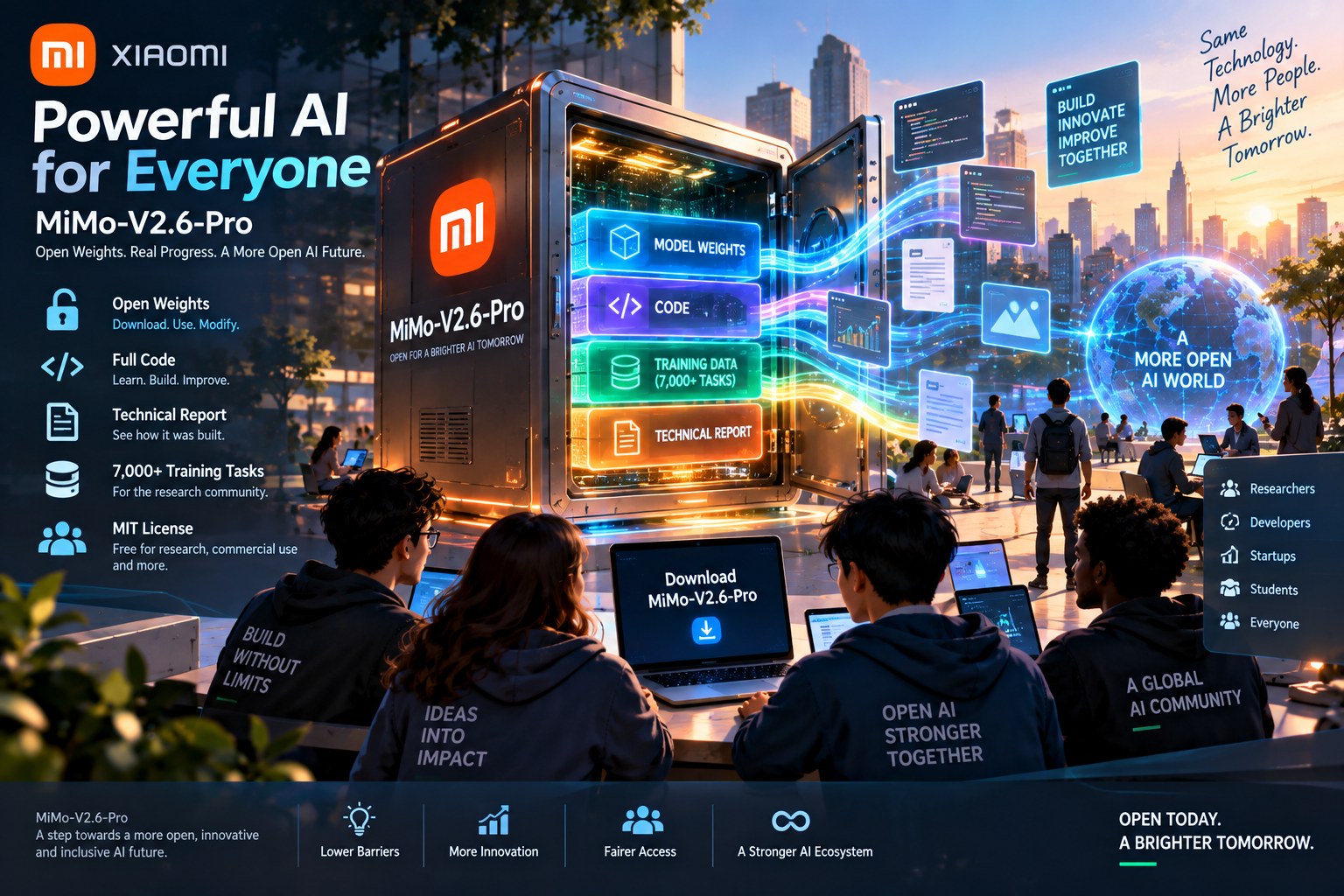
On September 22, 2026, Xiaomi did something most top AI companies avoid: it gave away its best model for free. MiMo-V2.6-Pro is the flagship of Xiaomi's new MiMo model family. It now sits at the top of the open-weight leaderboard from Artificial Analysis, an independent group that tests AI models. It scored 46 on their Intelligence Index. That ties it with xAI's brand-new Grok 4.7, a model you can only use if you pay for it. It also beats the earlier open-weight leaders, GLM-5.3 and Kimi K3, which both scored 44. Looking at Artificial Analysis's full ranking of every model, open and closed, MiMo-V2.6-Pro comes in sixth. Every model still ahead of it is a paid, closed one.
Here's the real difference: with a closed model, you never get the model itself. You just send it questions and it sends back answers. With MiMo-V2.6-Pro, anyone can download the actual model and use it however they want, for free.
What "open-weight" really means
Big AI models like GPT and Claude live behind an API. You type a question, the company's servers run the model, and you get a reply. You never touch the model itself. Xiaomi did something different. It put MiMo-V2.6's full weights, the numbers that make the model actually work, on Hugging Face, a site where people share AI models. It released them under an MIT licence, one of the most open licences there is. You can even use it to make money, and there's barely any restriction on that.
Xiaomi didn't stop at just the weights, either. It also shared a technical report that explains how the model was built. It released more than 7,000 training tasks it used to teach the model, along with the code behind its reasoning skills. This means other researchers can check Xiaomi's work and try to repeat it themselves.
How good is it, really?
A score of 46 on the Intelligence Index (Artificial Analysis's main test that mixes several reasoning and knowledge questions) ties MiMo-V2.6-Pro with Grok 4.7. That puts it ahead of other open models, which are stuck around 44. Artificial Analysis also says it's the cheapest model they track, costing about $0.13 per task. That's a rare mix: strong performance and a very low price.
But one score doesn't tell the whole story. Even Xiaomi's own test results show weak spots. On Terminal-Bench, a tough coding test, Xiaomi's numbers show Pro falling behind both Anthropic's Claude Opus 5 and OpenAI's latest coding model. And rankings like this don't stay still for long. Other labs update their models often, so being "the best open model" today might only last a few weeks.
As for the model itself, MiMo-V2.6-Pro has 1.02 trillion parameters (basically, the settings that shape how it thinks). But it only uses about 42 billion of them at a time to answer a question. This keeps it fast and cheap to run despite its huge size. Xiaomi also released a smaller version called MiMo-V2.6-Flash, a distilled 9-billion-parameter model, and an UltraSpeed option built for very fast replies.
Built fast, and shown in public
Xiaomi says the main training run for MiMo-V2.6 took less than six days. The cost is harder to pin down. Xiaomi actually livestreamed the training, so different news outlets caught different price tags at different moments. Numbers ranged from around $800,000-$900,000 partway through training for the Pro model, to a final figure near $2.6 million once it was done. Flash reportedly cost a few hundred thousand dollars more on top of that. Whatever the exact number, it's tiny next to what it usually costs to build a frontier AI model from scratch, which can run into the tens or hundreds of millions of dollars.
The person leading this work is Luo Fuli, who used to work at DeepSeek, another Chinese lab famous for its own open AI models. She streamed part of the training process live, letting people watch it happen. That's unusual. Most AI companies treat their training details like a trade secret.
Why this actually matters
A free, near-top model changes things for small companies and solo developers who can't afford to pay per request to a big AI company. They can download MiMo-V2.6, run it on their own computers or rented servers, tweak it for their own needs, and never send a single request to Xiaomi if they don't want to. For anyone building something that needs good AI, but not necessarily the single best AI on Earth, that's a real option. It also puts pressure on paid AI companies, because now a developer isn't just comparing one paid API to another. They're comparing a paid API to a free one that performs almost as well.
This also fits a pattern. Chinese AI labs like DeepSeek, Alibaba's Qwen team, and Moonshot AI keep releasing strong models as open weights, while many leading US labs keep their best work locked behind paid access. Xiaomi's release came out the same week as other Chinese AI and chip announcements, part of a bigger push to build an AI setup that doesn't depend on the most advanced US hardware. Where this goes matters. If open models keep closing the gap with paid ones, the AI industry might stop competing mainly over who has the smartest model. It could start competing over who can get capable AI into the most hands, cheaply. So far, Chinese labs have been much more willing to play that game.
For now, though, the simple takeaway is this: a genuinely strong AI model is out there for free, checked by an independent group, and that opens doors for anyone building on a budget. It doesn't settle who's actually "ahead" in AI overall, but it does change what's possible for the rest of us.