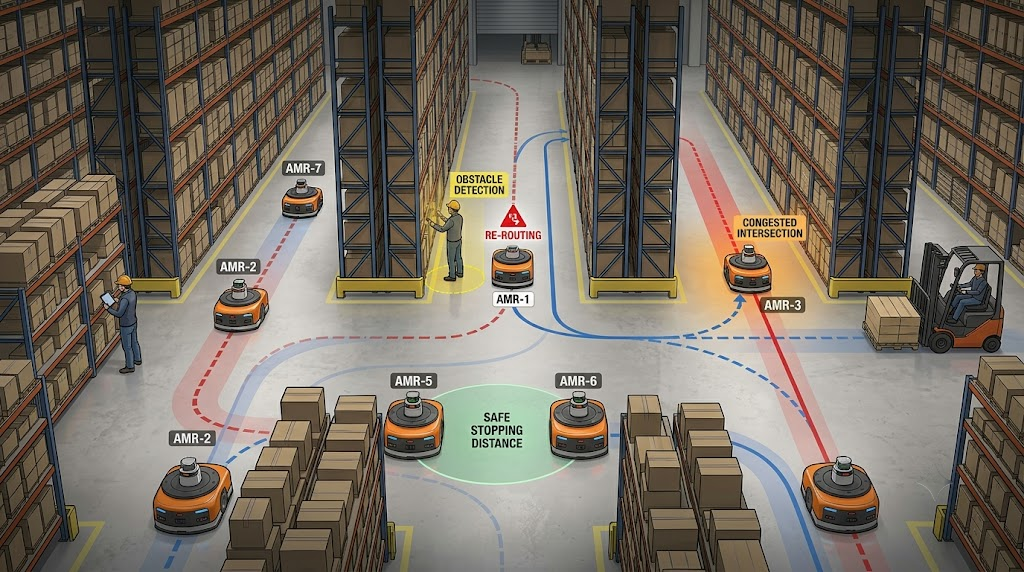
Picture hundreds of small robots moving through a warehouse while workers walk, forklifts cross aisles and new orders arrive every few seconds. If every robot simply chose the shortest route to its destination, the warehouse could quickly become a traffic jam. For modern autonomous mobile robots (AMRs), getting from A to B is therefore less about finding a path and more about finding a path that remains safe and efficient as everything around them changes.
A Robot First Needs to Know Where It Is
An AMR normally combines several sources of information to understand its surroundings. Depending on the system, cameras, LiDAR, depth sensors, wheel encoders and other sensors provide information about the robot's position and nearby objects.
Navigation software uses this information to build or update a map and estimate where the robot is within it. The robot can then plan a route around shelves, walls and other fixed obstacles. If a person, pallet or another robot suddenly appears, local navigation can adjust the movement rather than blindly following the original route.
Amazon's Proteus, for example, uses LiDAR and 3D point-cloud processing for real-time navigation and is designed to operate alongside workers. Amazon describes its newer navigation systems as using sensor information to understand dynamic warehouse environments.
The Shortest Route Is Not Always the Best Route
Path planning becomes much harder when many robots share the same floor. A robot may have several possible routes to a shelf, but the apparently shortest route could pass through an area where several other robots are heading. Fleet-management software therefore considers more than distance. It can account for congestion, task priority, robot positions and changing conditions.
This is becoming an important area of development. In May 2026, AutoStore highlighted AI-based optimization that can reduce congestion and manage robot movement in real time. Its Router software continuously recalculates routes to improve traffic flow as conditions change.
Research published in June 2026 also highlighted collision-free scheduling and routing as an ongoing challenge in robotic warehouse systems, showing that coordination remains an active engineering problem rather than a solved one.
Warehouse Robots Need Traffic Rules
With many robots operating together, navigation starts to resemble traffic management. Fleet software can decide which robot gets access to a busy section, reroute robots around congestion and prevent situations where multiple machines block each other. The objective is not simply to make individual robots efficient; the entire fleet has to keep moving.
Ocado's warehouse automation provides another example. Its autonomous mobile robot system was reported in May 2026 as operating across 127 warehouses and more than 1,000 stores, with over 2,500 AMRs deployed with customers. The company's broader automation technology uses software to coordinate robot movement across busy fulfilment operations.
People Change the Rules
A warehouse is not a closed robot-only environment. Workers can suddenly walk into an aisle, leave an object on the floor or change direction without warning.
Safety systems therefore need to detect people and other hazards and trigger actions such as slowing down, stopping or changing direction. Facility design also matters: routes, restricted zones, physical separation and emergency-stop systems can all contribute to risk reduction.
This is reflected in the current international safety work surrounding ISO 3691-4. The 2026 draft revision specifically addresses driverless industrial trucks and includes updates involving areas such as side detection, critical-edge detection and safeguarding of specific zones. The draft reached the enquiry stage in April 2026, with voting closing in September.
The Hard Part Is the Unexpected
Even sophisticated navigation cannot make a warehouse completely predictable. Sensor limitations, temporary obstacles, communication problems, congestion and unusual human behaviour can all complicate movement.
That is why warehouse autonomy is better understood as a combination of navigation, coordination and safety engineering rather than simply “AI driving a robot.” The robot needs to know where it is, understand what is around it, choose a sensible route, cooperate with other machines and stop safely when its assumptions no longer hold.
As warehouses become more crowded with robots, the challenge is not simply making each machine faster. It is making hundreds or thousands of machines share the same space without getting in one another's way—or getting in ours.