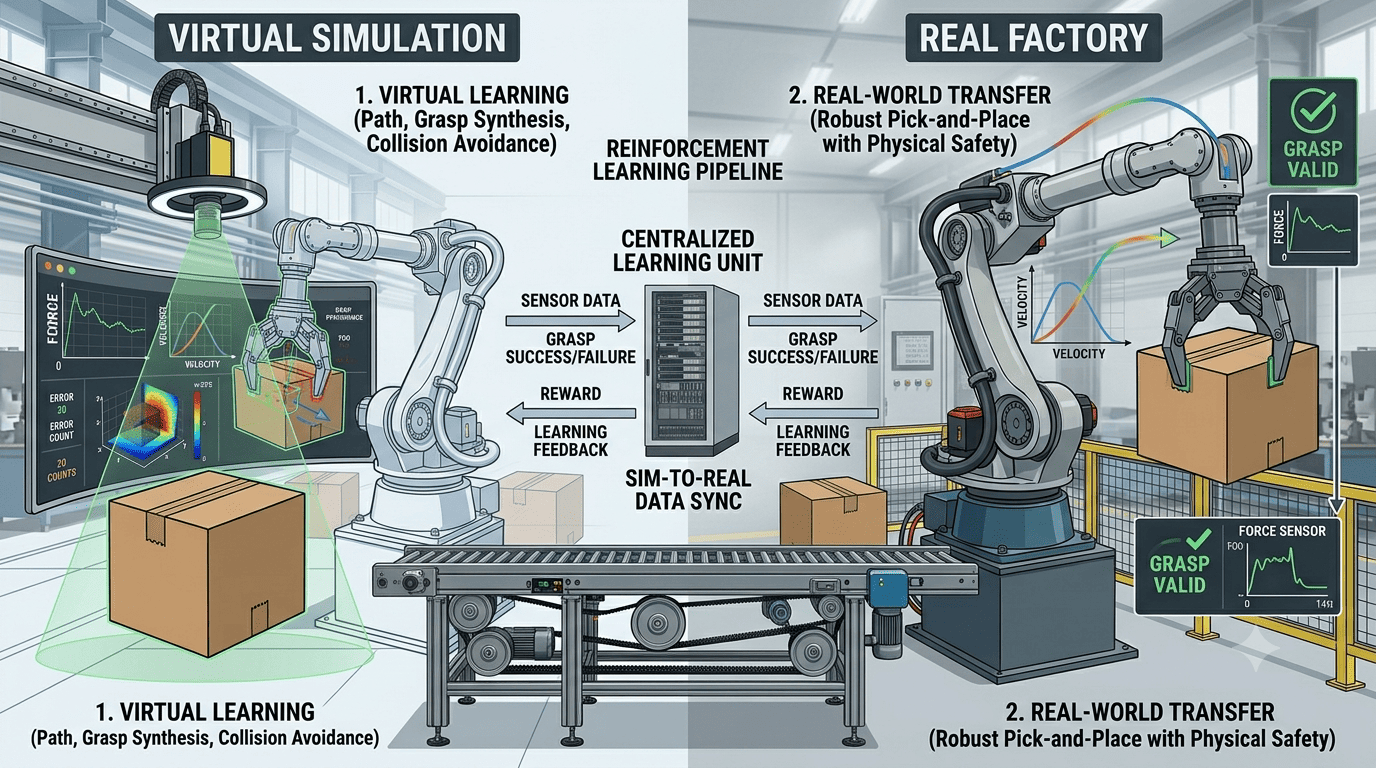
Teaching a computer to recognize an image or generate text happens entirely inside the digital world. Teaching a robot is different: the robot must turn what it sees and understands into physical movement. A small mistake can mean dropping an object, hitting equipment or stopping a task. In 2026, new robotics AI systems are making this process easier, but they also show why training physical machines remains difficult.
Computers Work With Data. Robots Work With the Real World
A software program can usually be tested repeatedly without changing the physical environment. Robots have to deal with changing lighting, object positions, surfaces, people and unexpected obstacles.
For example, if a robot is asked to pick up a cup, it needs to identify the cup, estimate its position, choose a safe grasp and move its arm without hitting nearby objects. Every step involves sensors, AI models and motor control.
Training a Robot Needs Physical Experience
Robots cannot learn everything from ordinary internet data. They also need information about physical actions: what happened when a robot moved its arm, touched an object or failed to grasp something.
This is why simulation has become an important part of robot training. In March 2026, AI2 introduced a simulation-first robotics system designed to train models in virtual environments and transfer them to real robots without additional manually collected data or fine-tuning in its reported experiments.
NVIDIA's 2026 Isaac GR00T platform also combines simulation, synthetic data, human demonstrations and real robot data to train humanoid robots. The aim is to reduce the amount of expensive real-world experimentation required.
The Sim-to-Real Problem
A virtual robot can learn in thousands of simulated situations, but the real world does not behave exactly like a simulation. Motors have imperfections, objects have different textures and friction changes how things move.
This difference is known as the sim-to-real gap. In July 2026, research on sim-to-real transfer continued to focus on making policies trained in simulation work more reliably on physical robots.
That matters because repeatedly training a physical robot can take more time, hardware and supervision than running the same experiment virtually.
2026 AI Models Are Making Robots More Adaptable
Several 2026 developments show how robot training is moving beyond fixed instructions.
In July 2026, Google DeepMind introduced Gemini Robotics 2, a vision-language-action system designed to convert visual and language information into robot actions. Google reported that its on-device version could adapt to new robot bodies using a few hours of adaptation data, with typically fewer than 200 examples.
NVIDIA's Isaac GR00T approach similarly combines vision, language, robot-state information and demonstrations to help robots learn general skills such as grasping and moving objects.
These systems are still being developed and evaluated; demonstrations and benchmark results should not be treated as proof that robots can reliably perform every task in uncontrolled environments.
Robots Still Need Safety Layers
AI alone cannot safely control a physical machine. Robots also require conventional control systems, limits on movement, collision detection, emergency stops and other safety mechanisms.
Google's 2026 Gemini Robotics 2 work, for example, includes safety mechanisms intended to detect uncertainty, request human intervention and bring a robot to a safe state when necessary.
The bigger challenge is therefore not simply teaching a robot what to do. It is teaching the robot to recognize when it does not know what to do—and making sure it fails safely when the real world behaves differently from its training.