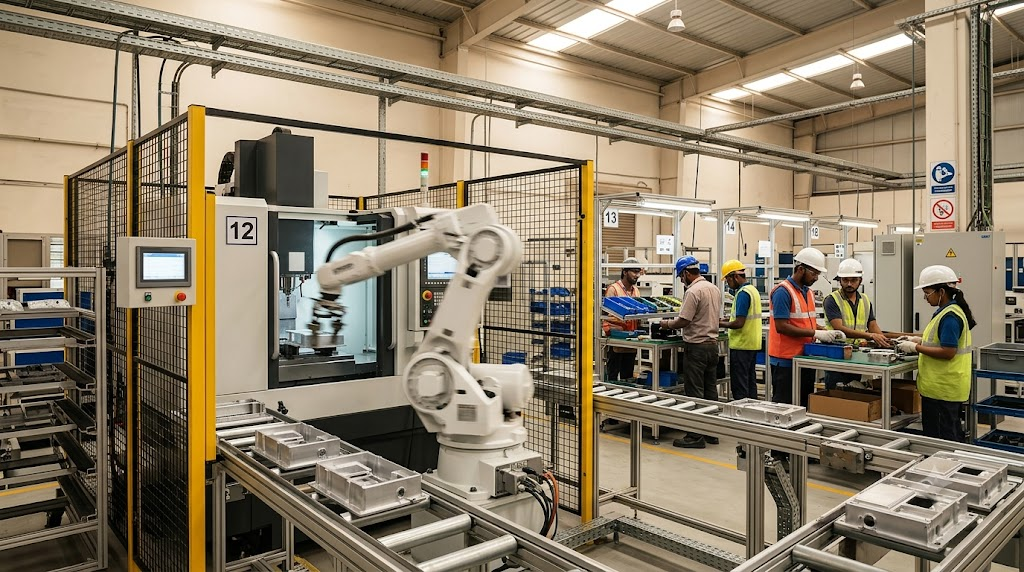
A factory does not always need dozens of robots to become more automated. Sometimes one robotic arm loading a machine, handling heavy parts or performing repetitive welding can solve the biggest production problem. In 2026, many manufacturers are approaching automation as a gradual process: identify one task, measure its results and then decide whether more automation makes sense.
Automation Usually Starts With a Bottleneck
Factories first look for tasks that repeatedly slow production or create quality and safety problems. A robot may be useful for machine loading, palletising, welding, inspection or repetitive assembly.
This is especially relevant in existing factories, where replacing an entire production line could require new machines, conveyors, control systems and changes to the factory layout. A September 2026 analysis of Indian manufacturing automation noted that existing plants already have equipment and processes built around years of production experience, making targeted automation a practical approach.
Instead of changing everything, a company can automate the specific operation that limits the rest of the line.
The Investment Has to Make Financial Sense
A robot's purchase price is only part of the investment. The factory may also need grippers, cameras, safety equipment, programming, integration, training and maintenance.
The important calculation is return on investment (ROI): how much additional value the automation produces compared with what the company spends on it.
Production volume matters here. A robot performing the same task thousands of times every day may justify its cost more easily than a robot handling a small batch of products that changes every few hours.
A 2026 guide for Indian MSMEs recommends measuring actual production performance before choosing an automation project, because automating a process with low utilisation or poor standardisation can reduce the expected return.
Existing Equipment Makes Full Automation Complicated
Most factories are not starting with an empty building. They already have CNC machines, presses, conveyors, inspection stations and workers.
Connecting a new robot to this equipment can require custom programming, communication interfaces, safety systems and physical changes. This process is called integration.
A single robotic cell can therefore be easier to introduce than an entirely automated production line. The robot can be installed around an existing machine while the rest of the factory continues operating.
This approach also reduces disruption. Instead of stopping an entire production line for a major redesign, manufacturers can test automation at one workstation first.
Gradual Automation Reduces Risk
A first automation project can also act as a learning exercise. Operators learn how to program and maintain the equipment, while managers can measure actual cycle time, downtime, quality and maintenance costs.
If the first application performs as expected, the company can expand automation to another process. If it does not, the problem can be identified without having redesigned the entire factory.
This gradual approach is particularly relevant to smaller manufacturers. A 2026 report on small-factory automation noted that limited budgets make process selection important because expensive integration work or production interruptions can quickly affect the expected return.
Full Automation Is Not Always the Goal
A factory can be highly productive without automating every operation. Some tasks are easy for robots because they are repetitive, predictable and high-volume. Others require flexibility, judgement or frequent changes, making automation more difficult to justify.
India's official capital-expenditure survey also shows that robotics investment remains selective: 5.83% of manufacturing enterprises reported robotics-related capital-expenditure proposals for FY 2025–26, with 4.50% reporting planned proposals for FY 2026–27.
The practical path is therefore not necessarily manual versus fully automated. It can be a combination of people and machines, with automation introduced where it solves a measurable production problem and expanded only when the results support the next step.