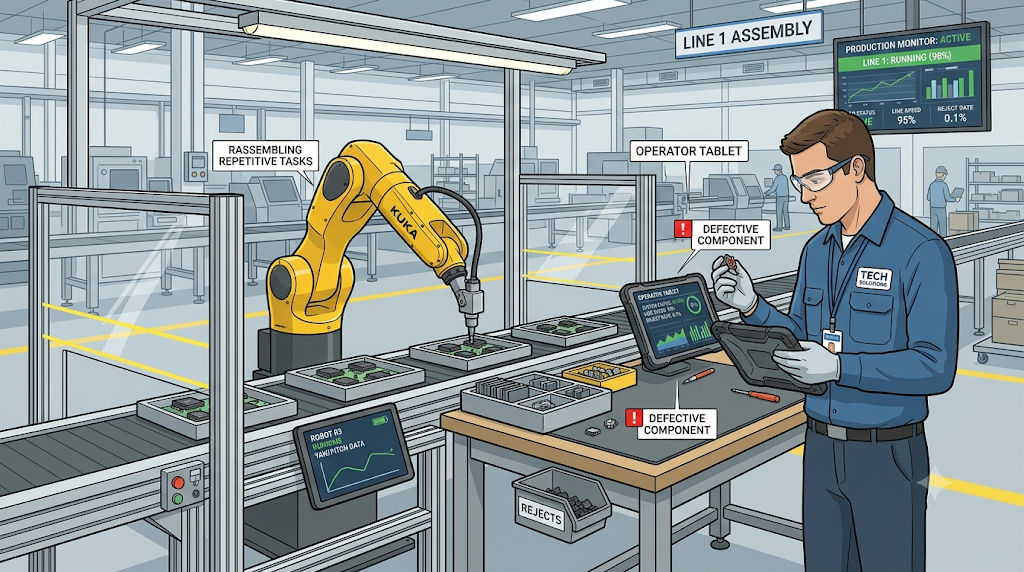
A factory robot can repeat the same movement thousands of times without getting tired. But what happens when the part it expects is missing, a sensor stops working, or a product looks slightly different from anything in its training data? That is where the human worker still matters.
Modern factories are becoming increasingly automated. Industrial robots handle welding, assembly, material movement, packaging and other repetitive operations. Yet automation does not mean removing people from the process. Instead, factories are increasingly combining robotic precision and speed with human judgment.
Robots Are Excellent at Repetition
Industrial robots work best when the environment and task are predictable. A robot can follow programmed movements, position components accurately and maintain a consistent production cycle.
Newer systems add cameras, force sensors, artificial intelligence and other sensing technologies. A vision system, for example, can capture images of a component, analyse its shape and position, and provide information that allows the robot to adjust its movement.
However, these systems still depend heavily on defined operating conditions. NIST's 2026 roadmap for AI in smart manufacturing highlights continuing challenges involving industrial data, integration between different sensing and control systems, and the need for reliable and trustworthy AI in high-stakes environments.
Humans Handle the Exceptions
Factories rarely remain perfectly predictable.
A component can arrive incorrectly, a conveyor can jam, a tool can wear out, or a new product variant can require a different process. A robot may detect that something is wrong, but deciding what to do next can require context and experience.
This is why human operators, engineers and supervisors remain important. They can investigate an unusual situation, change a process, decide whether production should continue and coordinate several machines or teams.
A June 2026 World Economic Forum framework describes this changing role directly: as intelligent systems take on more speed-, scale- and pattern-based tasks, human contribution increasingly moves toward judgment, accountability, exception handling and governance.
Maintenance and Quality Still Need People
Maintenance is another major boundary of automation. Robots themselves contain motors, joints, sensors, controllers, tools and electrical systems that can fail or require adjustment.
Safety guidance from the U.S. Occupational Safety and Health Administration notes that robot-related accidents can occur during non-routine activities such as programming, maintenance, testing, setup and adjustment. This makes trained human technicians essential even in highly automated facilities.
Quality control is also becoming a shared responsibility. A 2026 research study on human-centric assembly demonstrated a system combining cameras, wearables, force control, AI-based object detection and a digital twin to monitor both workers and robots during elevator-panel assembly.
The goal is not simply to let a robot inspect everything. Human knowledge remains valuable when deciding whether an unusual defect is acceptable, whether a process should be changed, or whether a recurring problem indicates a deeper manufacturing issue.
The Factory of the Future Is Human + Robot
The latest direction in manufacturing is therefore not necessarily “lights-out” production everywhere. It is increasingly about assigning the right task to the right system.
Robots provide repeatability, strength, speed and precision. Humans provide flexibility, experience, responsibility and decision-making when conditions change.
The International Federation of Robotics reported in August 2026 that robotics can automate specific tasks while also creating new tasks and occupations. The World Economic Forum's 2026 research similarly identifies emerging roles such as quality automation technicians and robotics engineers or orchestrators.
The practical challenge is no longer simply building a robot that can perform a task. It is designing a factory where humans can safely supervise, maintain, correct and improve increasingly intelligent machines.
In that environment, the most useful question may not be “Can a robot replace this worker?” but “Which parts of this job should the robot handle, and where does human judgment add the most value?”
Short Summary
Modern industrial robots can perform repetitive, precise and physically demanding tasks, but factories still depend on people for judgment, maintenance, quality decisions and unexpected problems. Recent 2026 research and industry reports show that the next stage of manufacturing is increasingly focused on combining robotic speed with human adaptability.