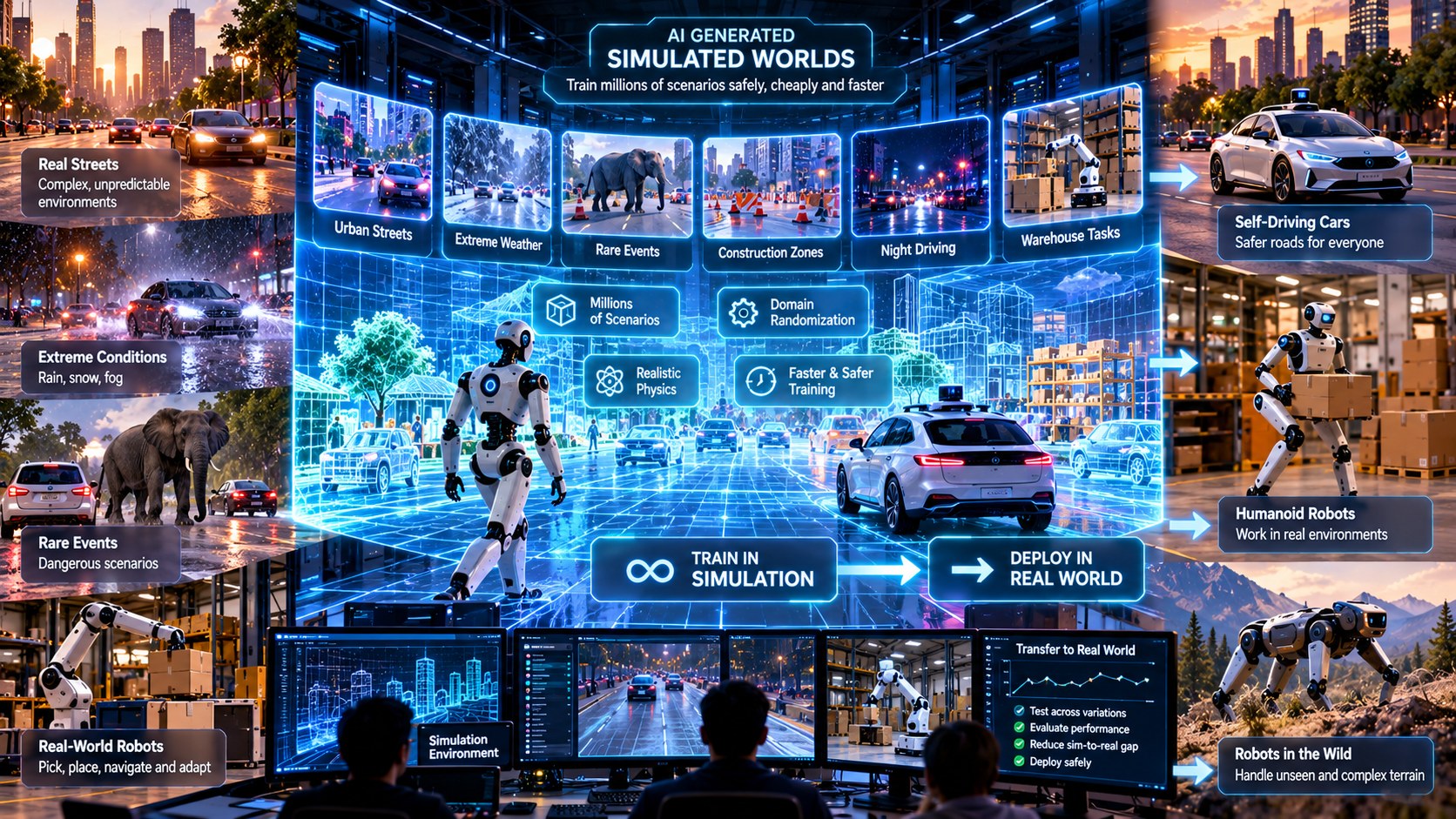
A robot that only learns by trying things in real life learns slowly. It breaks things. Sometimes it hurts someone. So companies building robots and self-driving cars now do most of the learning somewhere else first: inside a computer. They build fake, AI-made worlds where a robot can fail a million times for free, long before it touches anything real. This used to be a backup tool. Now, for the biggest companies, it's the main way these machines learn at all.
The scale is already huge
Waymo is the best example. The company has driven over 127 million real self-driving miles. It likes to bring up that number. But here's the thing: it now runs an estimated 10 to 20 million fake miles every single day. Over time, that's added up to tens of billions of simulated miles, based on its own job listings and public statements. In other words, most of what Waymo's cars have "experienced" never actually happened on a real road.
In 2026, Waymo launched something called a World Model. It's built using Google DeepMind's Genie technology, and it can invent situations that are too rare or too dangerous to test in real life. Waymo has even mentioned tornadoes and elephants wandering onto highways as examples.
Robotics is heading the same way. Nvidia makes a tool called Cosmos. It creates realistic fake scenes using AI, and developers have downloaded it more than 3 million times, according to Nvidia. Companies building humanoid robots, like Figure, Agility, Agile Robots, and AgiBot, use Cosmos alongside another Nvidia tool called Isaac Sim. Together, they generate training data and test how a robot behaves, all before any real hardware gets touched. Nvidia also says robots trained with its newer tools succeed at new tasks more than twice as often as older methods. Worth noting: that number comes from Nvidia's own tests. No outside group has confirmed it yet.
Why simulation stopped being optional
The reason is simple. Real-world training is slow. It's expensive. And sometimes it's just not safe. You can't let a new robot practice carrying a hot pan. You can't let a self-driving car practice almost hitting a pedestrian. Simulation gets rid of that problem completely.
Engineers also use a trick called domain randomization. It just means changing small things over and over, like lighting, textures, or how heavy an object is. Doing this thousands of times helps a robot's skills carry over better once it meets the real world, which is always messier than a simulation. Waymo even says one day in simulation gives it roughly the same variety as 100 years of real driving.
This is also why simulators have become products of their own. Waabi, a self-driving startup, says its simulator scored 99.7% on a realism test. But that number comes from Waabi's own test, using its own method. It's a claim the company trusts enough to publish, not something an outside group has checked.
The gap nobody has fully closed
There's a real problem hiding under all of this. It's called the sim-to-real gap. A robot can perform perfectly in a simulation and still act unpredictably once it meets real noise, real light, and real friction.
For years, there's been no standard way to measure how realistic a simulator actually is. In the US, no federal regulator has made companies prove their simulations are close enough to reality before letting a robot or car loose in public. That's starting to change, though. The US National Highway Traffic Safety Administration says it wants new safety rules, with real performance tests, by 2028.
Other countries are already ahead. China's GB/T 47025 standard, which sets rules for simulation testing in self-driving cars, took effect in January 2026. A group at the United Nations has also written a draft global rule. It would make companies show a clear path from their simulation results to their safety claims. Even that rule doesn't set an exact accuracy number, though, because measuring simulation quality is genuinely hard to pin down.
Waymo's own safety numbers, like a 90% drop in serious crashes compared to human drivers, come from its own peer-reviewed research. But if most of a car's "experience" comes from AI-made scenarios instead of real sensors on real roads, it's fair to ask how close those scenarios really are to reality. That's a question regulators are only just starting to take seriously.
What's coming soon, and what's still open
In the near future, expect simulation to keep growing as the starting point for training almost any physical AI system. Warehouse arms, humanoid robots, delivery robots, self-driving cars, all of it, simply because simulation is much cheaper than trial and error in the real world. Expect more companies to build their own "world models" too, the way Waymo and Nvidia have, systems that can invent realistic scenes instead of just replaying old recordings.
What's harder to fix is this: nobody has agreed on how to independently check that a fake world is realistic enough to trust. Right now, the companies building these simulators are mostly the ones grading their own work. Whether that changes through outside rules, independent testing, or just enough real-world accidents to force the issue, that's one of the bigger open questions for the next few years.