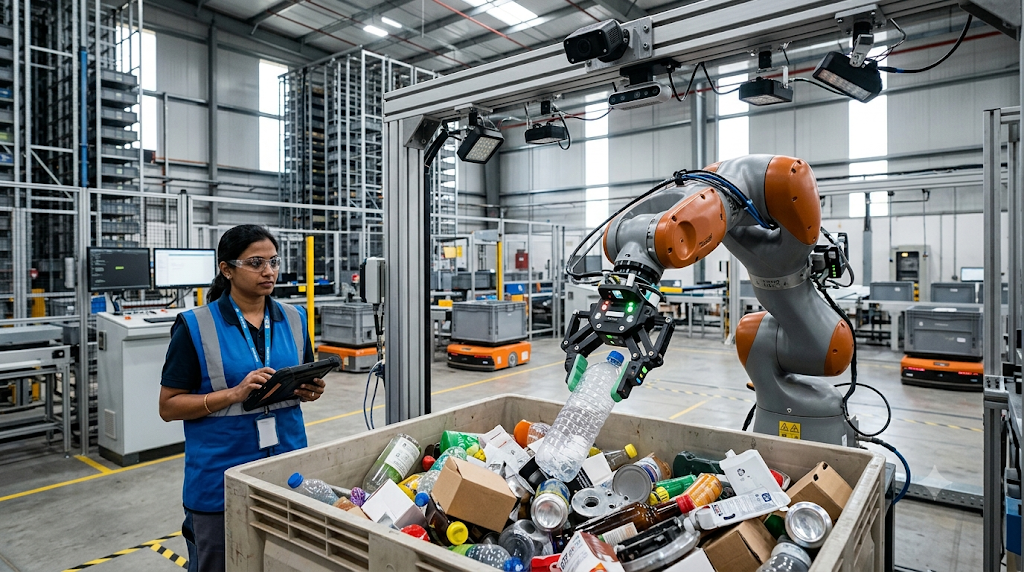
Why Picking Up an Object Is Still Difficult for Robots
A person can easily reach into a box, identify a bottle and pick it up. If the bottle slips, we automatically change our grip. For a robot, this simple action involves several difficult steps.
The robot must understand what the object is, where it is, how it is positioned, where to grip it and how much force to use. If something goes wrong, the robot may drop, damage or push the object away.
This is why robotic picking is still an important challenge in warehouses, factories and other real-world environments.
Seeing an Object Is Not Enough
Robots commonly use cameras to identify objects and estimate their position. However, a normal camera mainly provides a 2D view.
Robots often need depth information to understand the object's distance, shape and position in three-dimensional space. Depth cameras, stereo cameras and other 3D sensors can help.
Even with these sensors, problems remain. Shiny objects can create reflections, dark objects can be difficult to detect and objects that are close together can appear as one. Partially hidden objects are also difficult to recognize.
Modern AI models are improving robotic perception. In 2026, Vision-Language-Action (VLA) systems are being developed to connect what robots see with instructions and physical actions.
The Gripper Must Use the Right Force
After finding an object, the robot still has to pick it up correctly.
Different objects require different gripping methods. A hard box can handle a firm grip, while a plastic bag or soft object can change shape. Glass objects need enough force to prevent slipping without breaking them.
This is where force and tactile sensors become useful.
Force sensors help robots understand how much pressure they are applying. Tactile sensors provide information about physical contact. This can help a robot detect situations such as slipping and adjust its grip.
In 2026, researchers are increasingly combining vision and touch to improve robotic manipulation.
Warehouses Make Picking More Difficult
Warehouses are one of the biggest challenges for robotic picking because products can have very different shapes, sizes and materials.
A robot may need to pick a cardboard box, bottle, clothing item or irregularly shaped product from the same area.
The robot must find a safe grasp point while avoiding nearby objects. If products are randomly placed inside a container, the robot may also need to move one object before reaching another.
Factories can be easier because robots often work with the same components in predictable positions. Warehouses are much less predictable.
AI Is Making Robots More Flexible
Traditional robots usually follow programmed movements. Modern AI-based robots are moving toward systems that can understand instructions and choose actions.
Vision-Language-Action models combine visual information, language and robot actions. This allows robots to move toward more flexible tasks instead of performing only one fixed movement.
Google DeepMind's Gemini Robotics systems are an example of this direction. They are designed to help robots understand their surroundings, follow instructions and perform physical tasks.
NVIDIA is also developing technologies around Physical AI, where AI systems are trained and tested for real-world robots using simulation and digital environments.
Robots Are Learning to Use Touch
Vision tells a robot what is in front of it, but touch becomes important when the robot actually contacts an object.
For example, a camera can help a robot locate a bottle. After the gripper touches the bottle, tactile feedback can help determine whether the grip is stable.
If the bottle starts slipping, the robot can potentially increase or change its grip.
Research in 2026 is exploring tactile foundation models and systems that combine visual information with touch for more reliable manipulation.
Simulation Helps Robots Learn
Teaching robots directly in the real world can be expensive. Robots may need many attempts to learn a task, and mistakes can damage objects or equipment.
Simulation allows developers to test different objects, movements and grippers in a virtual environment before using a physical robot.
Physical AI platforms are increasingly using simulation and digital twins to help train and test robots.
However, the real world is still more complicated than simulation. Objects can have unexpected friction, weight and flexibility. Therefore, robots still need to learn how to handle real-world uncertainty.
Reliability Is the Biggest Challenge
The goal is not simply to make a robot pick up an object once.
The robot must be able to pick up many different objects repeatedly, quickly and safely.
A small failure can become a major problem in a warehouse or factory. A dropped product may require human intervention, while a damaged component can increase costs.
This is why modern robotics focuses on perception, AI reasoning, force control, tactile sensing and reliable movement together.
What Is Changing in 2026?
Robotic picking is increasingly combining several technologies:
- Computer vision – identifies objects and their locations.
- 3D sensing – provides depth and shape information.
- VLA models – connect vision, instructions and physical actions.
- Force sensing – helps control gripping pressure.
- Tactile sensing – helps robots understand physical contact.
- Physical AI and simulation – help robots learn and test tasks before real-world deployment.
Conclusion
Picking up an object looks simple to humans because we automatically combine vision, touch, experience and movement.
For robots, these abilities must be created through hardware, sensors and AI.
In 2026, robotics is moving toward systems that can see, understand, touch, act and correct mistakes. The long-term goal is to build robots that can safely pick up unfamiliar objects and adapt when conditions change.
That is why something as simple as picking up an object remains one of the most interesting challenges in robotics.