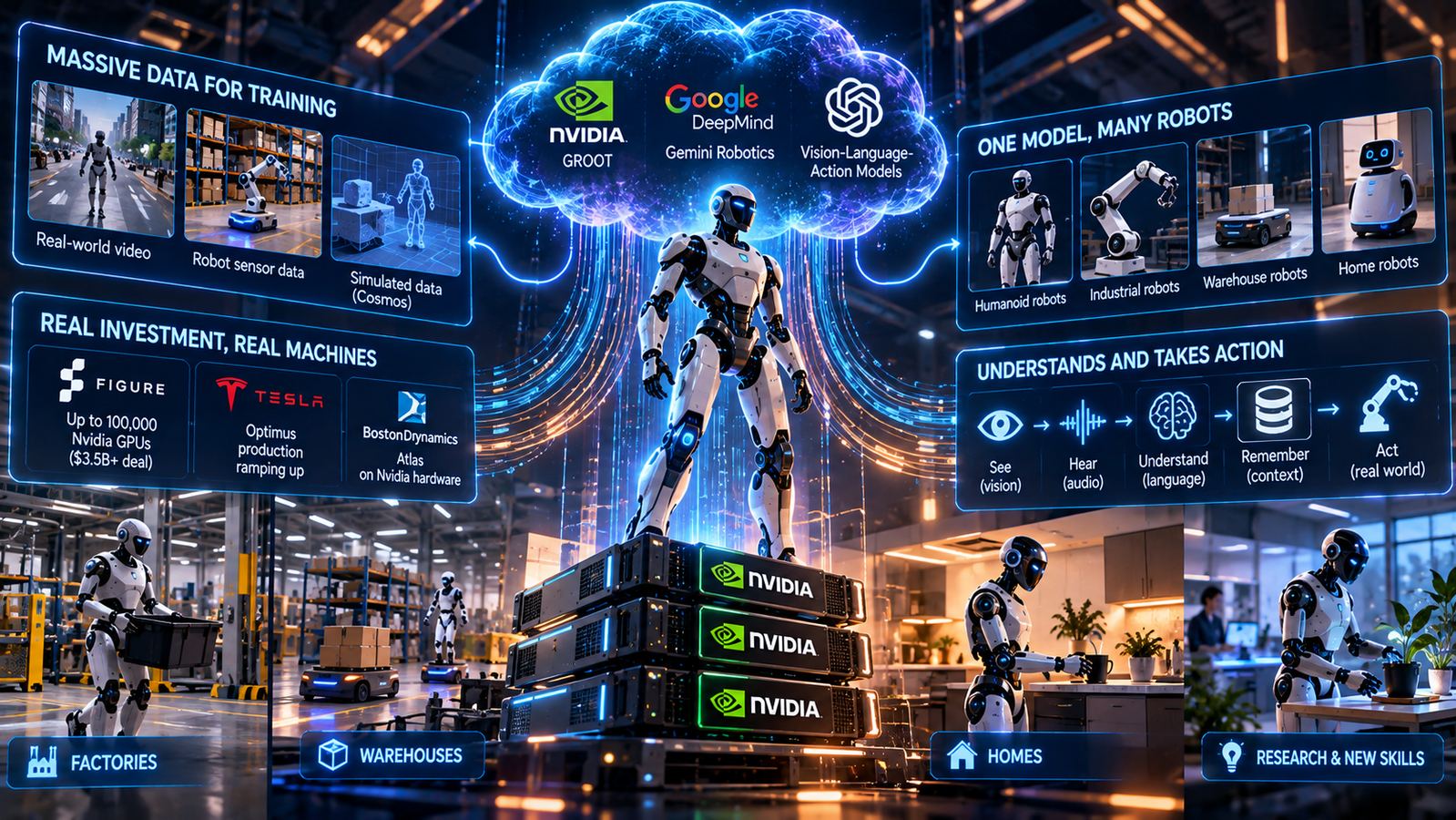
For the past few years, most AI has lived on a screen. You type something, a model answers, and that's it. That is starting to change. Nvidia, Google DeepMind, and a group of well-funded robot startups now think robots, not chatbots, will be the next big market for AI. Nvidia's CEO, Jensen Huang, calls this "physical AI." He says every industrial company will eventually turn into a robotics company. That's a big claim. But the amount of money flowing into this space shows a lot of investors believe at least part of it.
The model behind the machine
For a long time, robots were programmed by hand. An engineer wrote exact instructions for one exact task. That works fine on a factory line, where the same thing happens over and over. It falls apart the moment a robot has to work somewhere messy, like a kitchen, a warehouse, or your living room.
So companies borrowed an idea from the chatbot world: the foundation model. Instead of writing rules for every single task, engineers train one big model on huge amounts of video, sensor readings, and simulated movement. This kind of model is called a Vision-Language-Action model, or VLA for short. It watches what a camera sees, understands a plain instruction like "pick up the cup," and turns that into actual motor commands. In theory, the same model can be adjusted to run on different robot bodies, not just one.
Nvidia has built its own version of this, called GR00T, along with a tool called Cosmos that creates fake training data by simulating scenes. Google DeepMind has a similar model called Gemini Robotics, built on top of its regular Gemini AI. A startup called Physical Intelligence says one of its models figured out how to use an appliance it had barely seen before, just by mixing general knowledge from the web with a little hands-on practice. That's Physical Intelligence's own claim. No outside researchers have confirmed it yet, so treat it as an interesting demo, not a proven result.
Real money, real machines, but still early
This isn't just talk. In September 2026, humanoid robot maker Figure signed a deal with a company called Nscale for up to 100,000 Nvidia GPUs. The deal starts with $3.5 billion in computing power, and both companies say it could grow past $6 billion. Figure says it needs all that power because training its robot model, called Helix, now takes more data and computing than the company can handle on its own. That's basically the same problem chatbot companies ran into a few years back, just applied to robots instead of text.
Figure isn't the only one moving fast. Tesla has been ramping up production of its Optimus robot at its Fremont factory. Boston Dynamics, now owned by Hyundai, runs an electric version of its Atlas robot on Nvidia's hardware. Chinese companies like AgiBot are racing to build and ship their own humanoid robots. Investment tracker OpenCurious values Figure at around $39 billion right now. Skild AI sits at around $14 billion, and Physical Intelligence was valued at $5.6 billion as of late 2026, with reported talks underway to raise more money at close to double that. Keep in mind, those are just numbers investors are willing to bet on. They aren't proof any of these companies are actually making money yet.
There's also a fair question about how real some of this demand is. Some Wall Street analysts have pointed out that Nscale isn't just selling Figure computing power, it's also taking a stake in Figure as part of the same deal. That's the same playbook Nvidia has used with some of its own AI customers, and critics say arrangements like this can make demand for compute look bigger than it really is, since the seller has a financial stake in its buyer's success. It doesn't mean the deal is fake, but it's a reason to read the headline numbers with a little caution.
It's worth being clear about what's real and what's still a demo. Robots doing the same scripted motion on a factory line, that's real and working right now. Robots that walk into a room they've never seen and figure out a task on the spot, that's mostly still a lab demo or a carefully staged pilot. Battery life, reliability, and cost are still real problems. Most experts think general-purpose home robots are still years away, even though warehouse robots are getting closer to everyday use.
Why AI companies want in
For chip makers and AI labs, robots solve a real problem: where do you sell all this computing power next? Nvidia wants to be the infrastructure behind the whole robotics industry, the same role it already plays for chatbots and image generators. That means selling the GPUs to train robot models, the simulation software to test them safely, and the chips that go inside the robots themselves.
There's also a data reason. Every task a robot does in the real world, picking something up, sorting an item, walking across an uneven floor, creates a kind of training data you can't just scrape off the internet. Whoever gets robots out into the world first starts collecting that data first. And in AI, a head start on data tends to snowball.
What could go differently than planned
None of this is guaranteed to go the way these companies expect. Humanoid robots are expensive to build, and they're much harder to make reliable than a chatbot that just needs to stay online. If a chatbot gives a bad answer, that's annoying. If a robot misjudges a step or drops something heavy, that's a safety problem. That raises the bar for how sure these models need to be before people trust a robot standing next to them. Cost is another big question mark. Building a robot cheap enough for a regular household is a completely different challenge than building an industrial arm for a warehouse that already spends millions on equipment.
If things keep going the way they're going, the next few years probably won't look like robots showing up in homes. It will look more like warehouses and factories quietly handing off repetitive physical work to robots, while companies keep improving the AI underneath. Whether that eventually turns into a robot doing your dishes and laundry, or stays mostly stuck in factories for a long while yet, is the question the whole industry is racing to answer.