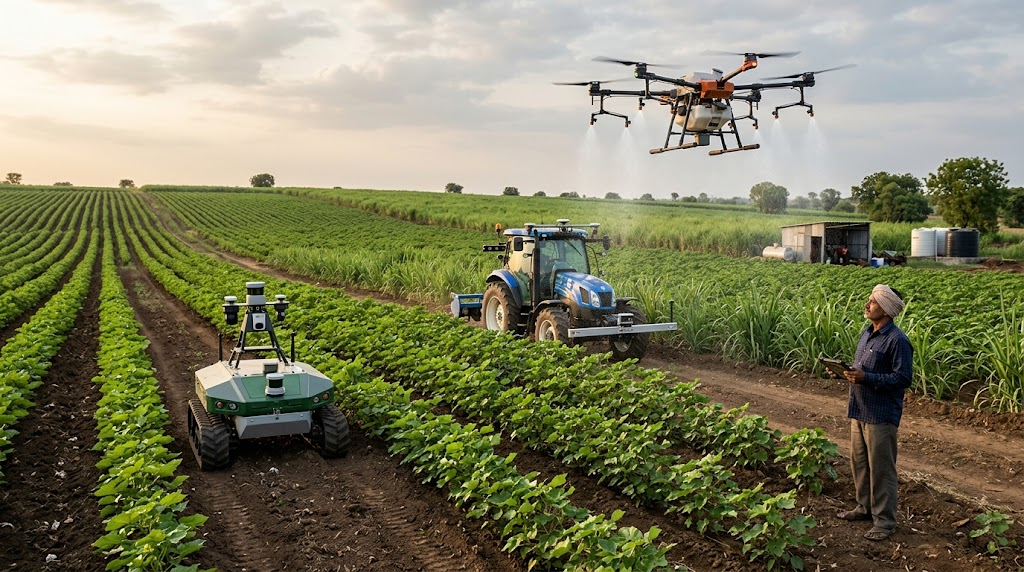
Robots in Indian agriculture range from small ground rovers to tractor-mounted systems and aerial drones. In 2026, these technologies are being developed, tested and demonstrated for specific tasks such as spraying, weeding, harvesting and crop monitoring rather than replacing farmers.
Spraying With Drones and Ground Robots
Agricultural drones are among the most visible forms of automation in Indian farming. They can follow planned flight paths while applying nutrients, fertilizers and crop-protection products, reducing the need for workers to carry spraying equipment.
A July 2026 government update reported that ICAR, State Agricultural Universities and Krishi Vigyan Kendras conducted 40,928 Kisan Drone demonstrations covering 40,918 hectares between 2023–24 and 2025–26. The demonstrations focused on applying nutrients, fertilizers and agrochemicals according to prescribed procedures.
Ground-based systems are also being developed for spraying. AgMove Robotics’ Farm Guardian Rover is a remote-controlled and autonomous rover designed for vineyards and horticultural farms. A 2026 report said the rover had been deployed for spraying, intercultural operations and crop management, using real-time kinematic positioning to navigate narrow crop rows. Its commercial track record is still developing.
AI-Powered Robots Are Fighting Weeds
Weeding is another area where agricultural robotics is being developed in India.
Hyderabad-based Harvested Robotics is testing RAKSHAK, a tractor-mounted laser-weeding system. Cameras and computer vision identify weeds while robotic actuators direct lasers toward them. The system is designed to work with existing tractors instead of requiring farmers to replace their machinery.
The company currently describes RAKSHAK as being under testing, so it represents a developing technology rather than a widely deployed commercial machine.
Harvesting Requires More Precision
Harvesting is technically harder because a robot must identify ripe produce and physically remove it without damaging the crop.
A 2026 research study evaluated an autonomous robotic system for tomato harvesting in protected greenhouse cultivation. The system used computer vision to identify tomato maturity, navigate crop rows and operate a robotic cutting mechanism.
In the reported evaluations, the researchers measured 83.3% harvesting accuracy, a 4% fruit-damage rate and about 19 seconds of processing time per fruit. These results come from the study’s experimental setup and should not be treated as evidence of widespread robotic harvesting on Indian farms.
Monitoring Crops With AI and Sensors
Agricultural automation is also expanding through precision-agriculture systems that combine sensors, drones, AI and other technologies to collect information about crops and soil.
In August 2026, the Government of India said it was using satellites, drones, AI, remote sensing, GIS and IoT for technology-driven crop monitoring. ICAR’s National Program on Precision Agriculture is also developing technologies using ground, drone and satellite sensing, along with AI and ICT, for monitoring crop and soil health.
These systems can help agricultural teams identify changing field conditions and manage inputs more precisely, although not all of them are autonomous robots.
Fully Autonomous Farming Is Still Difficult
India is not yet at a stage where robots independently perform every farm operation from sowing to harvesting. Fields differ in soil, terrain, crop spacing, weather and infrastructure. Small and fragmented farms can also make expensive autonomous machinery difficult to justify.
The 2026 developments show a more gradual path: drones for spraying, robotic systems for weeding, specialized robots for harvesting, and AI-assisted crop monitoring. The establishment of a dedicated Robotics and Artificial Intelligence Laboratory at ICAR-IARI in February 2026 also reflects the growing research focus on agricultural automation.
For now, the practical direction is not farms without people, but farms where machines handle selected repetitive, difficult or hazardous tasks while farmers remain responsible for decisions, supervision and exceptions.