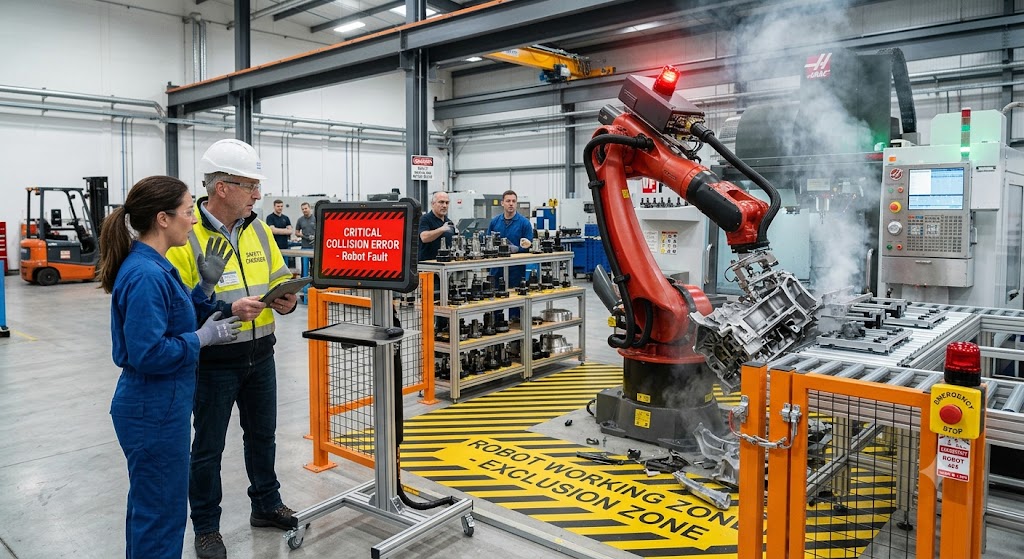
A robot arm suddenly moves in the wrong direction, drops a component or stops responding to a safety command. The first question may be, “Why did the robot make a mistake?” But in an industrial environment, the more useful question is: “Which part of the system failed, and who was responsible for that part?”
Modern industrial robots are not independent machines. They are connected to software, sensors, controllers, safety devices, tools, conveyors and human operators. That makes responsibility a system-level issue.
A Robot Does Not Work Alone
The latest ISO 10218 standards reflect this distinction. ISO 10218-1:2025 addresses safety requirements for industrial robots themselves, while ISO 10218-2:2025 addresses the integration of robots into complete applications and robot cells.
This matters because a robot can be safe by itself but become hazardous when integrated incorrectly. The application may involve an unsafe tool, poor layout, incorrect programming, inadequate guarding or unexpected interaction with another machine.
Responsibility therefore depends partly on where the failure originated. A manufacturer, integrator, programmer, employer and operator can have different responsibilities during different stages of the robot's lifecycle.
Human Supervision Is Not Just Watching
Human supervision does not mean an employee must stare at a robot continuously. Instead, people design operating procedures, monitor system conditions, respond to alarms, perform maintenance and intervene when the system encounters a situation outside its expected conditions.
OSHA notes that many robot accidents occur during non-routine activities such as programming, maintenance, testing, setup and adjustment. Its technical guidance also identifies human errors, control errors, software faults, improper installation and robot malfunctions as potential sources of hazards.
This is important because simply blaming an operator after an incident can miss the underlying problem. If a worker was given inadequate training, an unsafe procedure or poorly designed safeguards, the investigation needs to examine those factors as well.
Software Can Become Part of the Safety Problem
Modern robots increasingly use cameras, machine learning, advanced sensing and software-based control. These technologies can make systems more adaptable, but they also create additional points that must be tested.
NIST's 2026 roadmap for AI and machine learning in smart manufacturing identifies reliable operation, trustworthy AI and integration with different sensing and control systems as continuing challenges in high-stakes industrial environments.
Research published in 2026 also demonstrates why verification matters. A study of an industrial robotic system developed simulation-based verification and camera-fault testing tools to evaluate how a robotic inspection system behaves when faults are introduced. Such testing is aimed at finding weaknesses before they become production incidents.
Responsibility Starts Before the Robot Moves
The safest approach is to treat responsibility as part of the entire robot lifecycle: design, integration, commissioning, programming, operation, maintenance and decommissioning.
Safety systems can include guards, interlocks, emergency stops, protective sensors, controlled operating modes and procedures for maintenance. But these measures must match the actual risks of the application.
So when a robot makes a mistake, there is rarely enough information in the sentence “the robot failed.” Investigators need to determine what happened, whether the robot behaved according to its design, whether the application was integrated correctly, whether safety systems worked, and whether people followed appropriate procedures.
The robot may have made the movement, but responsibility is usually found by examining the entire system around that movement.