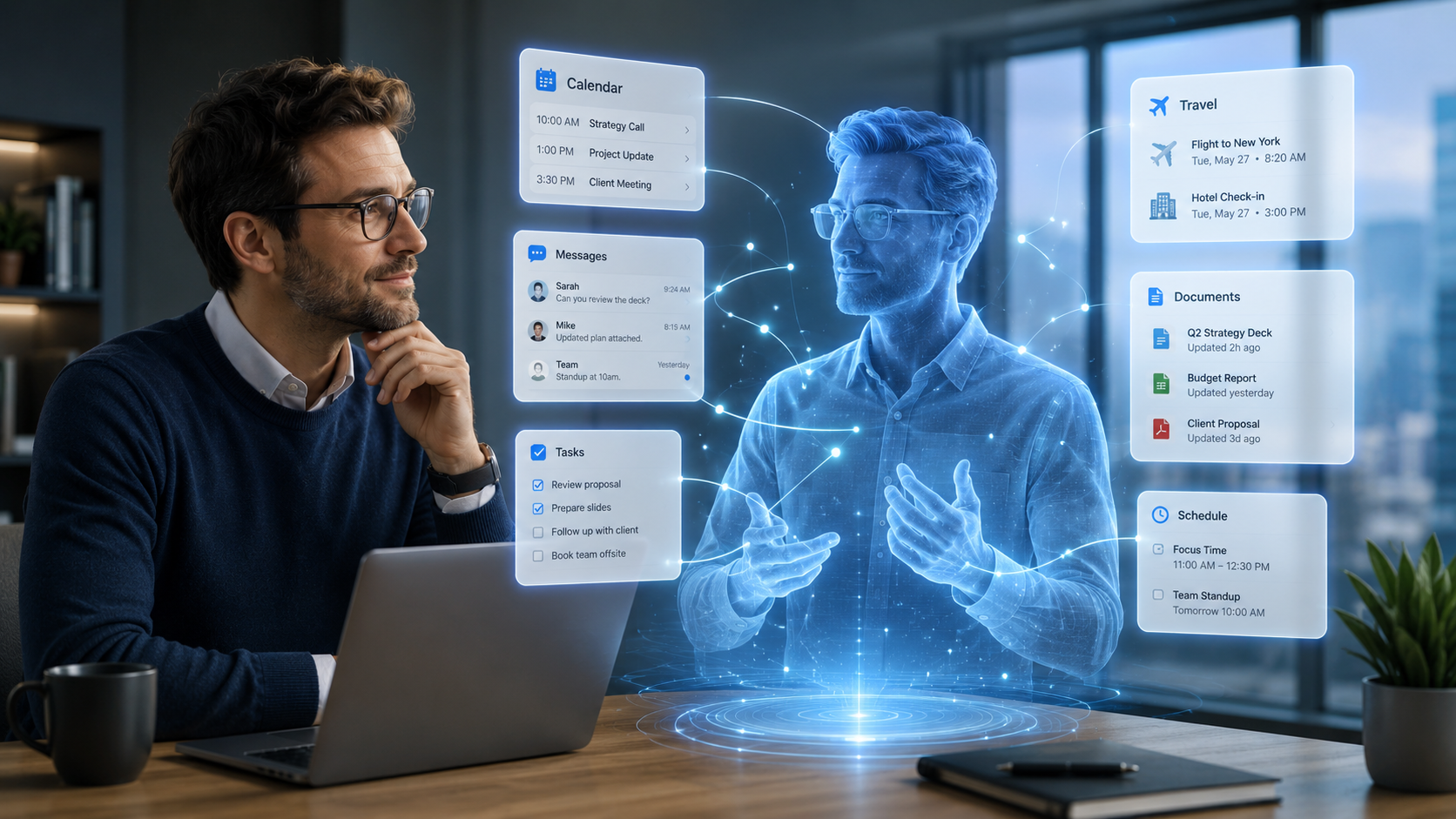
Imagine an AI that knows you dislike early meetings, remembers which airlines you avoid, understands how you normally reply to colleagues and notices that the electricity bill sitting in your inbox is due tomorrow.
Now give it permission to do something about all that.
That is roughly where the idea of the personal AI twin is heading.
Not a digital clone that develops consciousness, steals your identity and starts attending family functions on your behalf. Something more practical: an AI system that gradually learns enough about your preferences, routines and decisions to become a useful representative of you.
Several pieces needed to build one already exist.
It isn't really a twin
The phrase “digital twin” originally became popular in engineering.
A jet engine, factory or turbine can have a digital representation fed with real-world data. Engineers use it to understand how the physical system is behaving and sometimes predict what it might do next.
A personal AI twin is different.
It isn't necessarily simulating your body. It is building a working model of how you tend to behave and decide.
Modern AI assistants increasingly have some of the required ingredients: memory, access to tools, connected services and the ability to reason across several steps.
Put those together and an assistant no longer has to meet you from scratch every morning.
That sounds like a small change.
It isn't.
Memory changes everything
Ask a basic chatbot:
“Find somewhere for dinner.”
It immediately needs more information.
Where? What cuisine? What budget? Children coming? How far will you travel?
A personalised system might already know.
Perhaps you normally eat around 8 p.m. It knows you need somewhere suitable for children, dislike noisy restaurants and consider a ₹10,000 dinner sufficiently expensive that the restaurant had better include temporary ownership of the cutlery.
The AI hasn't necessarily become more intelligent.
It simply has better context.
OpenAI's current memory system, for example, can retain useful preferences and context from previous interactions. Researchers at MIT have separately explored “digital twins” that attempt to reproduce aspects of human decision-making.
We are moving from assistants that know things towards assistants that know something about you.
Then give the AI hands
Memory becomes far more powerful when combined with AI agents.
An assistant that knows your preferences but cannot perform actions is essentially a very observant colleague without a computer password.
Give it controlled access to tools and it can potentially:
- notice calendar conflicts;
- compare travel choices using your preferences;
- prepare routine reports;
- organise recurring tasks;
- draft responses in your usual style;
- remind you about things based on importance rather than a fixed timer.
Eventually, instead of issuing instructions such as:
“Find three flights, compare arrival times, check my calendar and then find a hotel nearby,”
you might simply say:
“Sort out my trip next week.”
The AI handles the decomposition.
That is a very different relationship with a computer.
Unfortunately, your twin needs to know a lot
Here comes the uncomfortable bit.
The more useful a personal AI becomes, the more information it may need.
Contacts. Calendar. Work documents. Travel patterns. Purchases. Preferences. Messages.
Possibly health or financial information, depending on what you let it do.
That creates an enormous privacy and security challenge.
A genuinely trustworthy personal AI needs granular permissions, understandable memory controls and the ability to forget things deliberately.
“Can access my calendar” should not silently evolve into “apparently knows everything I have done since 2009.”
Some processing may increasingly happen locally on devices precisely because sending every private detail into the cloud is not always desirable.
Delegation changes us too
There is an even more interesting question.
If an AI continuously screens messages, chooses routine purchases, organises meetings and decides which tasks deserve your attention, how much influence does it gain over your life?
We already delegate memory to phones, navigation to maps and arithmetic to calculators.
AI extends delegation into judgement.
That makes the ultimate measure of a personal AI twin surprisingly simple.
Not how human it sounds.
Not how convincing its avatar looks.
Not whether it can imitate your favourite phrases.
The breakthrough comes when it becomes reliable enough for you to say two words:
“Handle it.”
And then, ideally, it actually does.