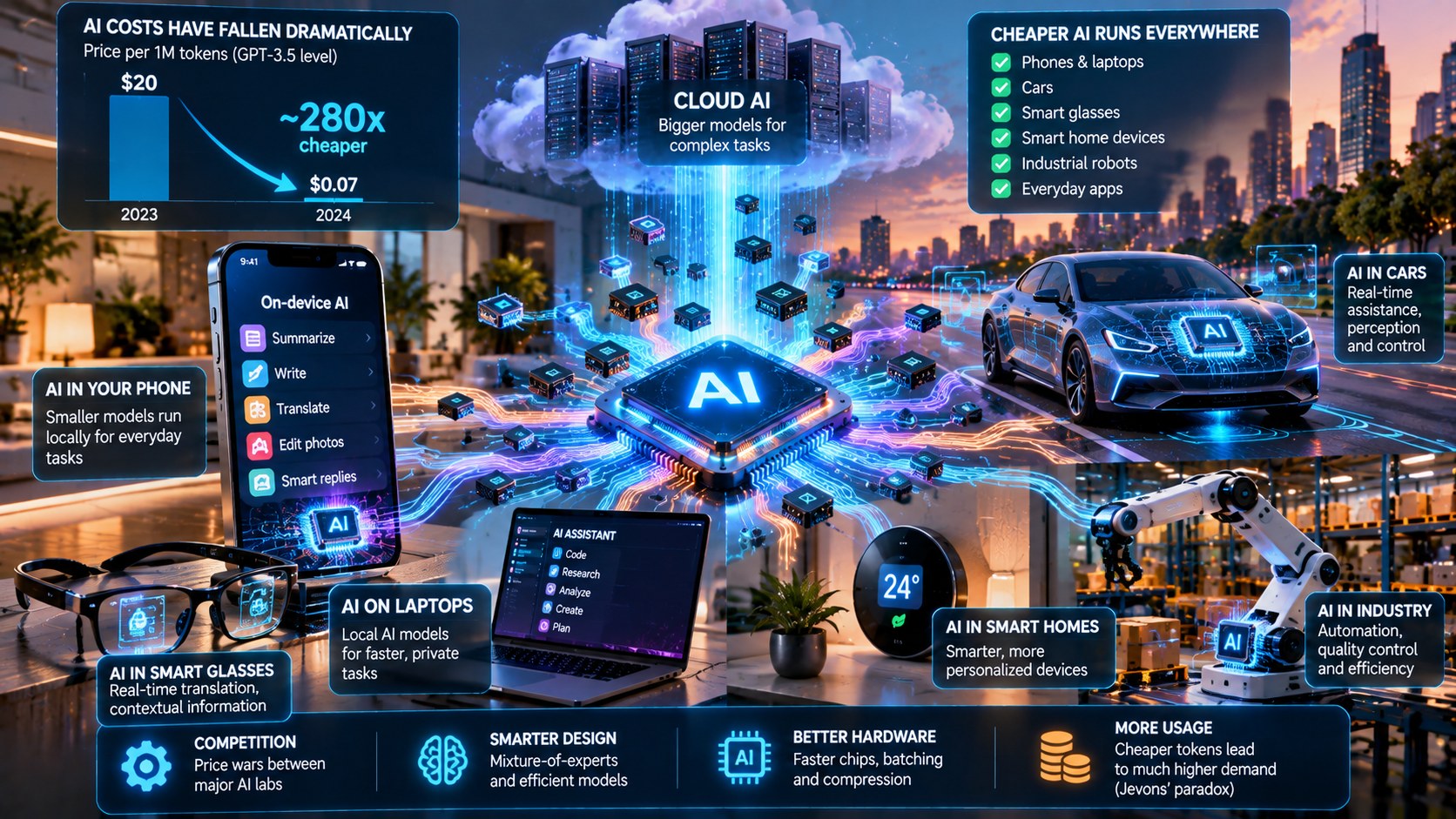
Two years ago, running AI at the level of GPT-3.5 cost about $20 for every million tokens. Companies had to budget carefully for every feature that used it. By late 2024, that same ability cost about 7 cents. That's a drop of roughly 280 times. The number comes from Stanford's 2025 AI Index. It uses data from a research group called Epoch AI. Some tasks got even cheaper than that. Epoch AI found price drops ranging from 9 times to 900 times a year, depending on the task. When something drops in price that fast, it stops feeling like a cost. It just becomes part of the background, like a database call nobody thinks about.
Where this price drop actually comes from
Three things are driving this. They feed off each other.
First, competition. DeepSeek released cheap models in 2025. That forced every major AI company, OpenAI, Google, Anthropic, to cut prices or lose customers. That price war hasn't stopped. Chinese labs like Zhipu now sell strong models like GLM-4.7 for a fraction of what big US labs charge.
Second, smarter design. Newer models often use something called mixture-of-experts. Picture a huge team of specialists. Only a few get called in for any single question. The whole team doesn't wake up every time. DeepSeek's model has 671 billion parameters in total. But it only uses 37 billion of them to answer any one question. That's about 18 times less work per answer.
Third, better infrastructure. Faster chips. Smarter batching. Compression tricks that shrink a model without making it dumber. All of this keeps pushing the cost down.
What "running everywhere" actually looks like
This isn't just about cheaper cloud bills. It shows up as real hardware too. Apple Intelligence runs a small AI model, about 3 billion parameters, right on your iPhone or Mac. It only calls Apple's servers when a task needs more power. Google's Gemini Nano does something similar on Pixel phones. Meta built small versions of Llama just for phones and laptops, so they can run without the internet. Qualcomm's newest chips come with built-in AI processors. They're made so small models run smoothly without draining your battery.
Counterpoint Research expects AI-capable phones to make up 45% of all phones sold in 2026. That's up from 36% the year before. By 2027, it should hit 52%. These small on-device models can't match something like GPT-5 or Claude Opus. They're built smaller on purpose. They're meant for simple jobs, like summarizing a text or writing a quick reply. But they're good enough for most everyday tasks. And they run with no server trip, no ongoing bill, and nothing leaving your phone.
The catch: cheaper tokens, bigger bills
Here's the part that surprises people. Falling prices haven't actually shrunk AI budgets. One 2026 report found that token prices dropped about tenfold. But total company spending on AI went up, not down.
Economists have a name for this. It's called Jevons' paradox. When something gets cheaper, people don't spend less on it overall. They just use a lot more of it. Cheap tokens are exactly what made things like AI agents and long chat conversations affordable in the first place. And those use way more tokens than one simple question ever did. So the price per token crashed. But the total number of tokens people bought grew even faster. That's not really strange. It's just what happens once something goes from rare to nearly free.
What this could lead to
In the near future, expect AI to keep showing up in places that don't even mention it. Spell-check. Customer service routing. Appliance screens. Factory sensors. The kind of background feature nobody would call "AI" out loud. It's just cheap enough now to add to almost anything. Expect small on-device models to keep closing the gap with cloud AI for everyday tasks. Harder reasoning will likely stay in the cloud for now. A phone chip still can't match the power a top AI model needs.
Looking further out, some analysts think AI could cost under a cent per million tokens by 2028. At that point, AI would be cheaper than a basic database query. That's a guess based on current trends. It's not a sure thing, and it depends on competition and better design continuing at this pace. What we do know for sure is this: cost isn't really the barrier to using AI anymore. The real question is which tasks are actually worth automating. That's a much harder question to answer than "can we afford it."