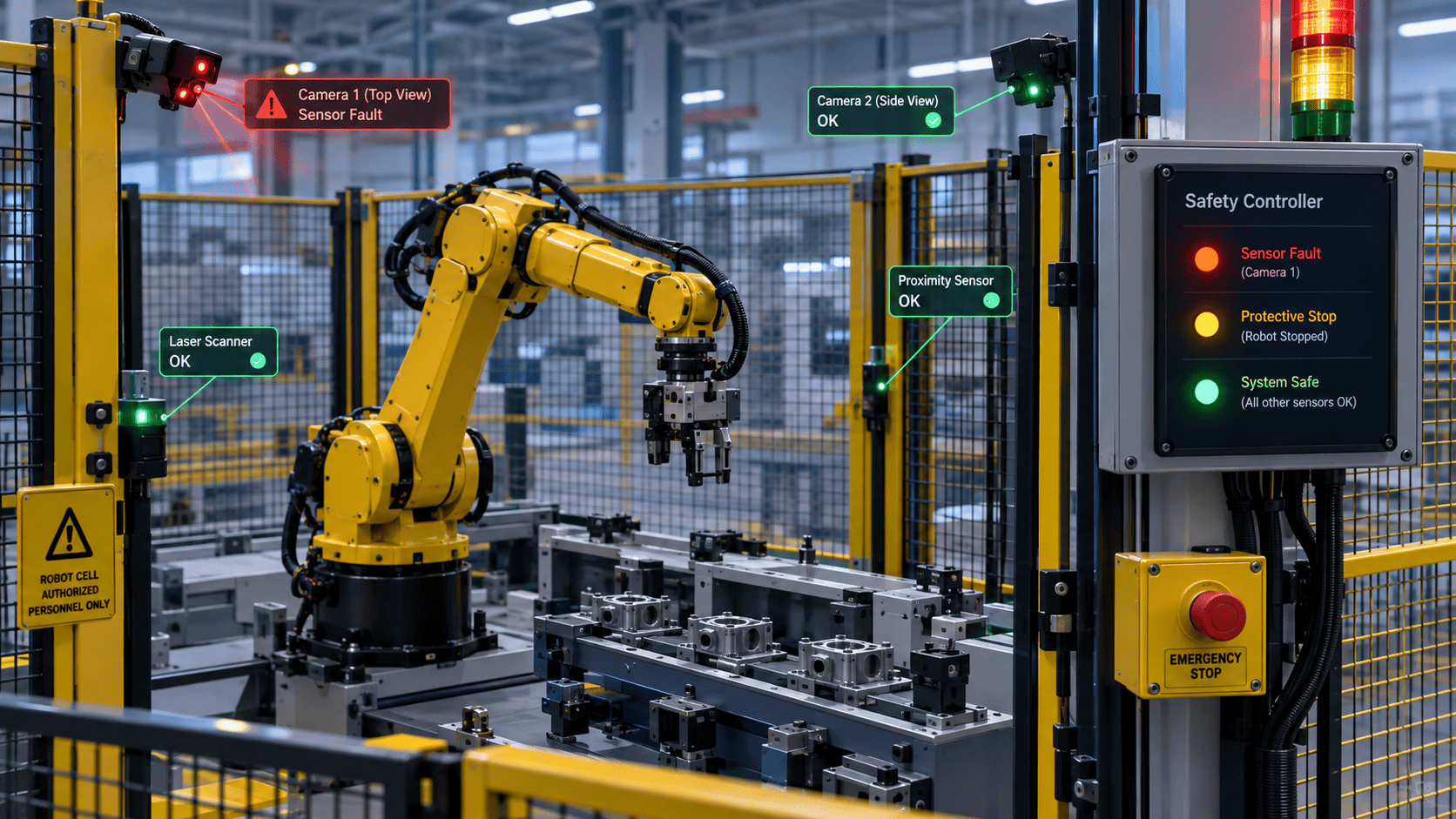
Imagine an industrial robot working normally when one of its cameras suddenly stops providing reliable information. The robot may still have power and its motors may still work, but its understanding of the environment has changed. In a safe industrial system, that is not simply a small technical error. It can become a safety event.
Sensors Are the Robot's Source of Information
Industrial robots can use different sensors for different purposes. Cameras can provide information about objects and their locations, while position, force, temperature and other sensors can help the robot and its controller monitor movement and operating conditions.
The exact response to a sensor failure depends on the robot application and its safety design. A failed camera used only for inspection may affect quality without creating a dangerous movement. A failed safety-related sensor can require the system to stop or enter another defined safe state.
This is why safety cannot depend on one sensor alone when a failure could create a hazard.
What Happens When a Sensor Fails?
Modern safety systems can monitor whether safety-related devices are operating correctly. If a fault is detected, the system can prevent or stop hazardous robot motion rather than allowing the robot to continue as though nothing happened.
The 2025 editions of ISO 10218-1 and ISO 10218-2 provide the current international framework for industrial robot safety and robot applications. The standards distinguish requirements for the robot itself from requirements for the complete robot cell, including integration, commissioning, operation and maintenance.
Emergency and protective stopping are important parts of this approach. OSHA's robotics guidance describes fail-safe presence-sensing systems and notes that redundancy and backup systems can be appropriate where a robot could create serious hazards.
Importantly, an emergency stop is not simply the same as cutting every electrical connection. OSHA explains that dynamic braking may be needed to control robot-arm inertia and prevent hazards such as a falling arm or a thrown workpiece.
Redundancy Can Prevent One Failure From Becoming a Disaster
One way engineers improve reliability is through redundancy or multiple sources of information. If one sensing channel fails, another may provide enough information for the system to detect the problem or maintain a safe state.
A 2026 Scientific Reports study specifically examined sensor failures in multi-sensor monitoring of industrial robot transmission components. The researchers proposed a “channel self-healing” approach to improve fault diagnosis when individual sensor channels become unreliable. This was a research study, not evidence that commercial industrial robots can automatically recover from every sensor failure.
Redundancy also has limits. Two sensors can share the same environmental problem, provide conflicting information or fail because of a common power, wiring or software issue. Engineers therefore need to consider the entire safety architecture rather than simply adding more sensors.
Safe Does Not Always Mean Keep Working
The safest response to a failed sensor is not necessarily to continue operating with reduced information. Depending on the application, the robot may perform a protective stop, controlled stop or another safety-defined response.
Afterward, technicians need to determine why the sensor failed, whether other components were affected and whether the system can be safely restarted.
This is the central idea behind robot safety: a robot does not need to be perfect to be safe. Its system needs to be designed so that foreseeable failures are detected and handled before they become dangerous.
As robots become more dependent on cameras, AI perception and multiple sensing systems, this principle becomes even more important. The question is not only whether a robot can see—but what happens when it suddenly cannot.