Quantum computing has spent years engaged in a wonderfully straightforward numbers competition: who has the most qubits?
There is only one awkward problem.
Qubits are extraordinarily bad at being qubits.
They are fragile, noisy and vulnerable to interactions with their surroundings. Building a useful quantum computer therefore requires something much less photogenic than announcing another record-sized processor:
making errors disappear faster than the machine creates them.
Why quantum information is so fragile
Ordinary computers represent information using bits that are either 0 or 1.
Quantum computers use qubits whose states can involve superpositions of 0 and 1 and correlations called entanglement. These properties make certain quantum algorithms potentially powerful.
They also make quantum information delicate.
Interactions with the environment, imperfect control signals and measurement errors can corrupt calculations. The problem is not simply that an occasional bit flips and somebody presses Undo.
Quantum states cannot generally be copied arbitrarily because of a fundamental result known as the no-cloning theorem. Measuring them directly can also disturb the information you are trying to preserve.
Quantum error correction therefore has to be considerably cleverer.
One useful qubit may require many physical ones
The central idea is to encode one logical qubit across multiple physical qubits.
Instead of trusting any single fragile qubit, the system spreads quantum information across a larger structure. Additional measurements can then reveal patterns indicating that an error has occurred without directly reading out the protected quantum state itself.
One important approach is the surface code, which arranges qubits so errors can be detected through repeated measurements of relationships between them.
This sounds wasteful because it is.
A fault-tolerant quantum computer may need enormous numbers of physical operations and physical qubits to provide a much smaller number of reliable logical qubits.
But reliability is the whole point.
A million unreliable qubits are not automatically more useful than a much smaller collection that can perform long calculations accurately.
The threshold is the number to watch
Quantum error correction contains an especially important concept: the error threshold.
Below a sufficiently low physical error rate, increasing the size of an error-correcting code should make the resulting logical information more reliable, not less.
That sounds almost obvious until you remember that adding more qubits also adds more physical components capable of making mistakes.
Crossing that threshold is therefore a crucial milestone.
Google Quantum AI reported such behaviour with its Willow processor in research published in Nature. Its researchers demonstrated surface-code memories where increasing the code distance reduced the logical error rate. A 101-physical-qubit distance-7 logical memory achieved a reported error rate of about 0.143% per error-correction cycle.
The important achievement was not “101 qubits.”
It was evidence that adding the right qubits made the encoded quantum information better protected.
That is a profound difference.
Does this mean useful quantum computers are here?
No.
And this is where quantum headlines have historically enjoyed a somewhat flexible relationship with the word “breakthrough.”
Demonstrating below-threshold error correction is an important research milestone. It is not the same as building a large fault-tolerant computer capable of running commercially valuable quantum algorithms.
Useful machines would need many logical qubits, extremely low logical error rates, reliable operations between those logical qubits, sophisticated decoding and large-scale control hardware.
The engineering overhead remains formidable.
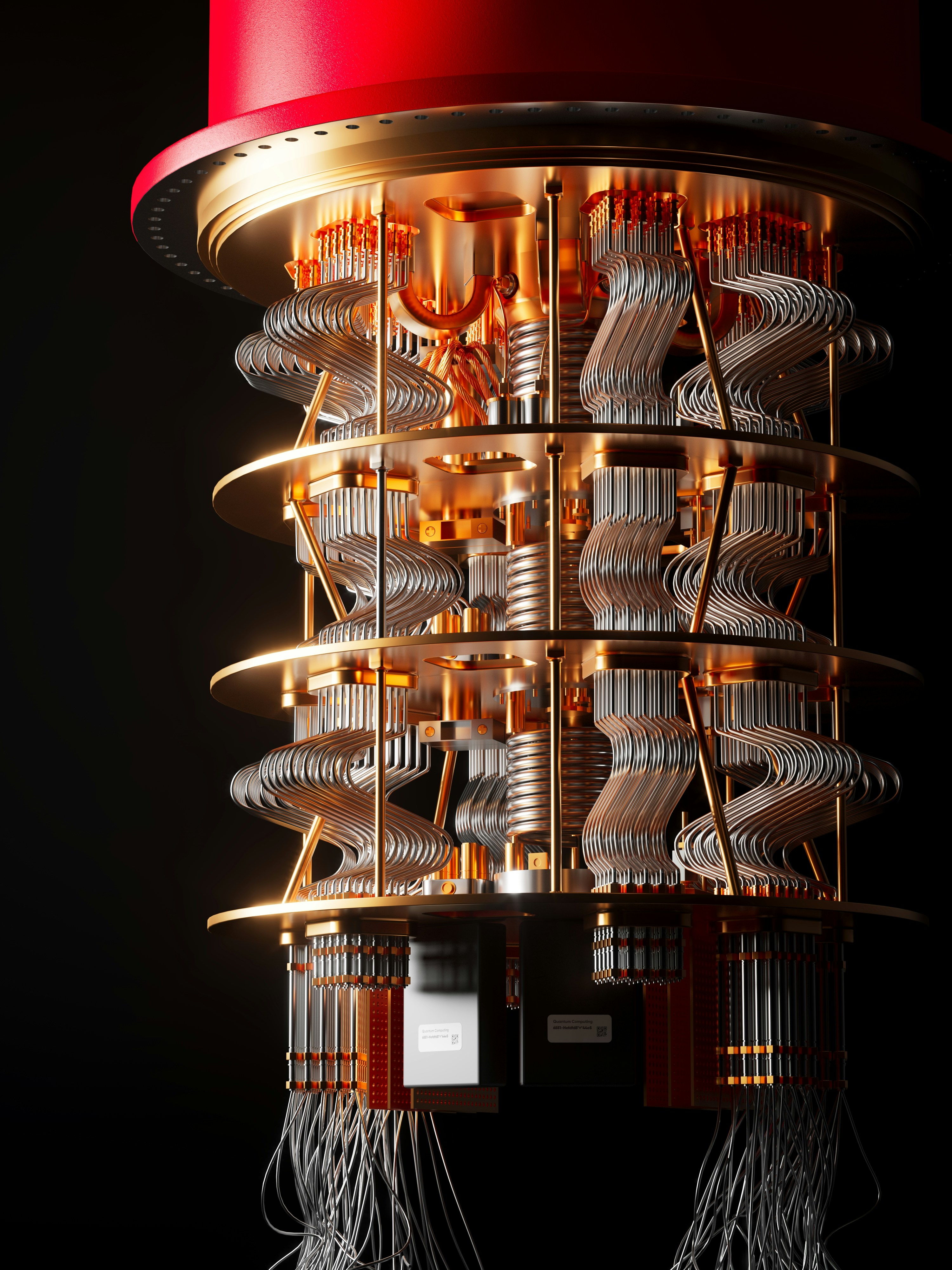
Those beautiful gold structures hanging inside quantum laboratories are dilution refrigerators operating at temperatures close to absolute zero. Apparently the future of computing requires something resembling a chandelier designed by a physicist with an unlimited plumbing budget.
Why error correction changes the quantum race
This is why processor qubit counts deserve caution.
What ultimately matters is not merely how many physical qubits a company can manufacture, but how reliably those qubits can support useful logical computation.
Quantum computing is slowly shifting from “How many qubits do you have?” toward better questions:
How noisy are they?
How good are the operations?
How many logical qubits can you sustain?
How does logical error scale as the code grows?
Those questions sound less exciting than another giant number on a presentation slide.
They may also tell us much more about who is actually getting closer to a useful quantum computer.
The future of quantum computing may indeed require millions of qubits.
The breakthrough will be making most of them spend their time ensuring the few qubits doing the useful work can be trusted.