What Is Happening?
For years, apps decided what you saw by quietly watching what you clicked or skipped. That changed on November 12, 2026, when Spotify launched three new tools for your phone that give you direct control over your Home screen.
Rolling out worldwide for both Free and Premium users, the update lets you clean up your screen and tell Spotify what you want to hear less of. As tech sites like PodcastingToday and Technobezz reported, this puts Spotify right alongside Facebook and Instagram, which have also added special spaces where users can check and edit the topics shaping their feeds.
Here are the three tools Spotify added:
-
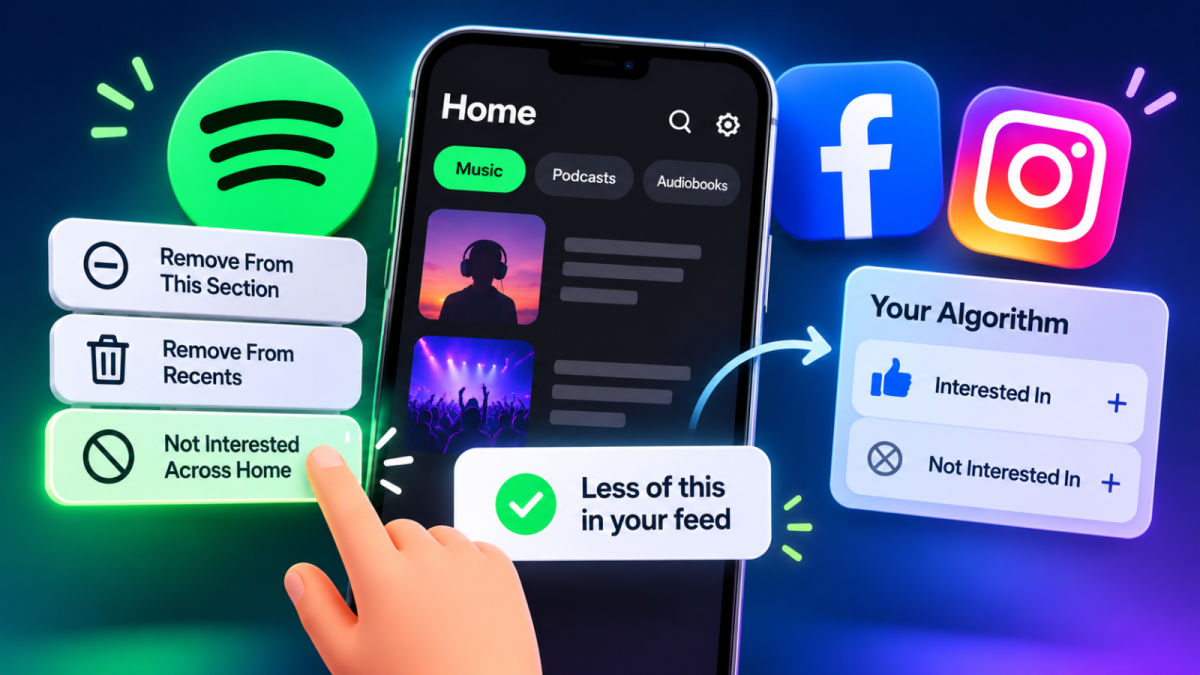
Remove From This Section: Press and hold a tile at the top of your Home screen to hide recent items from that shelf.
-
Remove From Recents: Clear a single song, playlist, or show from your Recents list.
-
Not Interested Across Home: Tap "Not interested" on Home cards to hear less from specific shows or authors.
How Does It Work?
Spotify makes a clear rule: hiding items is not the same as training the algorithm. Removing a tile from the top shelf or clearing your Recents list only hides that item from your eyes—it does not change what Spotify suggests next. But when you tap "Not interested," you send a direct signal that actually changes your future picks.
Spotify also uses a feature called Taste Profile, launched on September 23, 2026, for Premium users aged 18 and older in the US and New Zealand. As Hypebot noted, Taste Profile lets users type out in plain words what they want more or less of. Meta does something similar with its "Your algorithm" tool on Instagram and Facebook. According to Meta's tech blog, Facebook uses smart AI models to group your interests into "Interested In" and "Not Interested In" lists. You can add or block topics directly, and Meta filters out unwanted posts right away.
Why Is It Important?
Hiding a podcast or editing a topic tag might seem tiny on its own. But together, these updates show a massive shift: apps are moving away from quietly tracking your habits and letting you speak up directly.
This change is also happening alongside new laws. On November 11, 2026, the European Union proposed the Digital Fairness Act, which aims to stop addictive design and give people the right to turn off features built just to keep them hooked. Giving users a clear steering wheel helps apps build trust before strict rules arrive.
What Are the Challenges?
Giving listeners and viewers a mute button makes it harder for creators, podcasters, and advertisers to predict their reach. If audiences block whole topics or shows, sudden viral hits become rare. Also, Meta points out that understanding vague user prompts is tough, and many people rarely open settings menus unless they are already annoyed.
What Happens Next?
Seeing if Spotify brings Taste Profile to the whole world and watching how often everyday users actually tune their feeds will show if manual feed controls become normal everywhere.