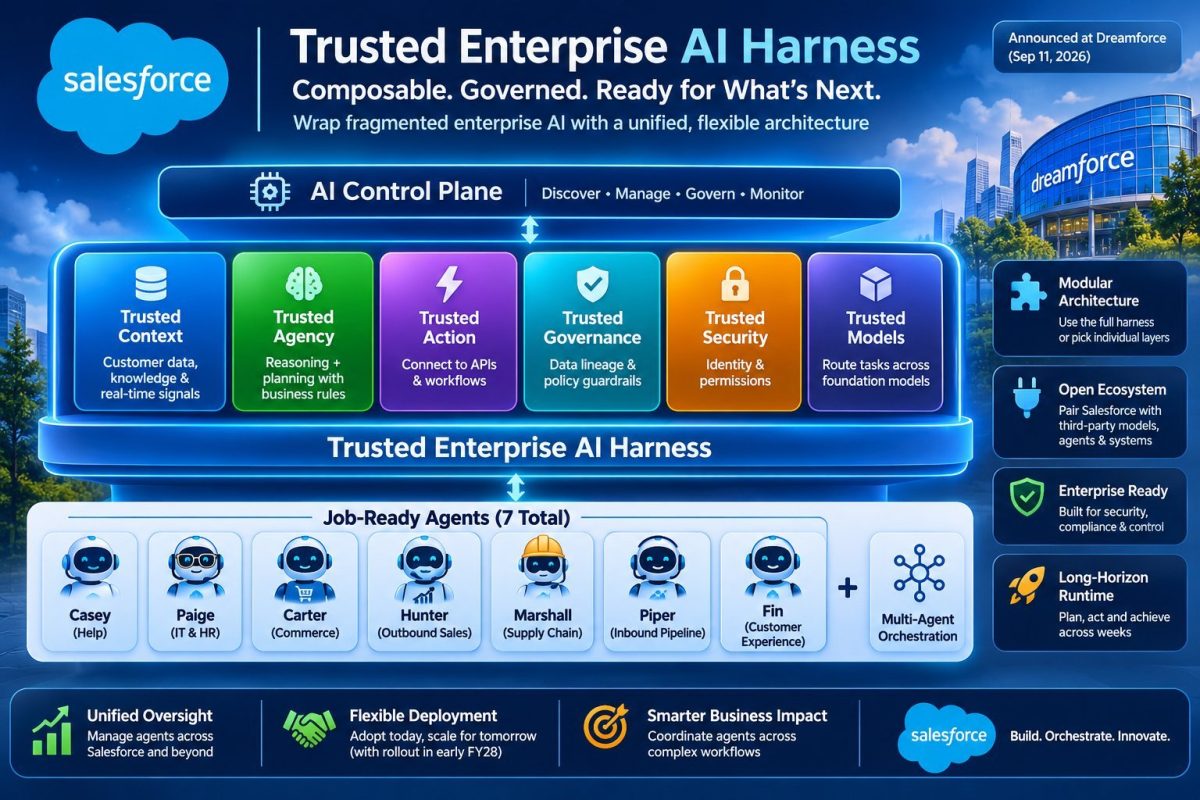
A lot of company AI projects get stuck because teams connect powerful models to separate apps that don't share the same business definitions or any central oversight. On September 11, 2026, before Dreamforce, Salesforce introduced the Trusted Enterprise AI Harness, a new AI Control Plane, and seven job-ready Agentforce agents. Instead of locking buyers into one closed system, it offers six pieces covering context, agency, action, governance, security, and models. Customers can use the whole harness or pick only the layers they want, and they can mix Salesforce tools with third-party models, agents, and outside systems.
How the harness works
According to Salesforce's September 11 announcements, the setup keeps business understanding and rule enforcement separate from the language models underneath. It has three main parts.
The first part is the six trusted capabilities. Trusted Context combines customer records with metadata, business meaning, company knowledge, real-time signals, and memory of past interactions. Trusted Agency mixes AI reasoning and planning with fixed rules. Trusted Action connects agents to APIs and workflows, and Trusted Governance enforces data lineage and policy limits. Trusted Security handles identity and permissions while agents run. Trusted Models sends tasks to different foundation models based on accuracy, speed, and cost.
The second part is the headless AI Control Plane, which sits across everything. Admins can find and register agents, set identity and access rules, and manage their lifecycles. It also checks performance, watches behavior while agents run, and tracks spending for both Salesforce agents and third-party ones. Salesforce built the harness "headless," so outside tools can use it through the Model Context Protocol (MCP), APIs, Skills, and plug-ins. The unified management starts rolling out in early fiscal 2028.
The third part is the job-ready agents and the long-horizon runtime. Salesforce introduced seven named agents: Casey (help), Paige (IT and HR), Carter (commerce), Hunter (outbound sales), Marshall (supply chain), Piper (inbound pipeline), and Fin (customer experience). Six are generally available now, along with Multi-Agent Orchestration. Chatbots usually handle one turn at a time, but the new runtime adds memory across sessions, durable execution, and the ability for users to steer along the way. That lets agents like Hunter work on goals that take weeks.
What I think about it
To me, Trusted Context goes after the same problem that holds back other cross-system analytics tools, which is getting everyone to agree on what the data means. Agents can't reason well across CRM, ERP, and contract records unless the business definitions are standardized first. Rocket Mortgage CTO Shawn Malhotra said in the launch release that avoiding lock-in to one closed system matters because models keep changing. At the same time, Salesforce Ben and partner KVP pointed out that for now the harness mostly ties together products that already exist, until unified Control Plane management arrives in early FY28.
Still, architects should watch for two things before standardizing on it.
First, the roadmap timing. The underlying pieces and Multi-Agent Orchestration are shipping now, but the full unified AI Control Plane starts rolling out in early fiscal 2028. Teams should check the product documentation to see exactly what is ready today.
Second, matching meanings across systems. Bringing outside ERP, billing, and fulfillment metadata into Trusted Context takes careful data modeling and governance. If the definitions are messy, people using MCP or APIs can't safely trigger automatic actions.
What happens next
By combining a headless, MCP-friendly layer for meaning and governance with long-running job-ready agents, Salesforce is trying to become the control layer around AI setups that use many vendors. Companies that set their cross-system definitions and human-approval limits early can coordinate specialized agents on multi-week workflows and still check what happened afterward.