Robots That Climb Trees and Pick Fruit
Picking coconuts is hard and risky work. Workers climb tall, bare trunks, sometimes as high as 15 metres, to cut down the fruit. Now researchers have built robots that can climb trees and harvest fruit. Most are still prototypes, but one has been tested on a real coconut farm. Here’s what these robots can do, and how they compare with other ways of picking fruit.
A coconut robot built in India
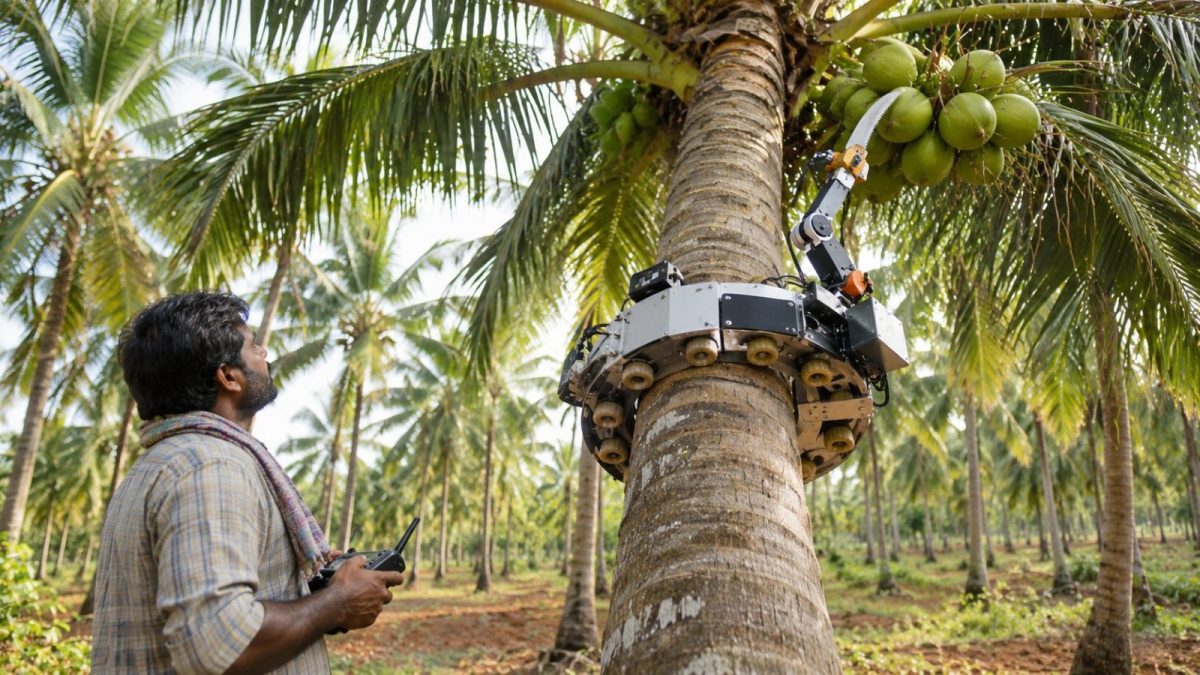
A team at Amrita Vishwa Vidyapeetham, a university in India, built a robot called Amaran. It climbs coconut trees and cuts down the coconut bunch. The team shared its results in an engineering journal paper in 2020.
In the farm tests described in the paper, Amaran climbed trees up to 15.2 metres tall and handled trunks that lean by up to 30 degrees.
How Amaran climbs and picks
Picture a ring around a tree trunk. Amaran’s ring-shaped body has eight wheels that press against the trunk and roll the robot up, down and around it.
A person on the ground steers it with a joystick or a phone app. At the top, a robot arm moves a cutter to the stem of the bunch. If the main battery dies, a backup helps the robot come back down.
Why climbing robots matter
Kerala has struggled for a long time to find enough coconut climbers. Estimates of how many it needs go from 30,000 to 50,000. The Coconut Development Board has trained thousands, but reports say the shortage is still there.
In one test reported by IEEE Spectrum, a 50-year-old expert picked a tree in 11.8 minutes. Amaran took 21.9 minutes, and 14 of those went to setup. The human harvester got tired after about 15 trees a day. The team says Amaran can reach 22 a day if its operator doesn’t get tired, but the report doesn’t give any long-term farm data.
What are the limits?
Amaran isn’t a finished product. A person still has to steer it, and setting it up takes time. Megalingam says no two coconut trees are the same, so it’s hard to build a perfect robot. Cost is another problem, so he suggests that communities could share one robot.
Amaran also has simpler rivals. Machines that help a person climb a coconut tree already exist in India, so a robot has to beat them, not just human climbers. Ring-shaped robots also have trouble with branches. Treebot, a research robot from Hong Kong, moves like an inchworm and can step from the trunk onto a branch, but it weighs only 600 grams and is still just a research project.
What happens next?
Some labs now skip climbing and reach the fruit from the ground. In January 2026, Washington State University showed a low-cost inflatable arm that picks an apple in about 25 seconds. Researcher Ming Luo says the simple design keeps costs and repairs low, though the detection system still needs work.
Growers are still careful. Axios quotes Ines Hanrahan of the Washington Tree Fruit Research Commission saying growers won’t invest until robots are tested locally. Israeli startup Picker AgRobotics aims to pick 95% of fruit, but that’s its own goal.
Robots that climb trees and pick fruit are still early, and none has fully replaced skilled workers. The next step is making them cheaper, faster and easier to use on real farms.