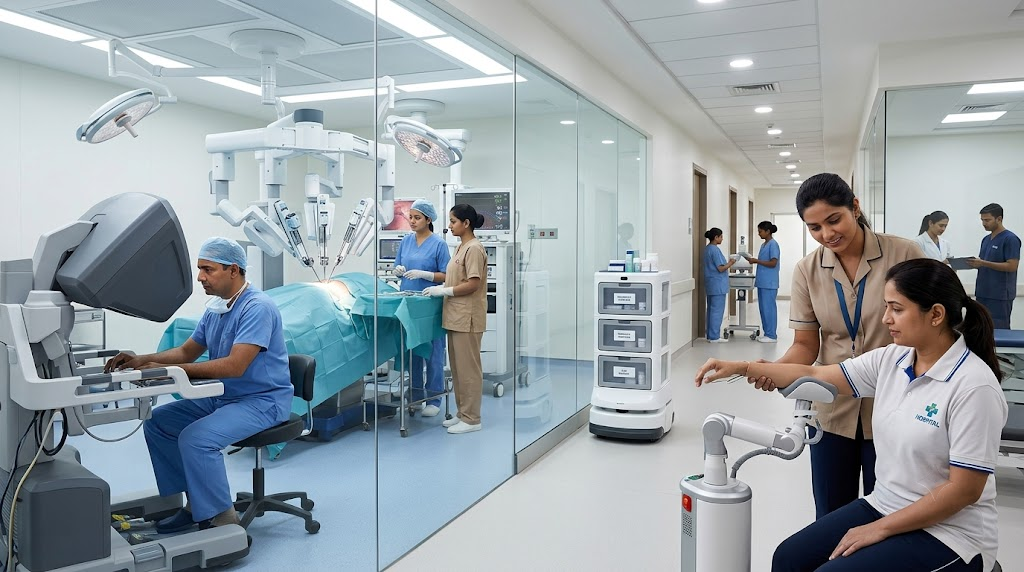
A hospital robot does not always look like a humanoid machine. It can be a robotic surgical system controlled by a doctor, a rehabilitation device helping a patient move an arm, or a mobile robot transporting supplies through hospital corridors. In India, these technologies are being used for some clinical and operational tasks, while others remain at the research or testing stage.
Robotic Surgery Is Already in Use
Surgical assistance is one of the clearest examples of hospital robotics in India. These systems do not replace the surgeon. Instead, the surgeon controls robotic instruments that can provide precise movement and support minimally invasive procedures.
In February 2026, AIIMS Bhubaneswar commissioned a surgical robotic system, becoming the first government institution in Odisha with a comprehensive robotic surgery programme. In July, the government also reported that Homi Bhabha Cancer Hospital and Research Centre in Punjab had completed more than 100 robotic cancer surgeries in six months.
Private hospitals are expanding their programmes as well. Apollo Hospitals reported more than 8,000 robotic-assisted surgeries across its network by February 2026. These examples show that surgical robotics has moved beyond laboratory demonstrations into real clinical use in India.
Rehabilitation Robots Help Patients Train
Robots can also assist people recovering from stroke, spinal injuries and other neurological conditions. Rehabilitation robots repeatedly guide or support specific movements while a therapist supervises the treatment.
RoboExo, developed at IIT Delhi, is a robotic upper-limb rehabilitation device designed to assist wrist and hand movements. IIT Delhi says it has been clinically validated in more than 100 patients and can be used in hospitals, clinics and home-based rehabilitation.
Another Indian example is Astrek Innovations, which has developed robotic exoskeleton technology for lower-limb rehabilitation. According to NITI Aayog's Frontier Tech programme, more than 69 patients had completed rehabilitation using its technology by July 2026.
These systems are designed as therapy tools, not autonomous replacements for physiotherapists.
Robots Can Move Medicines and Supplies
Hospital work also involves moving medicines, samples, linen and other supplies between departments. Autonomous mobile robots can potentially handle some of these repetitive journeys.
However, this area needs careful distinction in India. International hospital robots such as Aethon TUG and Moxi have established clinical logistics use, but evidence of large-scale deployment across Indian hospitals is more limited.
Indian healthcare robotics companies are developing delivery systems for tasks such as moving medicines and supplies between pharmacies, nursing stations and wards. The practical challenge is making robots work safely around patients, staff, elevators, doors and constantly changing hospital traffic.
Disinfection Is Another Use
Robots can also support hospital cleaning and disinfection. UV-C robots use ultraviolet light to treat exposed surfaces after rooms are cleared, reducing the amount of manual movement required for certain disinfection tasks.
India has also developed and tested such systems. Prabha, a UV disinfection robot developed by HuT Labs at Amrita Vishwa Vidyapeetham, was tested and deployed at Amrita Institute of Medical Sciences in Kochi.
Research continues to improve these machines. A 2026 IIT Bombay study examined a UVC robot with movable arms, highlighting an important limitation: UV light can have difficulty reaching surfaces hidden behind objects or inside shadowed areas.
The Hospital Robot Is Still a Tool
The biggest misconception is that hospital robots are becoming independent doctors or nurses. Most real systems perform a specific function under human supervision.
Surgical robots depend on surgeons. Rehabilitation robots work with patients and therapists. Delivery robots need controlled routes and hospital infrastructure. Disinfection robots require careful room preparation and safety procedures.
India's hospital robotics sector is therefore developing in several directions at once. Some technologies, particularly robotic surgery, are already being used clinically. Others, such as rehabilitation systems, are moving through validation and commercialization, while autonomous logistics and advanced disinfection remain more selective or experimental.
The near-term role of robots in Indian hospitals is less about replacing healthcare workers and more about helping them perform precise, repetitive or physically demanding tasks while humans remain responsible for clinical decisions and patient care.