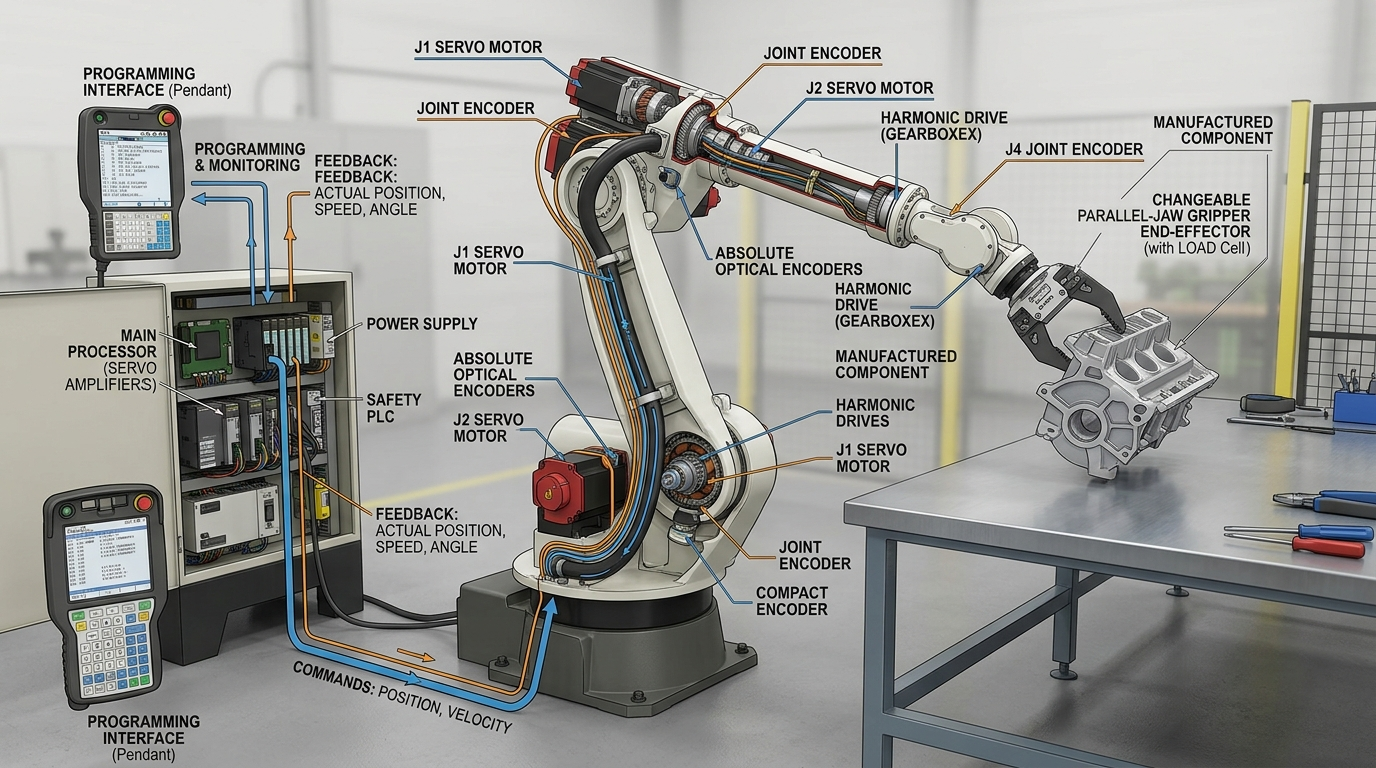
A robotic arm can look deceptively simple: a few metal links, some rotating joints and a tool at the end. But making that arm repeatedly weld a car part, pick a component or assemble a product requires several systems to work together with precise timing.
The arm itself is only one part of the solution.
Motors and Joints Create the Movement
The joints are where a robot gets its movement. Most industrial articulated robots use rotating joints powered by electric servo motors. These motors provide controlled motion and torque, while gear systems help deliver the force needed to move the robot's links and payload.
The number and arrangement of joints determine how freely the arm can move. A six-axis robot, for example, can position and orient its tool in three-dimensional space, giving it the flexibility needed for many manufacturing tasks.
But simply having powerful motors is not enough. The robot needs to know exactly where each joint is.
Encoders Tell the Robot Where It Is
This is where encoders become important. An encoder measures the position or rotation of a joint and sends feedback to the control system.
The controller can compare the robot's actual position with its intended position and continuously correct the motion. This feedback loop is one reason industrial robots can perform highly repetitive movements with considerable precision.
The important idea is that the robot is not simply told to “move the arm.” Its controller coordinates multiple joints while monitoring their positions.
The Controller Turns Instructions Into Motion
The controller acts as the system's central coordinator. A programmed task is converted into trajectories and coordinated joint movements. The controller also works with sensors, communication systems and safety functions.
Programming determines what the robot should do. Traditionally, operators could teach positions directly, while modern systems increasingly use offline programming, simulation, vision and more advanced software.
Recent research is also extending this idea. In August 2026, NIST reported work on composing digital twins for a robot arm and gripper, exploring how virtual models can be connected and reused for manufacturing systems.
The Tool at the End Often Determines the Job
A robot arm cannot perform every task with the same tool. The end-effector is what actually interacts with the workpiece.
A vacuum tool can pick up flat objects. A gripper can hold components. A welding torch can join metal. Other tools can cut, drill, polish, inspect or apply adhesives.
A 2026 review of manufacturing end-effectors highlights how application-specific tooling, sensors, actuators and control methods are central to expanding what robotic arms can do.
This is why two factories can use similar robot arms but perform completely different jobs.
The Real Value Comes From the Whole System
A useful robotic arm is therefore not just a collection of motors and joints. It is a coordinated system of mechanics, feedback, control software, programming, tooling and safety equipment.
That also explains why automation can become difficult when something changes. A gripper may struggle with different part shapes. A sensor may provide unreliable data. Software may need updating. The arm may be mechanically capable of a task but still require better tooling or integration with conveyors and other machines.
In 2026, industrial robotics is also moving toward greater use of AI, digital twins and more adaptable automation. But the fundamental principle remains the same: the robot becomes useful when all its parts work together to solve a specific physical task reliably.