A robot may have advanced AI, but it still needs a body that can move properly. For example, if a robot can see a cup but cannot hold it, its AI will not be very useful.
Researchers at Carnegie Mellon University have developed a humanoid robot called Pixel to solve this problem. They designed its body, movement system and AI to work together.
The research paper was published online as a preprint on November 2, 2026.
What Is the Pixel Robot?
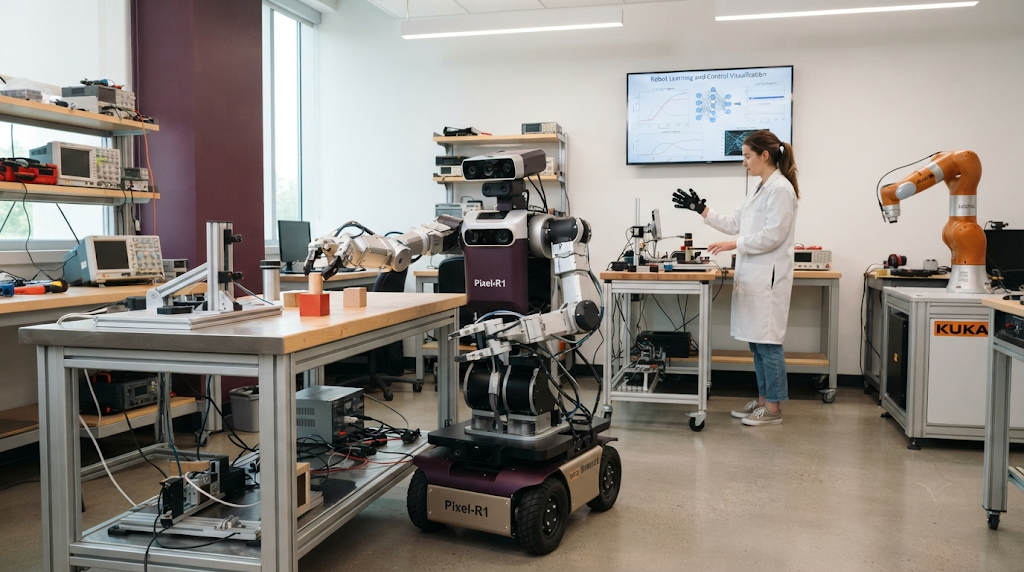
Pixel is a humanoid robot that moves using wheels instead of legs.
It has a human-like upper body, movable arms, a flexible torso and a lifting system.
According to the researchers, the robot costs less than $15,000.
The team designed Pixel to move in ways similar to humans, making it easier to learn from human actions.
Its grippers are also slightly flexible, helping it hold delicate objects without damaging them.
How Does Pixel Learn New Tasks?
Pixel learns by watching and following human demonstrations.
Researchers can control it using a 3D-printed arm controller, a VR joystick or a full-body tracking system.
They also developed a low-cost system that records people performing tasks without using a robot.
Pixel uses AI to understand instructions and decide what actions to take.
One AI system plans the steps using images and language. Another controls the robot's arms and body movements.
In one demonstration, Pixel completed several tasks over a few minutes using the same AI system with different instructions.
Why Is Pixel Different?
Many robots are developed by designing their hardware and software separately.
However, the Pixel team believes both should be developed together.
Their tests showed that different body parts are important for completing tasks.
When the torso movement was disabled, average task progress dropped to 47.4%.
Without head control, it dropped to 52%. Without the lifting system, it fell to 71.2%.
These results show how much the robot depends on its physical design.
The researchers also found that a head camera alone could not clearly see small details, such as a vacuum cleaner's power button.
What Tasks Can Pixel Perform?
On its project website, Pixel is shown arranging pillows, sweeping floors, vacuuming and hanging a jacket.
However, not every demonstration was completed independently.
Some videos show the robot being controlled by a person.
The researchers have not published success rates for every independent task.
Pixel is also still a research robot. It has not been proven reliable for continuous factory work or everyday commercial use.
What Happens Next?
The researchers hope Pixel will help other teams study how robot bodies, controls and AI can work together.
They also plan to release the project as open-source, allowing other researchers to study and improve the design.
Pixel is not ready for everyday use yet, but it shows an important idea: building better robots is not only about improving AI. Their bodies and movement systems matter just as much.