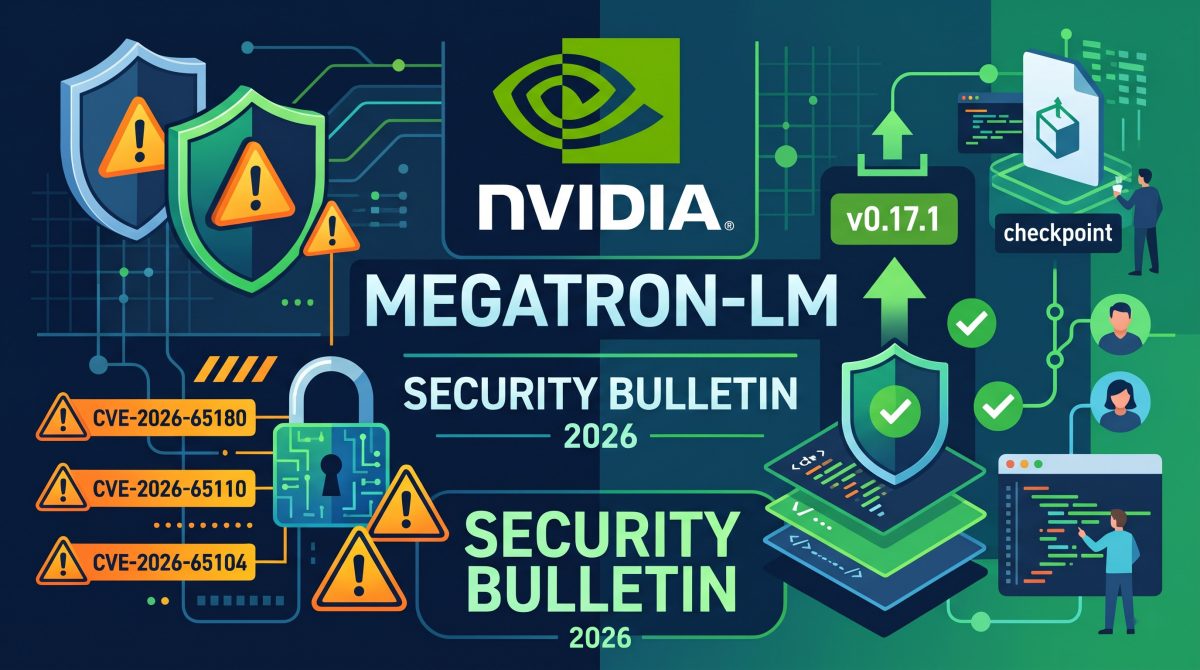
NVIDIA has fixed three security flaws in Megatron-LM, a popular tool for training large AI language models. These Megatron-LM security vulnerabilities were published on October 13, 2026. Think of a model checkpoint as a saved game file. If someone swaps it for a fake one, opening it could do more than load your progress. NVIDIA says users should update to version 0.17.1 or later.
Three Flaws in One NVIDIA Security Bulletin
NVIDIA released Security Bulletin 5881 for Megatron-LM in October 2026. It lists three issues. Each has a “High” severity rating on a standard 10-point scale called CVSS. Two score 7.8, and one scores 7.1.
Two flaws, CVE-2026-65180 and CVE-2026-65110, involve checkpoint loading. They could let an attacker run code if a user loads a booby-trapped file. The third, CVE-2026-65104, affects inference, the step where a trained model answers requests. NVIDIA’s table covers all platforms and earlier versions.
Outside researchers found these flaws. NVIDIA’s bulletin credits individual researchers, including a team from Tsinghua University, for reporting them.
How Do These Attacks Work?
A checkpoint is a file that stores what a model has learned. Loading it means rebuilding that data from the file. The two checkpoint flaws involve unsafe handling of this step, known as deserialization. A crafted file could trick the software into running the attacker’s code.
The third flaw is different. Megatron-LM keeps a cache, a short-term memory, for inference requests. NVIDIA says an attacker could cause hash collisions there. A hash is like a short label for data. If two different requests get the same label, the system may mix them up. This could lead to data tampering and partial information disclosure.
Why AI Teams Should Care
Megatron-LM runs on powerful GPU systems. These machines often hold model weights, training data, and other private files. Code running on them could expose or change that material. For the checkpoint flaws, NVIDIA says a successful attack may lead to code execution, higher access rights, information disclosure, and data tampering.
Sharing checkpoints between teams is common. That habit makes the risk practical, not just theoretical. Inference servers matter too, because they answer live user requests.
What Are the Limits and Open Questions?
Here is what we could not confirm. We found no verified reports of attacks using these flaws, but that can change. Check CISA’s Known Exploited Vulnerabilities catalog for updates.
Still, details are messy. The bulletin’s version table lists different fixed versions for each flaw, while its text says to use 0.17.1 or later. Teams should read NVIDIA’s bulletin directly instead of relying on summaries.
What Should Developers Do Next?
Update Megatron-LM to version 0.17.1 or later from NVIDIA’s GitHub repository. NVIDIA also suggests checking the risk in your own setup.
Also, avoid loading checkpoint files from sources you do not trust. Keep a record of where each file came from. Run training jobs with limited permissions, so one bad file cannot reach everything.
Megatron-LM security vulnerabilities like these show that AI tools need the same care as any other software. A model file is not just data. Treat unknown files with caution, patch quickly, and keep good records of where your models come from.