The Customer Service Dilemma
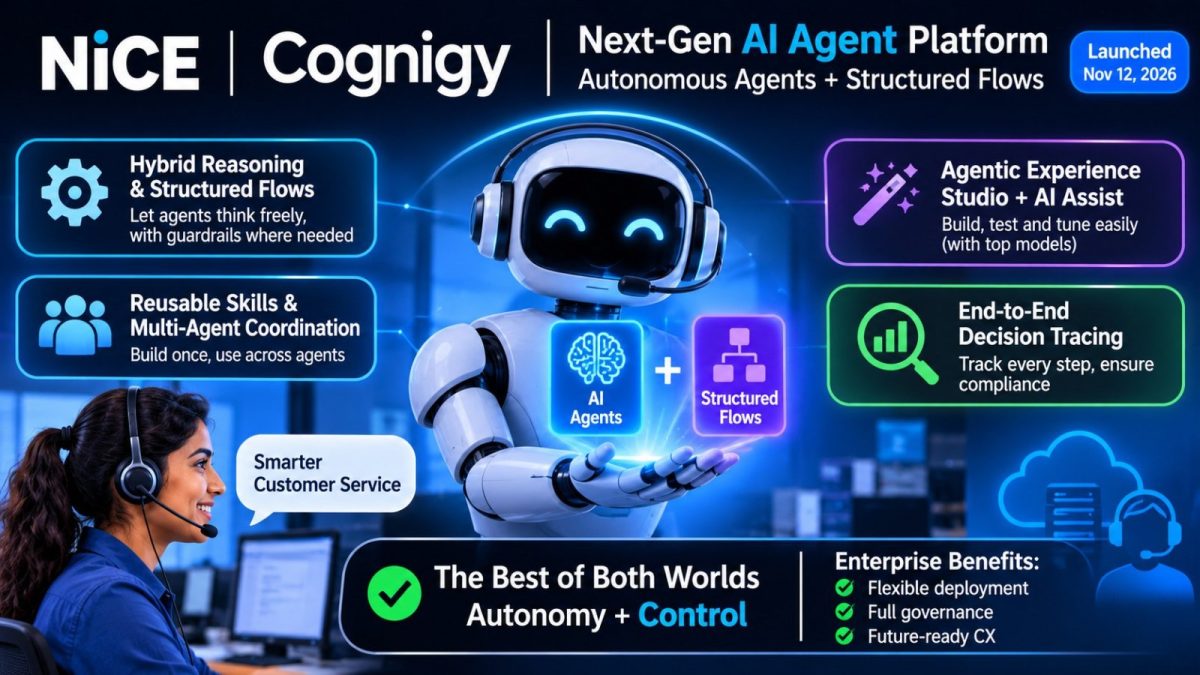
Anyone who runs customer service has a tough choice when they bring in AI. If the AI is too free, it might go off script and say something wrong. If it’s too strict, it’s just a boring chatbot that makes callers angry. On November 12, 2026 (with more news coverage on November 13), NiCE released an updated version of NiCE Cognigy, its AI agent platform for big companies. The cool part is that it lets companies mix free-thinking AI agents with fixed, step-by-step flows in one place, with rules and control. So companies don’t have to pick between flexible AI and strict compliance anymore. They can decide exactly where the agent can think for itself and where it has to follow a set process.
Why Mixing the Two Matters
I think customer service automation is kind of stuck right now. Old script bots fall apart the second a caller says something a little different than expected. But AI that’s totally on its own can’t pass compliance checks in places like banks, hospitals, and insurance companies.
NiCE’s idea is to treat autonomy like a dial you can turn up or down instead of an on/off switch. It also fits with something that’s starting to happen, which is customers showing up with their own personal AI agents to handle things like disputes, cancellations, and simple questions for them.
What the Platform Can Do: Mixed Control and Teamwork
According to NiCE’s Business Wire announcement, the update lets companies manage AI agents across the whole customer journey, with one place to see and control everything.
- Mixed reasoning and fixed flows: Companies can combine free AI reasoning with set workflows. Risky things like checking someone’s identity, approving refunds, or reading legal disclosures follow strict rule-based paths. Normal everyday questions can use the more flexible language models.
- Reusable skills and teamwork: Teams build skills, tools, and personas once and reuse them with different agents. For harder requests, a main orchestrator agent manages smaller specialized agents and connects them to outside systems and to customers’ own AI agents.
What the Platform Can Do: Studio and Tracing
The updated Agentic Experience Studio comes with default speech-to-text, text-to-speech, and large language models, and you can add third-party ones if you want. It also has an AI Assist helper and built-in speech-to-speech voice. A tracing feature records every step the agent takes, including which skills it used, which outside tools it called, and why it made its choices, so auditing is quick.
Downsides to Think About
Hybrid control fixes a lot of compliance worries, but there are two real challenges for the teams setting it up.
- Drawing the line is hard: Architects have to decide which parts of a conversation can be open and which need strict guardrails. If they draw the lines badly, it either turns back into stiff old menus or leaves gaps where weird cases slip past the rules.
- Mixing models can be slower and cost more: The built-in default models make it easier to start. But if you add outside voice and reasoning models, you have to keep checking speed and usage so there aren’t awkward pauses in conversations or surprise bills.
What Happens Next
Companies already using NiCE Cognigy don’t have to change anything, since their current setups keep working. That means contact center teams can add the new orchestration and tracing tools a little at a time. By putting autonomous agents inside a structure with rules, NiCE is getting Cognigy ready for a future where company bots talk to customers’ AI assistants more and more.


