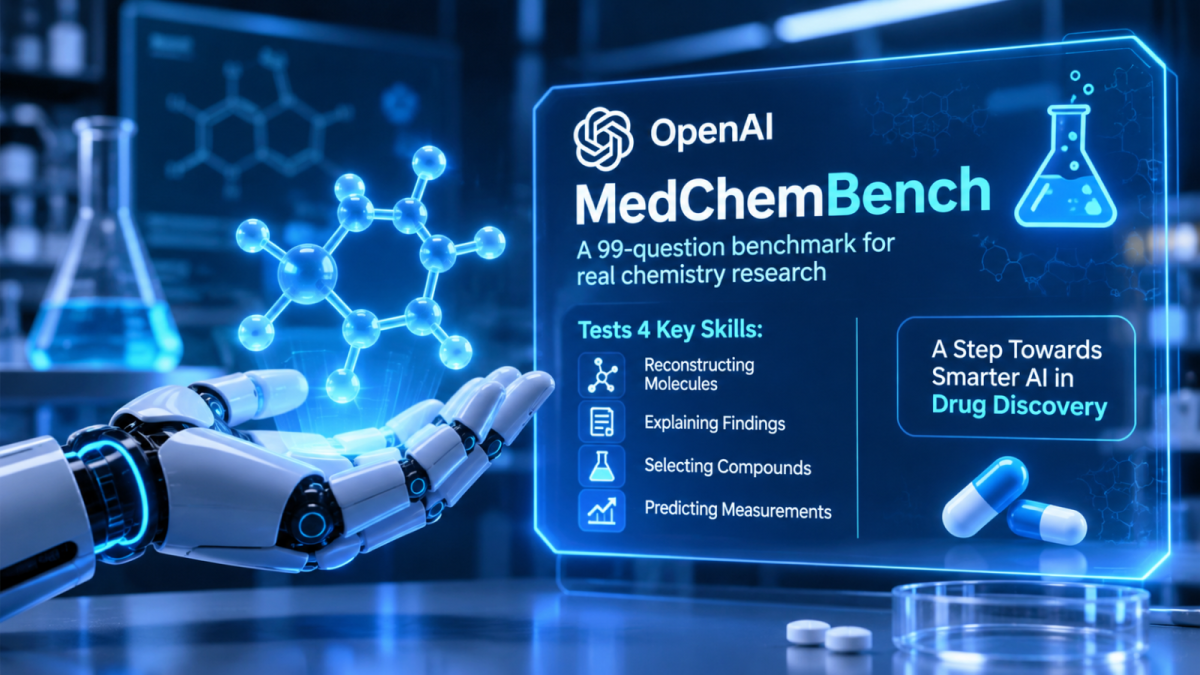
OpenAI published MedChemBench on November 20, 2026, a benchmark of 99 medicinal chemistry problems. MedChemBench tests whether AI models can work with real chemistry research. It's a chemistry exam, not a drug-discovery diploma. It's also a test that OpenAI built, ran and reported itself.
What MedChemBench Tests
iXBT reports that the 99 problems come from 117 scientific papers and patents and involve 761 molecular structures. Models have to connect a molecule's structure with experimental evidence to explain results, compare compounds and predict properties. OpenAI separates four skills: reconstructing molecules, explaining findings, selecting compounds and predicting measurements.
How Models Were Tested
Each model answered once, without extra tools, feedback or new experiments. So the test measures how well a model works with known scientific data, not real drug development. OpenAI says the results don't show whether models can discover new drugs or improve decisions in the lab.
What the Results Suggest
Reports say models do fairly well at rebuilding molecular structures and explaining experimental evidence, but have clear room to improve at picking compounds and predicting numbers for properties. Scores are hard to compare. iXBT reports that OpenAI's own testing gave GPT-6.2 Astra 84.5% of the available points at the highest reasoning level. Tracker pages list much lower numbers, and OpenAI's earlier GPT-Rosalind post reported 27.5% on a different version of the benchmark. Only compare scores within the same version.
The Homework Problem
OpenAI built the benchmark, chose the problems and compared its own models. R&D World asked the questions this raises: who designed and graded the rubrics, were the graders independent of OpenAI, and can outside groups reproduce the scores? I didn't find a human chemist baseline or results from a rival lab in the coverage I saw.
State of the Art: Benchmarks as Product Claims
MedChemBench sits next to OpenAI's GPT-Rosalind life-sciences models, whose access runs through a trusted-access review. OpenAI also built LifeSciBench, which it describes as judged by outside experts. Benchmarks like these help buyers, and they also work as product claims.
Future Potential and Applications
If independent testing confirms the results, tools like this could help medicinal chemists with jobs like interpreting experimental data and shortlisting compounds. That's a possibility, not something the benchmark shows.
Future Impact and Business Opportunities
Pharma buyers may start asking for independent test results before they trust vendor claims. That could create demand for third-party evaluators and shared benchmarks that others can reproduce.
Challenges
The benchmark is one release, scores change from version to version, and it doesn't test lab work or new discoveries. Readers shouldn't take it as proof that AI can design drugs.
Conclusion
MedChemBench is a useful exam, but a company grading its own homework can only show so much. The next step is independent grading.


