What Is Happening?
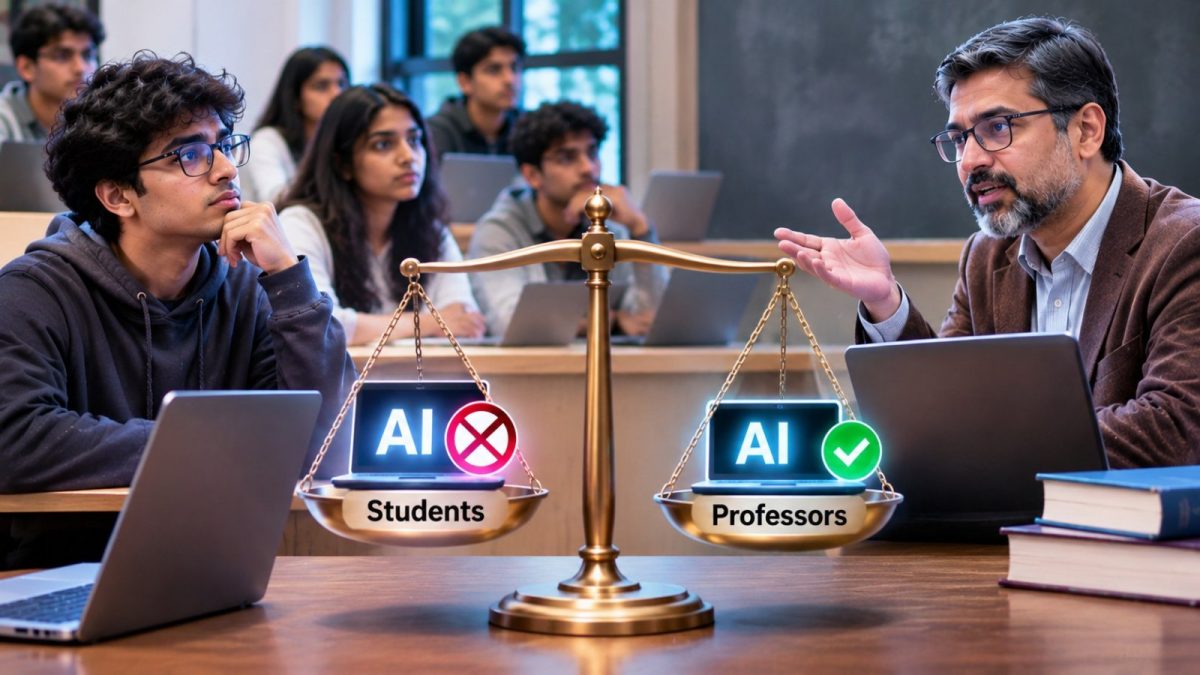
Students are starting to hold their schools to the same rules they have to follow. Last year, a Northeastern University student asked for an $8,000 tuition refund after learning a professor used AI for grading notes and slides while banning students from using it. The refund was denied, but student frustration kept growing.
In October 2026, the Student Senate at Eastern Illinois University passed a formal resolution asking leaders to set rules on how professors use AI. Students wrote that AI often gives bad facts and that using it to build classes makes the course feel less important.
How Does It Work?
Much of the trouble comes from how AI detectors work behind the scenes. Instead of checking spelling like a basic tool, an AI detector uses a trained model to score how smooth or predictable word choices look, guessing if a computer model likely wrote them.
Colleges often run student work through these checkers, and now the same tools are flagging professors. In August 2026, a student newspaper ran a UC Berkeley math professor's essay through the Pangram detector, which flagged it as 33 percent AI, even though she said it was mostly human work. In October 2026, Dartmouth's provost stepped down after a detector flagged his published writing and he admitted using a language model. A University of Chicago statistician also had hundreds of papers pulled from SSRN after using AI without clear notice.
Why Is It Important?
These cases show that student trust is now a big part of campus AI rules. When students see adults break the rules used to punish learners, trust in fair grading drops fast.
Flagging professors also shows a big flaw in AI detectors. Modern AI writes smoothly, and careful human writers often edit drafts heavily, so probability scores can easily guess wrong on adult writing.
What Are the Challenges?
Making one simple rule for a whole campus is tricky because students and teachers have different roles. Experts quoted by Inside Higher Ed note that students are in school to build skills, so letting AI do their thinking hurts learning, while professors already know their subject.
Checking thousands of papers also takes heavy server power and slows down grading workflows. Meanwhile, there is no single national rule, so each school decides on its own.
What Happens Next?
To fix the double standard, experts say colleges need clear honesty rules for everyone, not just students. Dartmouth's president wrote after the provost resigned that standards for students should apply to leaders too.
Going forward, more schools may ask both students and teachers to say openly when they use AI, helping build trust through simple honesty.