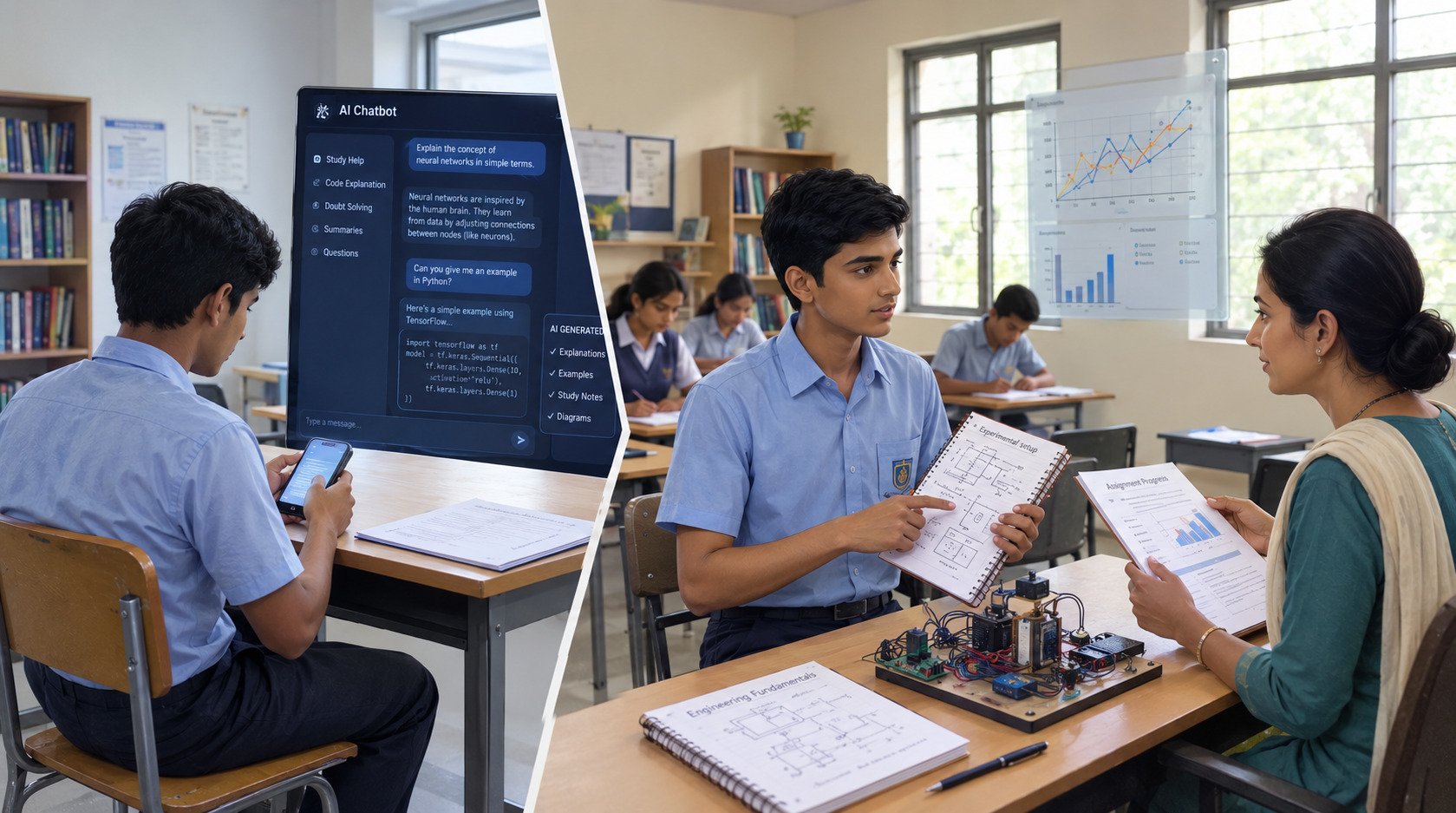
A math teacher in California opens every new class the same way now: he tells his students he knows they're using AI, and he's not going to pretend otherwise. It's a small admission, but it captures where homework is right now — not quietly dying, but openly being outsourced, with both students and teachers aware it's happening and unsure what to do about it. The same conversation is starting in Indian staffrooms, just a few months behind, because the tool doing the outsourcing is the same one everywhere.
The Homework Habit Is Already Breaking
A study out of UC Irvine gave the fear some numbers. Researchers went through 3.2 million student math problems on a widely used digital learning platform, spanning a decade, and compared behaviour before and after ChatGPT's release. High schoolers started spending 31% less time on the kind of word problems that paste neatly into a chatbot, while problems that needed hands-on graphing barely changed. College students showed a similar drop.
The giveaway was what happened under exam conditions: put those same students in a proctored test with no AI access, and the copy-paste shortcut disappeared entirely — because it couldn't be used. Worse, when researchers checked whether anything had actually been learned, the odds of solving an AI-friendly word problem correctly, unaided, had fallen 25% since ChatGPT arrived.
Homework was supposed to be where the concept sinks in through repetition and struggle. For a growing share of students, it's become a form to fill and hand over to a model instead.
India's Answer: Fewer Marks for Recall, More for Reasoning
CBSE isn't waiting to find out if the same pattern shows up here. Under its most sweeping curriculum overhaul in years, rolling out through the 2026–27 academic year, the board is pushing competency-based questions — case studies, data interpretation, situations that need reasoning rather than a remembered definition — up to roughly half the marks in subjects like Science for Classes 9 to 12.
Class 9 also has an open-book exam pilot underway, built on the theory that if students can already look everything up, the only honest test is whether they can use it. Internal assessment is being audited more seriously too, with projects, practicals and notebook work now carrying real weight instead of being a formality before the written paper.
None of this specifically targets AI use, and CBSE hasn't framed it that way. But a question that asks a student to interpret a graph or defend a choice is naturally harder to outsource wholesale than one asking them to define a term — which may be exactly why this direction is getting more urgent now than it looked five years ago.
Why the Oral Exam Is Making a Comeback
Ask around and the format teachers keep returning to is the viva — the old-fashioned oral exam, now increasingly done on video call for scale. It's a blunt but effective filter: a student can get an AI to write a paragraph, but explaining that paragraph out loud, answering a follow-up question, defending why they chose one approach over another — that still has to come from inside their own head.
Some Indian assessment platforms are already building this in, pairing AI-graded written answers with a short recorded or live viva for exactly this reason. The tradeoff is obvious and real: vivas take far more teacher time per student than marking a stack of papers, which is a genuine problem in classrooms of 40 or 50.
Practical projects and in-class problem-solving carry a version of the same logic — harder to fake, more expensive to run. The honest version of this shift isn't 'ban AI from homework.' It's schools admitting that if the finished product can be generated in seconds, the finished product was never what proved the learning happened — and building assessment around the parts of thinking that still can't be handed off.
What If Students Are Asked to Use AI?
There is another option: design assignments that make AI use part of the task. A student might be asked to use an AI tool to generate an explanation, then check it against textbooks or other sources, identify what the model got wrong and defend the corrections.
The assessment then focuses less on whether the student touched AI and more on whether they knew how to question its answer. This approach treats AI as a tool that students need to learn to use critically, rather than something that schools can simply pretend does not exist.
None of this makes homework pointless. It just makes the old kind — a worksheet nobody checks how you did, only whether you did it — a lot easier to fake than it used to be, and a lot less useful as a way of knowing what a student can actually do.
The schools rethinking assessment aren't reacting to AI out of panic; they're catching up to something that was arguably true even before AI existed, which is that testing whether you can produce an answer was always a weaker proxy for learning than testing whether you can explain and defend one.