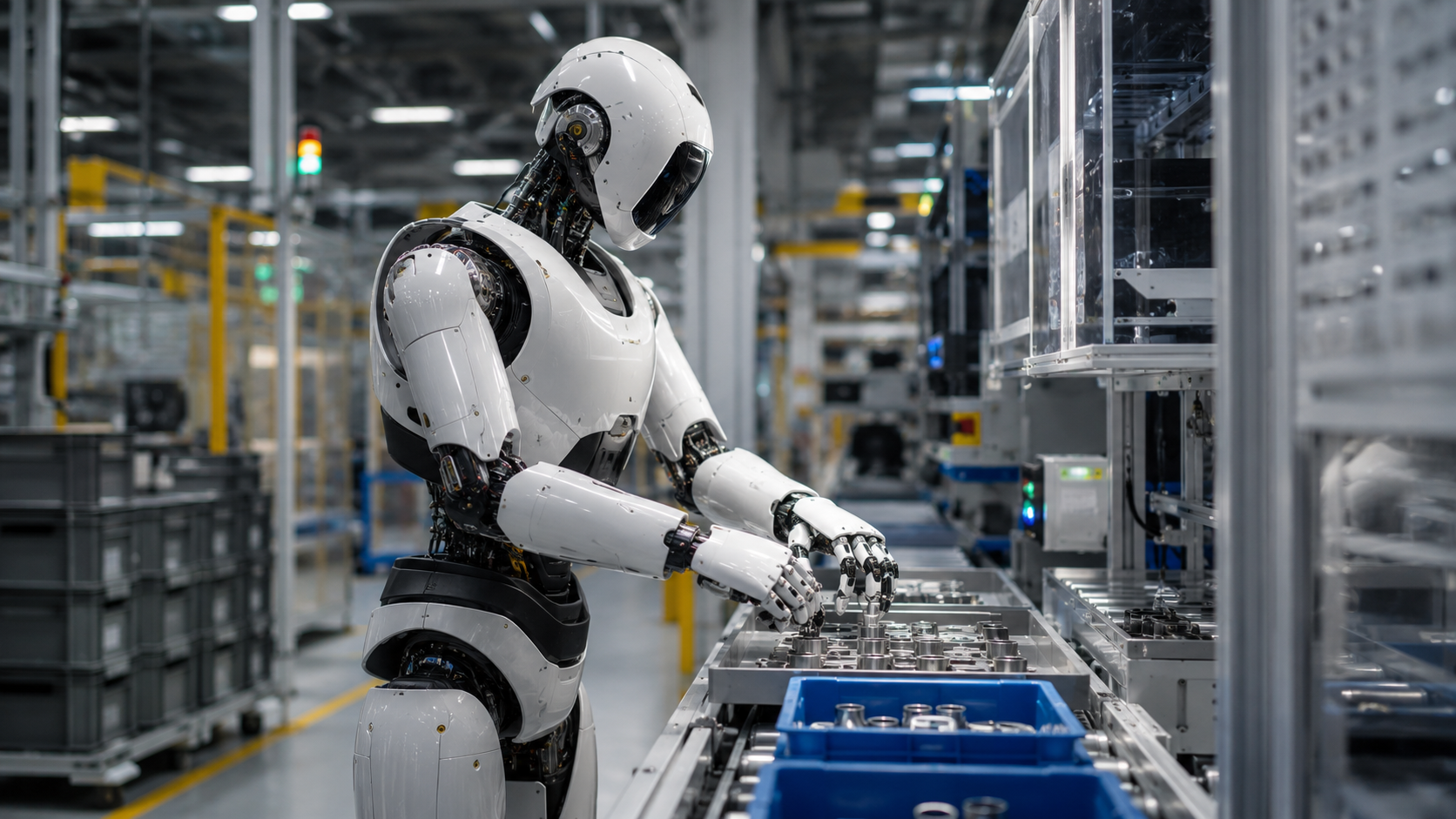
For years, the easiest way to make a humanoid robot famous was to make it dance.
In 2026, the more interesting test is considerably less glamorous: can it move parts around a factory for thousands of hours without falling over, breaking something expensive or requiring an engineer to hover behind it like an anxious parent?
Humanoid robotics is entering a different phase.
The demonstrations have not disappeared. But manufacturers are increasingly talking about deployments, production and actual work.
Why make a robot human-shaped at all?
Humans are a deeply inconvenient design.
Two legs are harder to balance than wheels. Hands contain many joints. Our bodies are mechanically complicated and, judged purely as industrial machinery, suspiciously under-engineered.
But there is one enormous advantage to a humanoid robot:
we already built the world for humanoids.
Factory aisles, shelves, stairs, tools, doors and workstations were designed around human bodies. A sufficiently capable humanoid could theoretically enter an existing workplace without requiring the entire environment to be rebuilt around it.
That is the economic argument.
The robot is complicated so the building does not have to be.
2026 is producing some unusually concrete milestones
Boston Dynamics unveiled the production version of its fully electric Atlas in January 2026 and said deployments were scheduled for Hyundai and Google DeepMind. Unlike the company's spectacular research Atlas machines, the new version is explicitly intended as an industrial product.
Figure, meanwhile, said in June that its Figure 03 robot had returned to BMW's Spartanburg plant after Figure 02 had contributed to production workflows there during 2025. The company says the newer robot is tackling a more complicated logistics/sequencing task involving whole-body movement. These are company-reported results rather than an independent audit, but they represent a considerably more meaningful test than a carefully staged promotional clip.
And the software is changing just as quickly.
Google DeepMind's Gemini Robotics 2, announced in July 2026, is intended to combine perception, language and motor control across different robotic bodies, while its embodied-reasoning model can plan multi-step physical tasks and coordinate multiple robots.
Hardware and AI are beginning to arrive at the same party.
Why has this taken so long?
Language models operate in a forgiving world.
Generate one slightly strange sentence and nobody loses a finger.
Robots do not enjoy that luxury.
A useful humanoid has to perceive objects, understand instructions, plan movements, maintain balance, control its hands, detect failures and react safely when the world behaves differently from its training data.
And the physical world always behaves differently.
A box is heavier than expected. Somebody leaves a trolley in the aisle. A component slips. Lighting changes. The floor is wet.
This is why robotics progress can look strangely unimpressive compared with AI software. A chatbot may leap from mediocre to astonishing in a release cycle. Getting a robot to reliably pick different objects for eight hours is an engineering victory disguised as warehouse boredom.
Factories make more sense than bedrooms
This is also why humanoids are likely to establish themselves in controlled workplaces before becoming general household servants.
Factories offer repeatable tasks, known environments, professional maintenance and clear economics.
Homes contain children, pets, blankets, stairs, glassware, clutter and that chair upon which clothing mysteriously accumulates until it becomes architecturally significant.
Industrial deployment does not prove that a general household robot is imminent.
But it matters because real deployments generate something robotics desperately needs: experience.
Every hour of operation can expose failure cases, produce training data and reveal whether the economics survive contact with reality.
For decades, humanoid robots have been judged by what they can demonstrate once.
The important metric now is becoming what they can do repeatedly.
A robot performing a backflip makes a better video.
A robot quietly completing the Tuesday shift may turn out to be the bigger technological event.