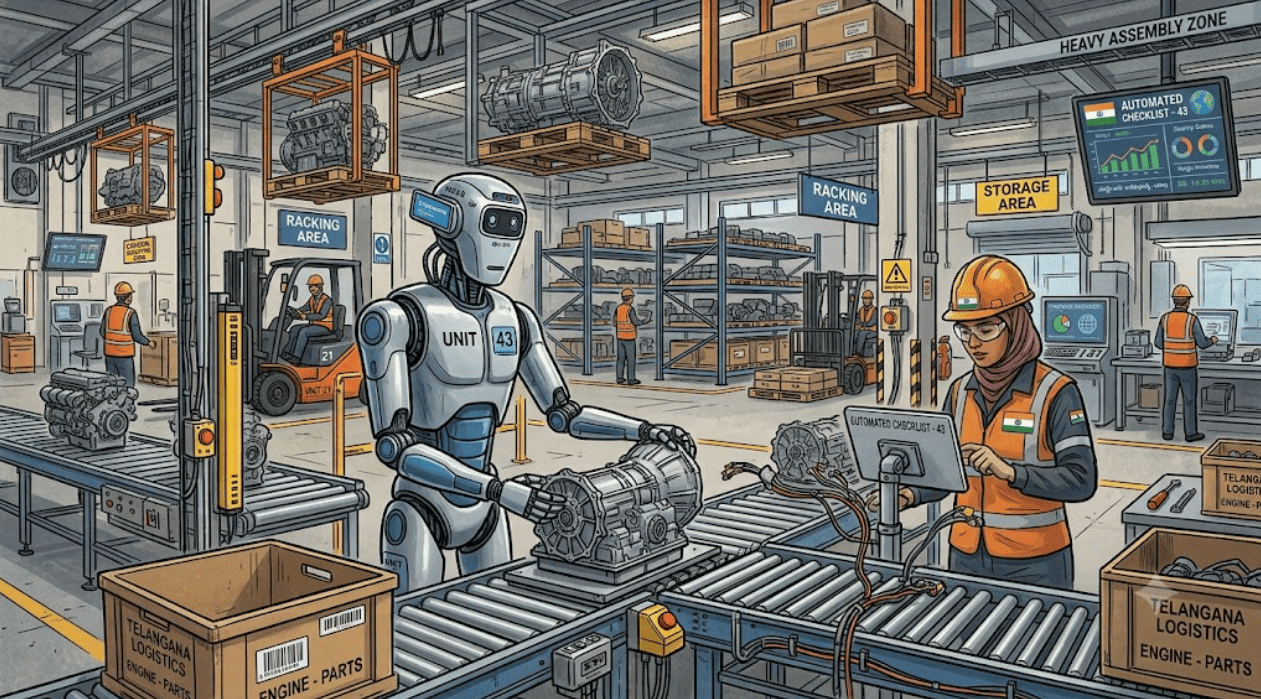
From demonstrations to factory pilots
A humanoid robot can now do more than walk across a stage. In 2026, robots are being tested in real industrial environments, but the important question has changed: can they perform useful work reliably enough to justify large-scale deployment?
At BMW's Spartanburg plant, Figure's newer Figure 03 humanoid began testing a more complex sequencing workflow in June 2026. The project builds on an earlier Figure 02 deployment. BMW says that earlier system supported production of more than 30,000 BMW X3 vehicles, moving more than 90,000 components during about 1,250 operating hours. These figures describe the earlier pilot, not a claim that humanoids are now doing general factory work.
BMW is also testing its AEON humanoid at Plant Leipzig in Germany. The March 2026 pilot is focused on production support, including material delivery and repetitive work. The company describes AEON as a pilot system, showing that major manufacturers are expanding experiments rather than declaring humanoids ready for every production task.
Digit and Apollo show a move toward commercial use
Agility Robotics provides another sign of progress. In February 2026, the company announced a commercial Robots-as-a-Service agreement with Toyota Motor Manufacturing Canada after a successful pilot. Digit is intended to support manufacturing, supply-chain and logistics operations. This is more significant than a demonstration because it connects a humanoid with a commercial service model and a paying industrial customer.
Apptronik is taking a different approach with Apollo. In 2026, the company introduced Apollo 2 and expanded its Robot Park facility in Austin. The site is being used to collect real-world robot data through teleoperation and autonomous operation. That matters because a humanoid cannot learn the physical world from internet text alone. It needs experience with objects, forces, positions, failures and recovery.
The robot's brain is becoming more physical
The software behind these machines is also changing. Google's Gemini Robotics 2, announced in July 2026, is designed for whole-body control, advanced dexterity and multi-robot collaboration. Instead of treating walking, reaching and manipulation as completely separate problems, newer physical-AI systems aim to connect perception, reasoning and movement.
A robot still needs cameras and other sensors to understand its surroundings, joint and motion sensing to track its body, and force or tactile feedback to handle contact. The difficult part is turning all of that information into safe actions when an object is different from expected, a person moves nearby, or a grip starts to fail.
The real test is reliability and economics
Humanoids therefore face a tougher test than simply completing a demonstration. A factory needs a machine that can work repeatedly, recover from errors, minimise downtime, manage charging and maintenance, and operate safely. The economics matter too. Agility's recent filings put illustrative five-year Digit costs at roughly $400,000 under its stated assumptions; these are company estimates rather than independent guarantees.
Figure has also reported a major increase in Figure 03 production capacity, saying it had delivered more than 350 robots and increased its production rate from one robot per day to one per hour. Again, these are company-reported figures. Scaling reliable hardware is itself a major challenge.
So, are humanoids ready?
The answer in August 2026 is yes for selected, structured jobs—but not for general-purpose autonomous work. Humanoids have moved beyond laboratory demonstrations into factory pilots, commercial agreements and limited workplace deployments. Yet most successful applications still involve defined tasks in controlled environments.
The next milestone is not a robot that looks more human. It is a robot that can perform useful work for thousands of hours, handle variation, recover from mistakes and make economic sense. That is the threshold the industry is now trying to cross.