How World Models Give Physical AI the Power of Internal Simulation
A robotic arm attempting to pick up a slippery glass container in a busy assembly plant cannot afford trial-anderror mistakes. Traditional control algorithms rely on hand-coded Newtonian mechanics and rigid geometric physics engines. When these systems encounter deformable materials, variable surface friction, or sudden occlusions, their hand-engineered control loops collapse, leading to failed grasps or equipment damage.
What world models do and how internal neural simulation work
World models represent a fundamental shift in embodied AI. Instead of calculating rigid differential equations in real-time, a world model trains a deep generative neural network—such as Recurrent State-Space Models (RSSMs) or Video Diffusion models—to learn an internal, predictive simulation of physical reality directly from camera visual streams and motor torque signals. The mechanism functions like a machine's imagination. Given a current visual observation and a proposed sequence of joint actions, the world model forecasts future visual states, contact dynamics, and reward states in a compact latent space. The robot's controller then simulates hundreds of potential action trajectories internally in milliseconds, selecting the optimal path before sending voltage signals to physical motor actuators.
Predictive planning versus traditional trial-and-error control
In conventional Model-Free Reinforcement Learning (RL), a physical robot must execute millions of exploratory actions on physical hardware to learn simple tasks—causing severe gear wear and motor degradation. World models decouple learning from physical hardware. By running rollout simulations inside learned latent dynamics, robots plan counterfactual trajectories safely inside software, reducing physical training requirements by up to 90% while improving adaptability to unexpected perturbations.
Relevance to Indian smart manufacturing and automation
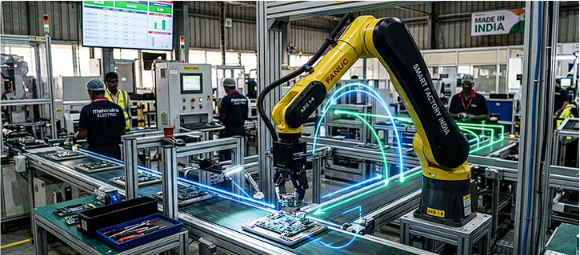
As India expands its domestic manufacturing footprint across automotive, electronics, and textile hubs in Maharashtra, Tamil Nadu, and Karnataka, flexible automation is paramount. Unstructured Indian factory environments frequently feature non-standard component dimensions, dust, and variable ambient lighting. Deploying world-model-guided robots enables domestic industrial manipulators to adapt dynamically to unmodeled assembly line shifts without requiring expensive environment re-engineering.
Leading Indian Robotics Companies & Commercial Products
Indian deep-tech startups and automation companies are implementing spatial prediction and neural world modeling into physical AI systems:
Ati Motors (Sherpa AMRs): Bengaluru-based autonomous mobile robot developer equipping industrial tuggers with predictive spatial vision world models for dynamic factory mapping and real-time obstacle avoidance.
GreyOrange (Ranger AMRs & GreyMatter OS): Global intra-logistics pioneer founded in India, using predictive spatial simulation engines to orchestrate high-density autonomous warehouse robot fleets in real time.
Peer Robotics (RM Series AMRs): Domestic mobile robotics startup building physical-AI AMRs that learn complex factory physics and intuitive human-robot force interaction without heavy cloud compute dependencies.
Practical bottlenecks: compute latency, drift, and contact noise
Despite impressive laboratory demonstrations, world models face real-world engineering constraints. Highresolution visual prediction requires substantial GPU compute, introducing latency mismatches in highfrequency closed-loop control (e.g., 500 Hz joint stabilization). Furthermore, autoregressive rollout predictions suffer from compounding error drift over long time horizons, causing the robot's internal world simulation to hallucinate physical states that diverge from reality.
Commercial deployment status and future outlook
Currently, world models are transitioning from university research laboratories (IISc, Stanford, DeepMind) into industrial pilot testing. While fully autonomous world-model fleets remain in prototype stages, hybrid controllers combining predictive world models with low-level PID safety guardrails are entering commercial trial deployment in high-precision warehouse logistics and electronic assembly.