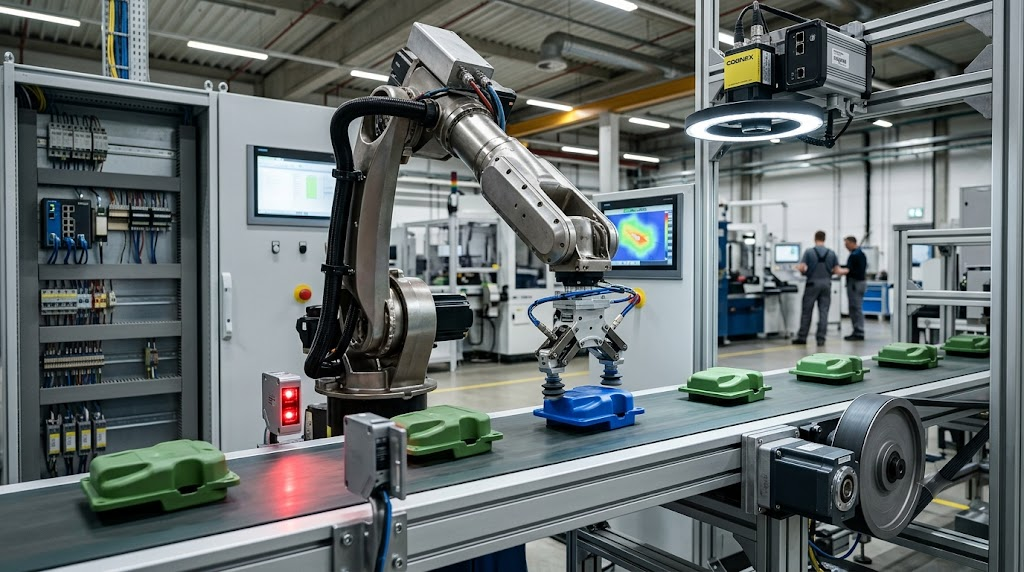
A robot picking a stationary object is relatively straightforward. Picking the same object while it moves continuously on a conveyor is a different problem. The robot has to know what the object is, where it is, how fast it is moving and where it will be when the robot reaches it. Modern conveyor systems combine cameras, sensors, encoders and real-time control software to make that possible.
First, the Robot Has to Find the Product
A camera positioned above the conveyor can capture images as products move through its field of view. Computer vision software can identify the product, estimate its position and determine its orientation.
This information is then converted into coordinates that the robot controller can understand. In 2026, conveyor-tracking systems are increasingly combining vision with real-time control rather than relying on products arriving at one fixed pickup position. A March 2026 industrial case study, for example, used a SCARA robot and camera-based conveyor tracking to identify product orientation and pick parts from a moving line.
The Encoder Tracks the Conveyor
Knowing where a product was when the camera saw it is not enough. The conveyor keeps moving.
An encoder attached to the conveyor measures its movement. As the belt travels, the control system updates the estimated position of each detected product.
This creates a continuously changing target for the robot. Instead of saying “pick the object at this fixed coordinate,” the system effectively calculates “the object will be here when the robot reaches it.”
A 2026 research study used a conveyor encoder, machine vision and a PLC to coordinate an industrial robot picking objects from a moving belt.
The Robot Moves With the Conveyor
The robot controller combines the product's detected position with the conveyor's movement information. It then adjusts the robot's trajectory so that the gripper reaches the object at the correct moment.
This is called conveyor tracking.
Some industrial systems can keep the conveyor running continuously instead of stopping it for every pick. KUKA's conveyor-tracking software, for example, synchronises robot movement with conveyor motion and can update the robot's movement while the line continues moving.
The same principle can be extended to multiple conveyors and multiple robots. KUKA's PickControl system coordinates picking and packing operations across multiple robots and conveyor locations.
Picking Is a Timing Problem
The robot does not simply need to reach the correct location. It needs to arrive at the right location at the right time.
The controller therefore considers factors such as conveyor speed, robot speed, product orientation and gripper position. Camera processing and communication also introduce small delays, so the system has to account for them.
Recent research shows why this matters. A September 2026 study on conveyor-based sorting reported that speed fluctuations, belt slippage, belt deviation and vibration can cause differences between a product's predicted and actual position, resulting in missed or failed grasps.
What Happens When the Belt Is Not Perfect?
Real conveyor systems are not perfectly predictable. Belts can slip, products can rotate or move slightly, lighting can affect camera detection and sensors can produce noisy measurements.
That is why reliable systems combine several technologies rather than depending on one measurement. Vision identifies the product, encoders measure conveyor movement, controllers calculate the changing target and robot feedback helps execute the movement.
The goal is not simply to make a robot move quickly. It is to make vision, conveyor movement and robot motion behave like one coordinated system.
As factories demand higher throughput and more flexible production, this coordination becomes increasingly important for sorting, packaging, inspection and pick-and-place applications.