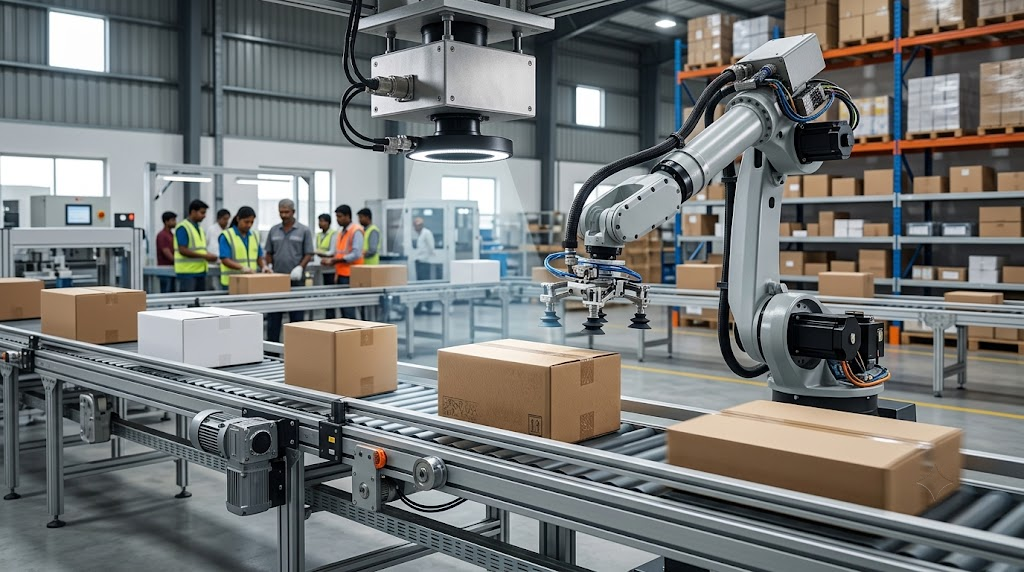
A box moving along a conveyor does not wait for a robot. It can change position every second, while other boxes may pass beside it. For a robot to pick the correct box, it must identify the target, calculate its position, track its movement and reach it at precisely the right time. In modern systems, cameras, AI vision, conveyor tracking and robot controllers work as one system.
The Camera Finds the Right Box
The process usually starts with a camera mounted above or beside the conveyor. It continuously captures images as boxes pass through its viewing area.
Computer-vision software analyses these images to identify objects and determine which box should be picked. Object-detection models can provide information such as the box's class, position and size. More advanced systems can also estimate orientation, which is important when a box is rotated.
A January 2026 Scientific Reports study demonstrated a six-axis robot using a lightweight machine-learning object-detection model to identify and track moving objects with an onboard camera.
Detection Is Not Enough
Finding a box in one image does not tell the robot where that box will be a moment later.
The system therefore needs tracking. It combines successive camera observations with information about conveyor movement to estimate how the target is moving.
An encoder attached to the conveyor can measure belt movement. The robot controller can use this information to continuously update the predicted position of the box.
This is known as conveyor tracking. Industrial systems can synchronise robot motion with a continuously moving conveyor instead of stopping the belt for every pick.
The Robot Calculates When to Pick
The robotic arm now has two important pieces of information: where the box is and how it is moving.
The controller calculates a trajectory that allows the gripper to reach the predicted pickup position at the correct time. The arm may even move in the same direction as the conveyor during the final part of the pick.
This makes timing critical. Camera processing, object detection, communication and robot movement all introduce small delays. If the predicted position is wrong by only a small amount, the gripper can miss the box.
A 2026 Scientific Reports study on vision-guided robotic manipulation highlighted this challenge by combining perception, calibration, motion planning and closed-loop control for dynamic pick-and-place tasks.
Choosing the Grasp Matters Too
Reaching the box is only half the problem. The robot also needs to decide where and how to grab it.
For a regular cardboard box, a gripper may target a suitable surface or edge. If boxes have different shapes or orientations, the vision system may need to provide more detailed position and orientation information.
Recent research has demonstrated moving-conveyor picking using 3D information, object detection and robotic control, showing how perception can be connected directly to the grasping process.
Real Conveyors Are Not Perfect
The biggest challenge is that the conveyor does not always behave exactly as expected. Belt speed can fluctuate, the belt can slip or vibrate, and a box can move or rotate after detection.
A September 2026 study found that conveyor speed changes, belt slippage, belt deviation and vibration can create differences between a target's predicted and actual position, causing missed grasps.
That is why reliable systems use a closed loop: camera detects → software tracks → controller predicts → robot moves → sensors and vision verify.
The important achievement is not simply making a robot pick quickly. It is making the robot understand which box to pick, where that box will be, and exactly when to reach it.