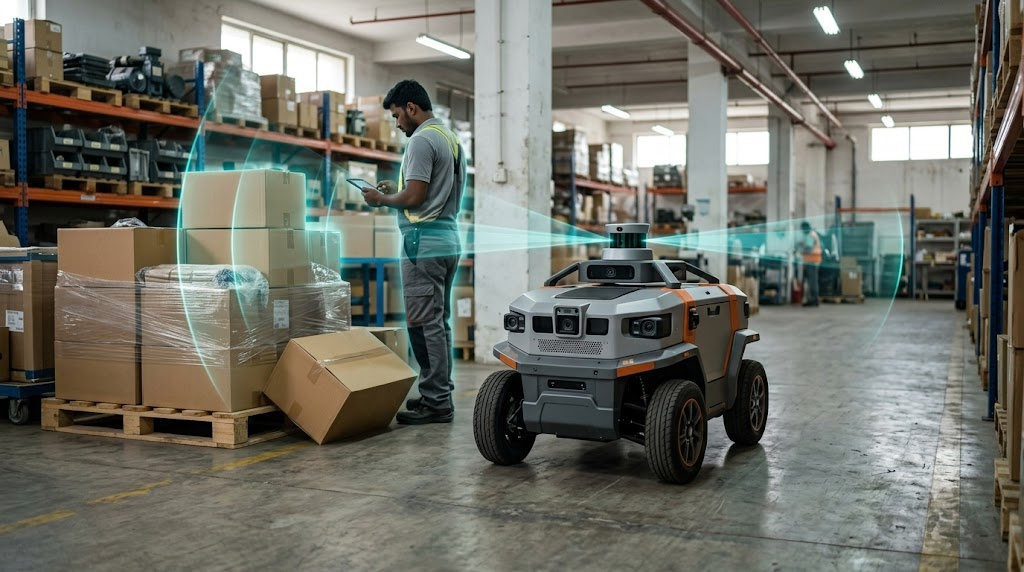
A warehouse robot cannot simply assume that the path ahead is clear. It continuously measures its surroundings, identifies possible obstacles and calculates whether it can safely continue. In 2026, research is increasingly combining cameras, LiDAR, IMUs and other sensors with real-time planning systems to make this process more reliable.
Different Sensors Give Robots Different Views
Cameras provide visual information that can help robots identify people, boxes and vehicles. Depth cameras can also estimate how far objects are from the robot. In April 2026, a Scientific Reports study developed a visual obstacle-avoidance system for indoor logistics robots using visual SLAM, optical flow and feature extraction to improve navigation around changing obstacles.
LiDAR works differently. It sends laser pulses and measures their return to calculate distances. These measurements can create a 2D scan or 3D point cloud showing walls, objects and open areas.
Ultrasonic sensors use sound waves to measure nearby objects and are useful for short-range detection. A June 2026 study comparing LiDAR and ultrasonic sensing highlighted that the two technologies have different strengths and limitations, supporting the use of sensor fusion rather than depending on one sensor.
Radar can add another source of distance and movement information, particularly where cameras or LiDAR may face environmental limitations.
From Sensor Data to an Obstacle
Sensors produce large amounts of raw data, but the robot must process that information before deciding what to do. Its onboard computer extracts features such as object position, free space and movement.
The robot can then use sensor fusion, combining measurements from multiple sensors. An IMU, for example, provides information about acceleration and rotation, while LiDAR and cameras provide information about the surrounding environment.
A 2026 Frontiers in Robotics and AI study demonstrated a multi-sensor navigation framework combining LiDAR, RGB-D cameras and IMUs. Its system used sensor fusion and a SLAM architecture to update environmental maps and track both static and moving obstacles. The researchers reported 93.6% path-planning success and an average dynamic-obstacle avoidance latency of 280 milliseconds in their tests.
The Robot Also Needs to Know Where It Is
Detecting an obstacle is easier when the robot knows its own position. SLAM, or Simultaneous Localization and Mapping, allows a robot to estimate where it is while building or updating a map.
A 2026 study of warehouse mobile robots combined 2D LiDAR, an IMU and wheel encoders within a SLAM system. The navigation software then used global path planning and local obstacle avoidance to guide the robot through the environment.
A simplified architecture looks like:
Sensors → Perception → Sensor Fusion → Localization and Mapping → Obstacle Detection → Path Planning → Motor Control
Detection Is Only Half the Job
Once an obstacle is detected, the robot must decide how to avoid it. A global planner can calculate a route toward the destination, while a local planner reacts to nearby obstacles.
In April 2026, an SAE technical paper described a LiDAR-driven navigation system combining SLAM with an improved A* path-planning method. When a moving obstacle was detected, the system recalculated the route and updated the robot's waypoints.
Research published in May 2026 also proposed a path re-planning and tracking framework designed to handle dynamic obstacles and uncertainty in autonomous navigation.
Why Robots Can Still Make Mistakes
Obstacle detection is not perfect. Sensor noise, incorrect object recognition, calibration errors and limited computing time can affect decisions. Moving people and vehicles are especially difficult because their positions can change while the robot is processing data.
Recent 2026 research therefore treats obstacle avoidance as a full-stack problem involving sensing, perception, mapping, prediction, planning and control. The goal is not simply to detect an object, but to understand whether it creates a collision risk and respond quickly enough to remain safe.