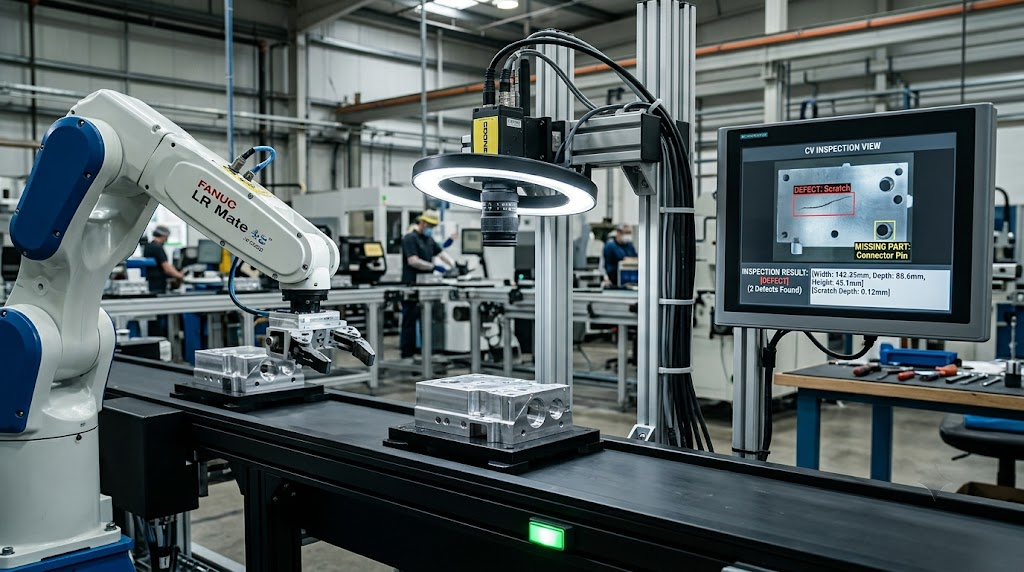
A tiny scratch on a metal part, a missing component or a slightly incorrect assembly can be difficult to spot when thousands of products move through a factory every day. Automated inspection gives manufacturers another way to find these problems: let machines capture and analyse every product.
But the camera is only the beginning.
First, the System Has to Capture a Good Image
An inspection system starts by placing a camera where it can see the required part of the product. The product may move on a conveyor, stop at an inspection station or be positioned by a robot.
Lighting is just as important as the camera. Reflections, shadows and changing brightness can hide defects or create false ones. Controlled illumination helps make the important features visible and keeps images more consistent.
The system can then measure features such as position, size, shape, colour or surface appearance.
Computer Vision Turns Images Into Information
Traditional machine vision can use rules to check an image. For example, software might look for a component in a particular location or compare a measured dimension with an allowed range.
AI-based inspection works differently. Machine-learning models can learn patterns from examples of acceptable and defective products. They can then classify defects, locate them or identify unusual areas.
A January 2026 review of AI-enabled industrial defect detection found that deep-learning approaches are being applied to defect classification, detection and segmentation, while also highlighting challenges such as training data, calibration and reliability.
AI Still Depends on the Data and the Setup
AI does not automatically make an inspection system reliable. The model needs suitable training data, and the images used during production must resemble the conditions in which the system was developed.
A July 2026 Scientific Reports study specifically examined image preprocessing for neural-network defect detection and noted that imaging variability and the quantity and quality of training data can affect system reliability.
Another August 2026 study on injection-moulded parts compared static, conveyor-based and robotic inspection setups. The researchers found that robotic inspection could improve detection by allowing camera position and viewing angles to be adjusted.
This shows why inspection is an engineering problem, not simply an AI problem.
Robots Can Move the Camera—or the Product
A robotic arm can make inspection more flexible by moving a camera around a component or positioning the product from different angles. This is useful when one fixed camera cannot see every surface.
Recent research is also exploring inspection for changing production environments. An August 2026 paper on zero-shot industrial defect detection investigated methods designed to identify defects when manufacturing conditions and defect types vary. This remains research rather than proof that factories can inspect any unknown defect without training.
Once a defect is detected, the system can send the result to a controller, trigger a rejection mechanism, alert an operator or store the inspection result for traceability.
The Hard Part Is Knowing What Counts as a Defect
Factories do not only need systems that detect defects. They need systems that detect the right defects consistently.
A scratch that is unacceptable on one product may be harmless on another. Changing lighting, product variations and rare defects can also challenge an AI model.
That is why modern inspection systems increasingly combine cameras, controlled lighting, measurement, AI and human oversight rather than treating the AI model as a complete replacement for quality engineering.
The goal is not simply to make a robot “see.” It is to turn visual information into a reliable quality decision at production speed.