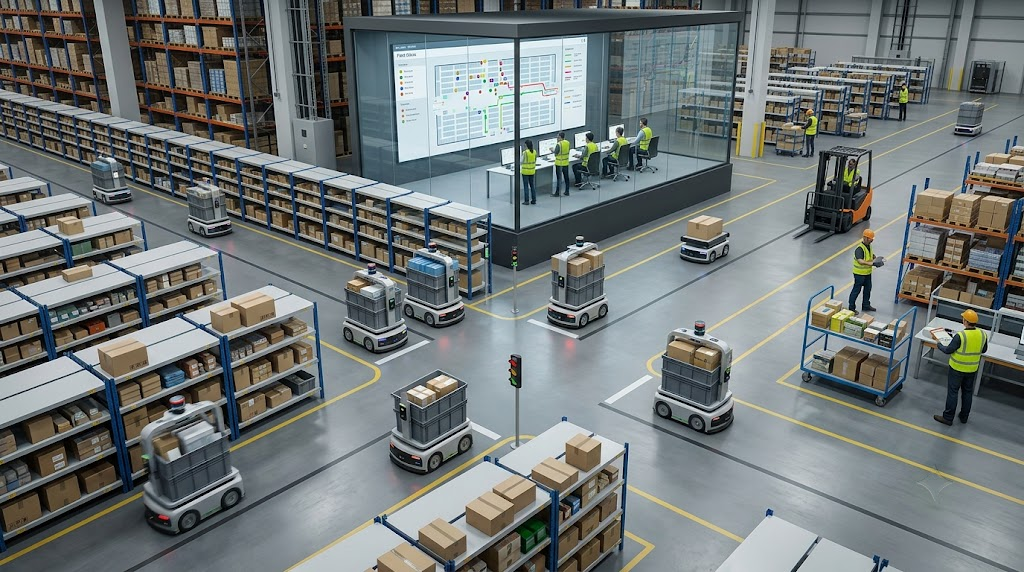
Imagine a warehouse with hundreds of autonomous mobile robots moving through the same aisles. They may be carrying different products, travelling at different speeds and heading to different destinations. If every robot planned its route independently, intersections could quickly become crowded. The solution is not simply better sensors on each robot. Modern warehouses use a combination of maps, onboard sensing, fleet-management software and traffic planning to coordinate the entire fleet.
A Shared Map Gives Robots a Common Picture
Before robots start moving, the warehouse is represented as a digital map. It can contain aisles, intersections, storage areas, charging stations and restricted zones.
Each robot uses its sensors and localization system to determine where it is on this map. LiDAR, cameras, wheel encoders and inertial sensors can help estimate position and detect nearby obstacles.
This creates two different layers of awareness: the robot understands its immediate surroundings, while fleet software can coordinate what is happening across the wider warehouse.
A 2026 review of warehouse robotics identifies perception, localization, mapping, path planning, communication infrastructure and fleet coordination as interconnected parts of large-scale autonomous warehouse systems.
Fleet Software Decides Who Goes Where
A fleet-management system acts as the coordination layer above individual robots. When a warehouse system creates a transport task, the fleet manager can assign it to a suitable robot based on factors such as location, workload and battery level.
The system also monitors robot positions and can change assignments when conditions change.
This becomes especially important when robots from different fleets share the same floor. A 2026 Indian case study from Drema describes a fleet-management system coordinating robots from three manufacturers, including task assignment, traffic management, charging schedules and a live warehouse map.
Traffic Planning Prevents Robot Gridlock
Avoiding a collision is only part of the problem. Robots also need to avoid blocking each other.
At a narrow aisle or intersection, the software can reserve a section of the route for one robot, make another wait or send it along an alternative path. More advanced systems can detect potential congestion before robots reach the affected area.
This is sometimes compared to air-traffic control: the software does not physically drive every robot, but it coordinates where and when robots can move.
In March 2026, MIT researchers and Symbotic described a system that uses deep reinforcement learning to decide which robots should receive priority as congestion develops. In simulations based on warehouse layouts, the approach achieved about a 25% throughput improvement over the methods tested by the researchers.
Sensors Handle What the Map Cannot Predict
A warehouse map cannot show everything that happens in real time. A worker may cross an aisle, a box may fall onto the floor or a forklift may temporarily block a route.
That is why each robot still needs its own sensors. If a robot detects an obstacle that was not present when its route was planned, it can slow down, stop or adjust its local path.
The fleet manager can then incorporate the changed situation into wider traffic decisions. This combination of central coordination and local perception is important because neither layer can handle every situation alone.
The Challenge Grows With Every Robot
Adding more robots does not simply multiply productivity. It also increases the number of possible interactions between machines.
A 2026 study of automated warehouse management notes that large robotic fleets can face collision risks, inefficient task scheduling and congestion when coordination is inadequate.
That is why large warehouse automation depends on more than autonomous navigation. Maps tell robots where they can travel, sensors tell them what is happening nearby, and fleet software coordinates tasks and traffic across the facility.
The real achievement is therefore not making hundreds of robots move independently. It is making hundreds of moving machines share the same space without turning the warehouse into a traffic jam.