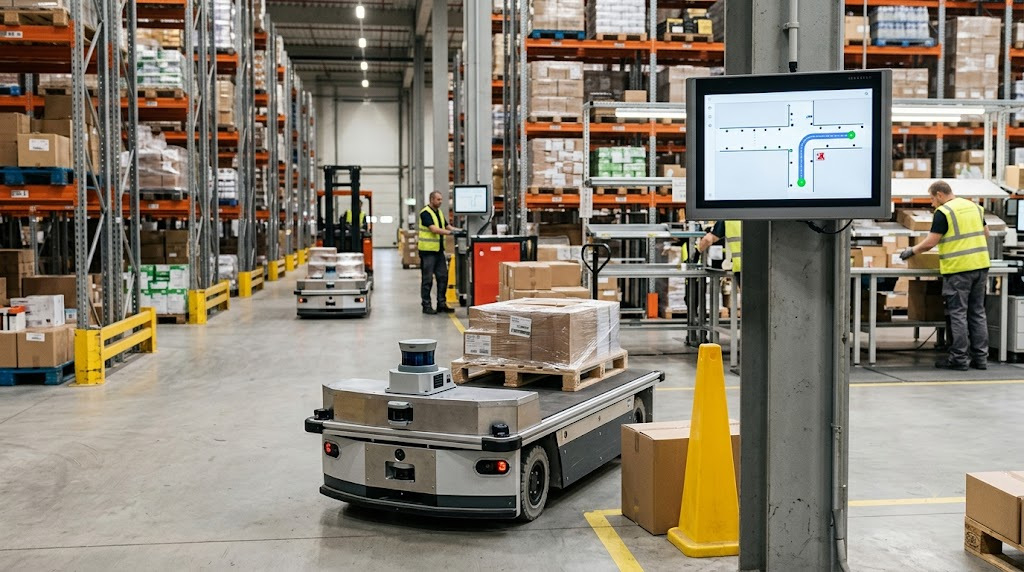
An autonomous mobile robot (AMR) can move goods from a storage area to a packing station without following a painted line or needing someone to steer it. But warehouses are busy, changing environments. Workers cross aisles, forklifts move loads and temporary obstacles block routes. How does a robot know where it is, choose a route and decide what to do when conditions change?
The answer combines sensors, mapping, localization and navigation software. These technologies are already used in mobile robotics, but making them work reliably across large, unpredictable warehouses remains a challenge.
How Robots Read Their Surroundings
One important technology is LiDAR (Light Detection and Ranging). It sends out laser pulses and measures their reflections to estimate distances to shelves, walls and nearby objects. Cameras provide visual information that can help identify landmarks and recognise objects.
Robots may also use wheel encoders to estimate distance travelled and inertial measurement units (IMUs) to measure changes in motion. Combining these inputs, a process called sensor fusion, can help improve position estimates. However, research has shown that transparent and highly reflective surfaces can produce misleading laser measurements, affecting robotic mapping (Koch et al., 2017).
How They Build Maps and Choose Routes
A robot entering an unfamiliar area may use SLAM, or Simultaneous Localization and Mapping, to build a map while estimating its own position. Navigation software then uses the map and position estimate to help plan a route.
Algorithms such as A* can search for paths around mapped obstacles. Local planning systems respond to immediate changes, allowing a robot to slow down, stop or select another route when an aisle becomes blocked.
In July 2026, researchers published 3L-Planner, a framework combining lightweight LiDAR mapping, path planning and trajectory control. Tests covered simulated environments and real-world gardens and corridors—not warehouse deployments specifically. The work demonstrates research progress in mobile-robot navigation, but further testing is needed to establish its performance in industrial warehouses (Fan et al., 2026).
What AMRs Can Do Today
AMRs can transport bins, totes and goods between storage, picking, packing and dispatch areas. Depending on their design, they can use mapped routes and onboard sensors to navigate without fixed floor-guidance lines.
Navigation is only one part of the operation. Multiple robots may need to share narrow aisles, receive tasks and avoid conflicting routes. A 2026 review by Lucia Pallottino examines these challenges, including fleet management, human–robot collaboration, safety and the difficulties of scaling robotic systems (Pallottino, 2026).
Not every AMR has the same level of independence. A systematic review published in July 2026 analysed 177 publications and proposed a framework for distinguishing mobile robots by their autonomy and control capabilities (Franke et al., 2026).
What Still Needs to Improve?
Warehouse conditions change throughout the day. Moving workers, temporary obstacles and inaccurate position estimates can disrupt navigation. Robots also need reliable communications, battery management, safety procedures and integration with warehouse management systems.
Cost matters too. Businesses must consider installation, software integration, staff training and maintenance before investing. Better navigation alone does not guarantee that automation will be economically worthwhile.
What Comes Next?
Future developments are likely to focus on more reliable sensor fusion, adaptive route planning and better coordination between robot fleets. AI could also help robots interpret unfamiliar obstacles and respond to changing warehouse layouts, although these capabilities must be validated through testing in real operating environments.
Another challenge is making robots work reliably alongside people and other machines. Improvements in collision avoidance, communication, battery management and fleet coordination will be important as warehouses deploy larger numbers of robots.
The goal is not simply to make robots move without human steering. It is to make them navigate safely, reliably and efficiently while conditions change around them. Progress will depend on how well sensing, mapping, localization and planning work together—not on any single algorithm or sensor.